
Carnot's theorem
Carnot's theorem proper noun: a theorem for the maximum efficiency obtainable from a heat engine.

Proper noun
Carnot's theorem
- A theorem for the maximum efficiency obtainable from a heat engine.
- Synonyms:
- Carnot's law, Carnot's rule
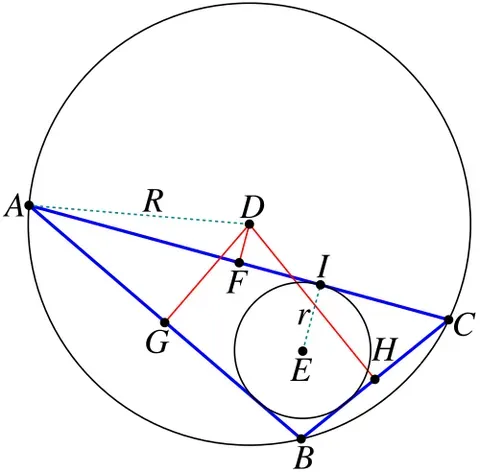
- A theorem stating that the sum of the signed distances from the circumcenter D to the sides of an arbitrary triangle ABC is DF + DG + DH = R + r, where r is the inradius and R the circumradius of the triangle.
- A theorem describing a relation between conic sections and triangles.
- A theorem describing a necessary and sufficient condition for three lines that are perpendicular to the (extended) sides of a triangle having a common point of intersection.
Synonyms of Carnot's theorem
Questions about Carnot's theorem
- What does Carnot's theorem mean?
- Carnot's theorem means a theorem for the maximum efficiency obtainable from a heat engine.
- What part of speech is Carnot's theorem?
- Carnot's theorem is a proper noun.
Words near Carnot's theorem in the dictionary
Source and license
Adapted from Wiktionary: Carnot's theorem (page history and authors). Text available under the Creative Commons Attribution-ShareAlike 4.0 license. Word.ws reformatted the entry and added links. Wiktionary data of 2026-09-02.
Last updated:
Cite this entry: “Carnot's theorem.” Word.ws, https://word.ws/carnot%27s_theorem. Based on Wiktionary, CC BY-SA 4.0.