
Hooper's paradox
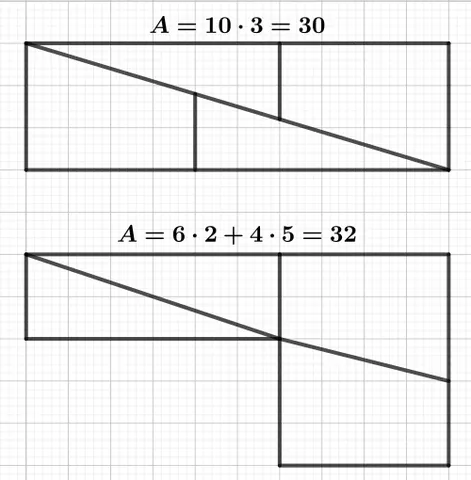
Hooper's paradox proper noun: a falsidical paradox based on an optical illusion, where a geometric shape with an area of 32 units is dissected into four parts, which are then assembled into a rectangle with an area of only 30 units; however, the triangles of the dissected shape are not quite identical to the triangles in the rectangle.

Proper noun
Hooper's paradox
- A falsidical paradox based on an optical illusion, where a geometric shape with an area of 32 units is dissected into four parts, which are then assembled into a rectangle with an area of only 30 units; however, the triangles of the dissected shape are not quite identical to the triangles in the rectangle.
Origin of Hooper's paradox
Published in 1774 by William Hooper.
Questions about Hooper's paradox
- What does Hooper's paradox mean?
- Hooper's paradox means a falsidical paradox based on an optical illusion, where a geometric shape with an area of 32 units is dissected into four parts, which are then assembled into a rectangle with an area of only 30 units; however, the triangles of the dissected shape are not quite identical to the triangles in the rectangle.
- What part of speech is Hooper's paradox?
- Hooper's paradox is a proper noun.
Words near Hooper's paradox in the dictionary
Source and license
Adapted from Wiktionary: Hooper's paradox (page history and authors). Text available under the Creative Commons Attribution-ShareAlike 4.0 license. Word.ws reformatted the entry and added links. Wiktionary data of 2026-09-02.
Last updated:
Cite this entry: “Hooper's paradox.” Word.ws, https://word.ws/hooper%27s_paradox. Based on Wiktionary, CC BY-SA 4.0.