
Thévenin's theorem
Thévenin's theorem proper noun: a theorem which states that any electric circuit between two terminals containing only resistors, voltage sources, and current sources can be equivalently replaced with a single voltage source and resistor.
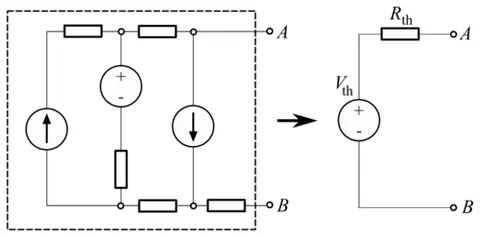

Proper noun
Thévenin's theorem
Origin of Thévenin's theorem
Derived in 1883 by French electrical engineer Léon Charles Thévenin; however, it had been independently derived in 1853 by German physicist Hermann von Helmholtz.
Questions about Thévenin's theorem
- What does Thévenin's theorem mean?
- Thévenin's theorem means a theorem which states that any electric circuit between two terminals containing only resistors, voltage sources, and current sources can be equivalently replaced with a single voltage source and resistor.
- What part of speech is Thévenin's theorem?
- Thévenin's theorem is a proper noun.
Words near Thévenin's theorem in the dictionary
Source and license
Adapted from Wiktionary: Thévenin's theorem (page history and authors). Text available under the Creative Commons Attribution-ShareAlike 4.0 license. Word.ws reformatted the entry and added links. Wiktionary data of 2026-09-02.
Last updated:
Cite this entry: “Thévenin's theorem.” Word.ws, https://word.ws/th%C3%A9venin%27s_theorem. Based on Wiktionary, CC BY-SA 4.0.