Word of the Day:
orchestra
What It Means
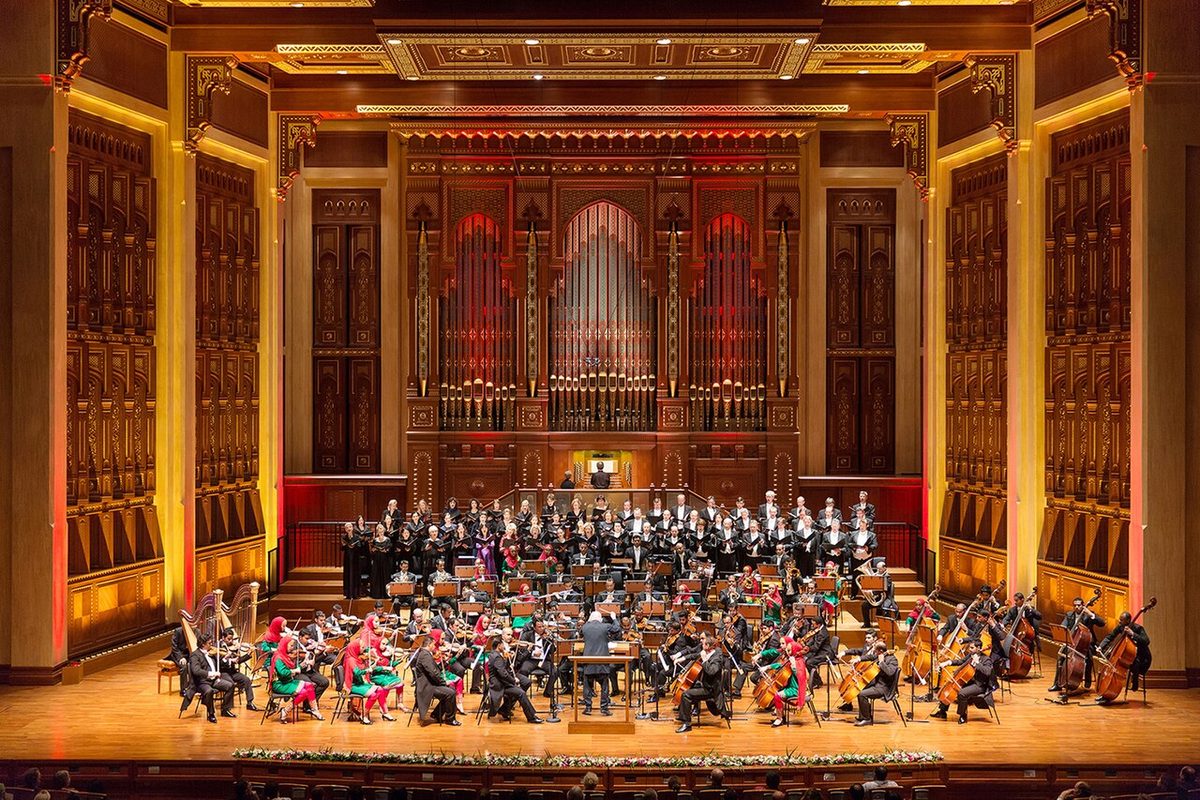
A large group of musicians who play together on various instruments, usually including some from strings, woodwind, brass and/or percussion; the instruments played by such a group.
A semicircular space in front of the stage used by the chorus in Ancient Greek and Hellenistic theatres.
The area in a theatre or concert hall where the musicians sit, immediately in front of and below the stage, sometimes (also) used by other performers.
The orchestra plays music for the dancers to dance to in the 19th century-styled dance hall.
Orchestra in Context
“It requires quite an orchestra to get a train to start; the guard blows his horn, the stationmaster rings a large bell, and the engine whistles.”
Did You Know?
Borrowed from Latin orchēstra, borrowed from Ancient Greek ὀρχήστρα (orkhḗstra), from ὀρχέομαι (orkhéomai, “to dance”) + -τρᾰ (-tră, “a suffix used to form instrument nouns (pl.)”).
Source and license
Adapted from Wiktionary: orchestra (page history and authors). Text available under the Creative Commons Attribution-ShareAlike 4.0 license. Word.ws chose the word and reformatted its meaning, examples and origin.
Cite this entry: “orchestra.” Word.ws, https://word.ws/orchestra. Based on Wiktionary, CC BY-SA 4.0.