
Ü-Tsang
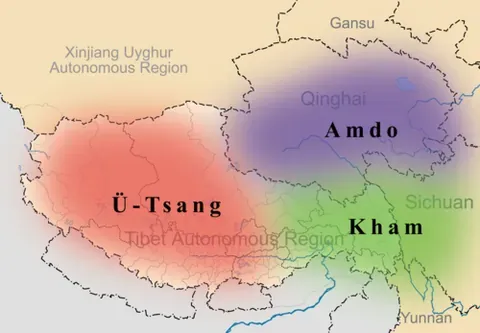
Ü-Tsang proper noun: one of the three traditional regions of Tibet covering a land area largely corresponding to most of the Tibet Autonomous Region.

Proper noun
Ü-Tsang
- One of the three traditional regions of Tibet covering a land area largely corresponding to most of the Tibet Autonomous Region.
- "In the Kongpo area of U-Tsang alone, more than 20,000 Chinese soldiers and Tibetan prisoners are involved in tree felling and transport," says the report.[1992 June 9, “Tibetan Neighbors Note Ecological 'Degradation'”, in Daily Report: China, number 111, sourced from Hong Kong South China Morning Post p 21 and Tibet Environment and Development Issues...
- The Northern Plain (U-Tsang)
The Northern Plain is the largest region of the country. This vast area called the Changthang, covers a large portion of the country. To the extreme north is a cold, desolate desert quarter neighboring on the Chinese-Turkestan border that is mostly uninhabited. The...[1998, Robert Z. Apte, Andrés R. Edwards, “The Geography of the Land of Snows”, in Tibet: Enduring Spirit, Exploited Land, 1st edition, Heartsfire Books, →ISBN, →LCCN, →OCLC, page 20
Origin of Ü-Tsang
Borrowed from Tibetan དབུས་གཙང (dbus gtsang).
Questions about Ü-Tsang
- What does Ü-Tsang mean?
- Ü-Tsang means one of the three traditional regions of Tibet covering a land area largely corresponding to most of the Tibet Autonomous Region.
- What part of speech is Ü-Tsang?
- Ü-Tsang is a proper noun.
Words near Ü-Tsang in the dictionary
Source and license
Adapted from Wiktionary: Ü-Tsang (page history and authors). Text available under the Creative Commons Attribution-ShareAlike 4.0 license. Word.ws reformatted the entry and added links. Wiktionary data of 2026-09-02.
Last updated:
Cite this entry: “Ü-Tsang.” Word.ws, https://word.ws/%C3%BC-tsang. Based on Wiktionary, CC BY-SA 4.0.