
basihyal
/beɪ.sɪˈhaɪ.əl/
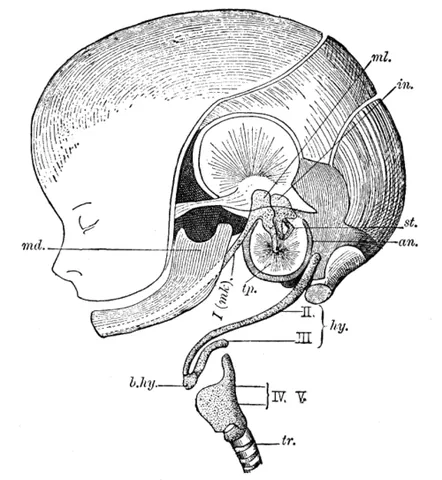
basihyal noun: either of two small bones that form the body of the inverted hyoid arch.

Noun
basihyal (plural basihyals)
- Either of two small bones that form the body of the inverted hyoid arch.
- Coburn (1982) used a posterior extension of the basihyal to group many taxa in Notropis (s. l.) (93).1992, M. M. Coburn, T. M. Cavender, “Phylogenetics of North American Cyprinidae”, in Richard L. Mayden, editor, Systematics, Historical Ecology, and North American Freshwater Fishes, page 362
- The hyoid cartilage is formed of a series of skeletal elements: entoglossum (or paraglossals), basihyal (basihyoid), basibranchial (or urohyal), ceratobranchial, and epibranchial (Fig. 3.21), the most anterior of which (entoglossum and basihyal) constitute the tongue skeleton.1999, Nicole Le Douarin, Chaya Kalcheim, The Neural Crest, page 111
Forms of basihyal
| plural | basihyals |
|---|
Origin of basihyal
From basi- + -hyal, from Ancient Greek ὖ (û, “the letter upsilon”).
Questions about basihyal
- What does basihyal mean?
- Basihyal means either of two small bones that form the body of the inverted hyoid arch.
- What part of speech is basihyal?
- Basihyal is a noun.
- How do you pronounce basihyal?
- Basihyal is pronounced /beɪ.sɪˈhaɪ.əl/.
- What is the plural of basihyal?
- The plural of basihyal is basihyals.
Words near basihyal in the dictionary
Source and license
Adapted from Wiktionary: basihyal (page history and authors). Text available under the Creative Commons Attribution-ShareAlike 4.0 license. Word.ws reformatted the entry and added links. Wiktionary data of 2026-09-02.
Last updated:
Cite this entry: “basihyal.” Word.ws, https://word.ws/basihyal. Based on Wiktionary, CC BY-SA 4.0.