
cimbalom
/ˈsɪmbələm/
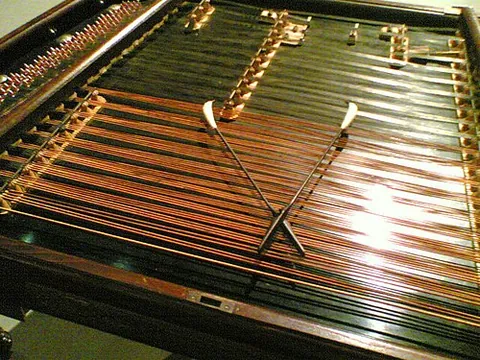
cimbalom noun: a type of concert hammered dulcimer used primarily in the music of Central and Eastern Europe.

Noun
cimbalom (plural cimbaloms)
- A type of concert hammered dulcimer used primarily in the music of Central and Eastern Europe.
- Either/Or, including Anthony Burr, clarinetist; Jane Rigler, flutist; and Richard Carrick and David Shively, percussionists, also employed the cimbalom, the Hungarian pianolike mutant whose twang remains familiar to boozy evenings in late-night Central European bars.2007 September 17, Bernard Holland, “Cryptic Messages or Silence From the ’60s Avant-Garde”, in New York Times
Forms of cimbalom
| plural | cimbaloms |
|---|---|
| alternative form | cymbalom |
| alternative form | cymbalum |
| alternative form | kymbalon |
| alternative form | tymbalon |
| alternative form | zimbalon |
| alternative form | zimbaloon |
Origin of cimbalom
From Hungarian cimbalom. Doublet of cymbal.
Questions about cimbalom
- What does cimbalom mean?
- Cimbalom means a type of concert hammered dulcimer used primarily in the music of Central and Eastern Europe.
- What part of speech is cimbalom?
- Cimbalom is a noun.
- How do you pronounce cimbalom?
- Cimbalom is pronounced /ˈsɪmbələm/.
- What is the plural of cimbalom?
- The plural of cimbalom is cimbaloms.
Words near cimbalom in the dictionary
Source and license
Adapted from Wiktionary: cimbalom (page history and authors). Text available under the Creative Commons Attribution-ShareAlike 4.0 license. Word.ws reformatted the entry and added links. Wiktionary data of 2026-09-02.
Last updated:
Cite this entry: “cimbalom.” Word.ws, https://word.ws/cimbalom. Based on Wiktionary, CC BY-SA 4.0.