
cross-polytope
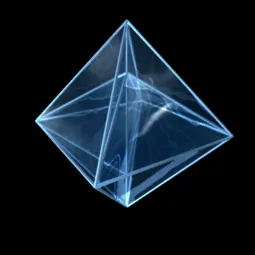
cross-polytope noun: a polytope that is the convex hull of points, two on each Cartesian axis of a Euclidean space, that are equidistant from the origin; an orthoplex.

Noun
cross-polytope (plural cross-polytopes)
- A polytope that is the convex hull of points, two on each Cartesian axis of a Euclidean space, that are equidistant from the origin; an orthoplex.
- The case p = 1, which is actually important to us, is illustrated in Figure 1.14; we are looking at the intersection of a cross-polytope with the probability simplex.2006, Ingemar Bengtsson, Karol Zyczkowski, Geometry of Quantum States: An Introduction to Quantum Entanglement, page 25
- The convex hulls of such crosses often appear as cells in Delaunay tilings – cross polytopes are examples, as are the more spectacular symmetric perfect Delaunay polytopes.2008, Robert Erdahl, Andrei Ordine, Konstantin Rybnikov, Perfect Delaunay Polytopes and Perfect Quadratic Functions on Lattices, Matthias Beck, et al. (editors), Contemporary Mathematics 452: Integer...
- Synonyms:
- cocube, hyperoctahedron, orthoplex
Synonyms of cross-polytope
- cocube
- hyperoctahedron
- orthoplex
Forms of cross-polytope
| plural | cross-polytopes |
|---|---|
| alternative form | cross polytope |
Questions about cross-polytope
- What does cross-polytope mean?
- Cross-polytope means a polytope that is the convex hull of points, two on each Cartesian axis of a Euclidean space, that are equidistant from the origin; an orthoplex.
- What part of speech is cross-polytope?
- Cross-polytope is a noun.
- What is the plural of cross-polytope?
- The plural of cross-polytope is cross-polytopes.
Words near cross-polytope in the dictionary
Source and license
Adapted from Wiktionary: cross-polytope (page history and authors). Text available under the Creative Commons Attribution-ShareAlike 4.0 license. Word.ws reformatted the entry and added links. Wiktionary data of 2026-09-02.
Last updated:
Cite this entry: “cross-polytope.” Word.ws, https://word.ws/cross-polytope. Based on Wiktionary, CC BY-SA 4.0.