
decurrent
UK/dɪˈkʌɹənt/
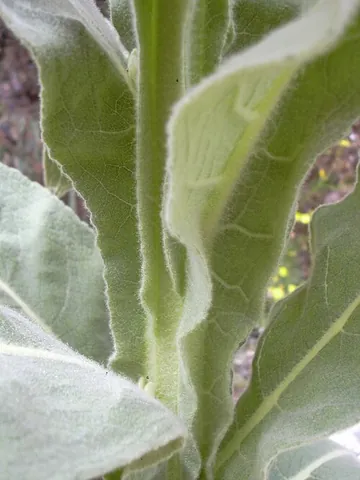
decurrent adjective: of plant parts: extending downward, most often in the case of leaf blades that partly wrap or have wings around the stem or petiole and extend down along the stem.

Adjective
decurrent (comparative more decurrent, superlative most decurrent)
- Of plant parts: extending downward, most often in the case of leaf blades that partly wrap or have wings around the stem or petiole and extend down along the stem.
- Of lamellae (the gills of a mushroom): broadly attached and extending down the stipe of the mushroom.
- In this group of mushrooms, the attachment of the gills to the stipe is decurrent.
- Running or extending downwards.
decurrent meaning in Tamil
decurrent in Tamil
- தண்டு ஒட்டி கீழ்வளர்ந்த
Forms of decurrent
| comparative | more decurrent |
|---|---|
| superlative | most decurrent |
Origin of decurrent
From Latin decurrens — de (“down”) + curro (“to run”).
Words formed from decurrent
Questions about decurrent
- What does decurrent mean?
- Decurrent means of plant parts: extending downward, most often in the case of leaf blades that partly wrap or have wings around the stem or petiole and extend down along the stem.
- What is decurrent in Tamil?
- Decurrent in Tamil is தண்டு ஒட்டி கீழ்வளர்ந்த. See Decurrent meaning in Tamil.
- What part of speech is decurrent?
- Decurrent is an adjective.
- How do you pronounce decurrent?
- Decurrent is pronounced /dɪˈkʌɹənt/ (UK).
Words near decurrent in the dictionary
Source and license
Adapted from Wiktionary: decurrent (page history and authors); decurrent (Tamil Wiktionary) (page history and authors). Text available under the Creative Commons Attribution-ShareAlike 4.0 license. Word.ws reformatted the entry and added links. Wiktionary data of 2026-09-02.
Last updated:
Cite this entry: “decurrent.” Word.ws, https://word.ws/decurrent. Based on Wiktionary, CC BY-SA 4.0.