
Diana
/daɪˈænə/
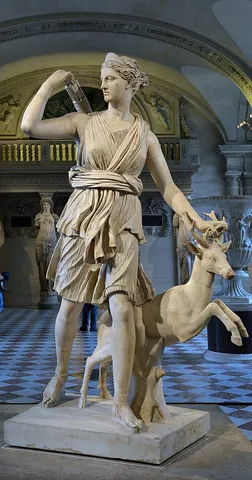
Diana proper noun: the daughter of Latona and Jupiter, and twin sister of Apollo; the goddess of the hunt, associated wild animals and the forest or wilderness, and an emblem of chastity; the Roman counterpart of Artemis.

Proper noun
Diana
- The daughter of Latona and Jupiter, and twin sister of Apollo; the goddess of the hunt, associated wild animals and the forest or wilderness, and an emblem of chastity; the Roman counterpart of Artemis.
- So that not only this our craft is in danger to be set at nought; but also that the temple of the great goddess Diana should be despised, and her magnificence should be destroyed, whom all Asia and all the world worshippeth.
- 78 Diana, a main belt asteroid.
- The Moon; the Moon as a deity.
- She betook herself to the bedroom in the western wing, there to lie and watch pale Diana chase the Hunter down the sky.1961, Xavier Herbert, Soldiers' Women, Netley, SA: Fontana Books, published 1978, page 138
- A female given name from Latin.
- But succeeding ages (little regarding S. Chrysosthome's admonition to the contrary) have recalled prophane names, so as now Diana, Cassandra, Hyppolytus, Venus, Lais, names of unhappy disaster are as rife, as ever they were in paganism.1605, William Camden, Remains Concerning Britain, John Russell Smith, published 1870, page 56
- A wholesome British name like Diana, Anne, Margaret or Elizabeth impresses a judge much more than all your vulgar Marilyns, Donnas, Madonnas and Dawns.1993, James Kirkup, Queens Have Died Young and Fair, P. Owen, →ISBN, page 94
Noun
Diana (plural Dianas)
- A Diana monkey.
- A Diana fritillary.
Diana meaning in Hindi, Marathi, Bengali and Odia
Diana in Hindi
- Roman goddess
- डायना ḍāynā
- female given name
- डायना ḍāynā
Diana in Marathi
- Roman goddess
- डायना ḍāynā
- female given name
- डायना ḍāynā
Diana in Bengali
- দাইঅ্যান্যা
Diana in Odia
- Roman goddess
- ଡ଼ାଏନା ṛāenā
More languagesFewer languages
- Diana in Vietnamese
- thần Đi-anh
Forms of Diana
| plural | Dianas |
|---|
Origin of Diana
Borrowed from Late Latin Diāna, short form of Latin Dīāna, derived by syncope from Old Latin Dīvāna, equivalent to dīvus + -āna; roughly akin to Proto-Italic *deiwā (“goddess”) + Proto-Indo-European *-néh₂. Originally an Old Italic divinity of light and the moon; later identified as the Roman counterpart to Greek goddess Artemis. Cognate of Attic Greek Διώνη (Diṓnē), similarly syncopated from older Ancient Greek Διϝωνη (Diwōnē), whence via Latin Diōne is derived English Dione used in various ways across astronomy, chemistry, biology, and as a given name. From the same root Proto-Indo-European *dyúh₃onh₂- also potentially cognate to English June via Latin Jūnō.
Words formed from Diana
Phrases with Diana
Words that rhyme with Diana
Questions about Diana
- What does Diana mean?
- Diana means the daughter of Latona and Jupiter, and twin sister of Apollo; the goddess of the hunt, associated wild animals and the forest or wilderness, and an emblem of chastity; the Roman counterpart of Artemis.
- What is Diana in Hindi?
- Diana in Hindi is डायना (ḍāynā). See Diana meaning in Hindi.
- What part of speech is Diana?
- Diana can be a proper noun or a noun.
- How do you pronounce Diana?
- Diana is pronounced /daɪˈænə/ (UK).
Words near Diana in the dictionary
Source and license
Adapted from Wiktionary: Diana (page history and authors); diana (Bengali Wiktionary) (page history and authors). Text available under the Creative Commons Attribution-ShareAlike 4.0 license. Word.ws reformatted the entry and added links. Wiktionary data of 2026-09-02.
Last updated:
Pronunciation audio from Wikimedia Commons, each file under its own free license: LL-Q1860 (eng)-Vealhurl-Diana.wav.
Cite this entry: “Diana.” Word.ws, https://word.ws/diana. Based on Wiktionary, CC BY-SA 4.0.