
Eurystheus
US/juˈɹɪs.θi.əs/
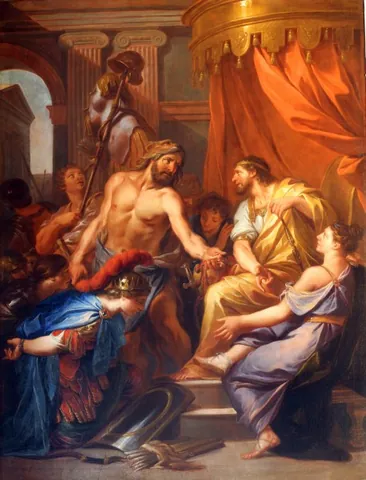
Eurystheus proper noun: a Mycenaean king of Tiryns (or, according to some authors, of Argos), in Argolis, son of Sthenelus and grandson of Perseus, who imposed the twelve labours on Heracles.

Proper noun
Eurystheus
- A Mycenaean king of Tiryns (or, according to some authors, of Argos), in Argolis, son of Sthenelus and grandson of Perseus, who imposed the twelve labours on Heracles.
- "But why hasn't Iolaus killed Eurystheus?," she asks. In a witticism very much akin to Electra's "But where are the messengers?," Euripides has Alcmene ask, essentially, why the plot she is part of has just swerved from its expected course: Iolaus is supposed to kill Eurystheus, by tradition.1991, Transactions of the American Philological Association, Scholars Press, page 129
- Already we have seen from Iliad 19 and the birth of Eurystheus that at an early stage of the tradition Herakles was destined to be subordinate to his cousin.1993, Timothy Gantz, Early Greek Myth: A Guide to Literary and Artistic Sources, Volume 2, Johns Hopkins University Press, page 381
Origin of Eurystheus
Borrowed from Latin Eurystheus, from Ancient Greek Εὐρυσθεύς (Eurustheús).
Words formed from Eurystheus
- Eurysthean
Questions about Eurystheus
- What does Eurystheus mean?
- Eurystheus means a Mycenaean king of Tiryns (or, according to some authors, of Argos), in Argolis, son of Sthenelus and grandson of Perseus, who imposed the twelve labours on Heracles.
- What part of speech is Eurystheus?
- Eurystheus is a proper noun.
- How do you pronounce Eurystheus?
- Eurystheus is pronounced /juˈɹɪs.θi.əs/ (US).
Words near Eurystheus in the dictionary
Source and license
Adapted from Wiktionary: Eurystheus (page history and authors). Text available under the Creative Commons Attribution-ShareAlike 4.0 license. Word.ws reformatted the entry and added links. Wiktionary data of 2026-09-02.
Last updated:
Cite this entry: “Eurystheus.” Word.ws, https://word.ws/eurystheus. Based on Wiktionary, CC BY-SA 4.0.