
feague
/fiːɡ/
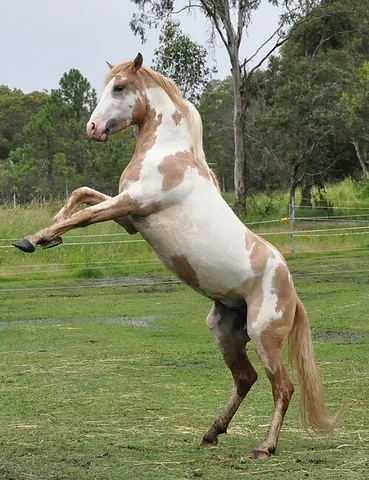
feague verb: to increase the liveliness of a horse by inserting an irritant, such as a piece of peeled raw ginger or a live eel, in its anus.

Verb
feague (third-person singular simple present feagues, present participle feaguing, simple past and past participle feagued)
- To increase the liveliness of a horse by inserting an irritant, such as a piece of peeled raw ginger or a live eel, in its anus.
- FEAGUE, to feague a horse; to put ginger up a horse's fundament, to make him lively, and carry his tail well; it is said, a forfeit is incurred by any horse dealer's servant, who shall show a horse without first feagueing him, used figuratively for encouraging or spiriting one up.1785, Francis Grose, A Classical Dictionary of the Vulgar Tongue, 1st edition, London: Printed for S. Hooper, No. 212, High Holborn, →OCLC, page 61
- Feague. To feague a horſe; to put ginger up a horſe's fundament, and formerly, as it is ſaid, a live eel, to make him lively, and carry his tail well: it is ſaid, a forfeit is incurred by any horſe dealer's ſervant, who ſhall ſhew a horſe without firſt feaguing him. Feague is uſed, figuratively...1788, Francis Grose, A Classical Dictionary of the Vulgar Tongue, 2nd corr. and enl. edition, London: Printed for S. Hooper, №. 212, High Holborn, facing Bloomsbury Square, →OCLC
- Synonyms:
- ginger
- To beat or whip; to drive.
- Dol[l]. (aside). Oh, if I wist this old priest would not sticke to me, by Ioue, I would ingle this old seruing-man. / Harp[oole]. Oh you old mad colt! yfaith, Ile feak you! fil all the pots in the house there.1600, Anthony Munday, Michael Drayton, Richard Hathwaye, Robert Wilson, The First Part of the True and Honorable History, of the Life of Sir Iohn Old-castle, the Good Lord Cobham. As it hath been...
- [T]here's one Count Sharnofsky, too, such another ambitious dry-chops, he hath not the grace to love good drink, and yet he hath the impudence to aim at the Crown. […] [H]e squints at it fearfully, and he hath an itch at the Princess too; (Landlord squints, and makes grim-faces,) but I hope the...1671, John Crowne, Juliana, or The Princess of Poland: A Tragicomedy, as it is Acted at His Royal Highness the Duke of York's Theatre, London: Printed for Will Cademan […] and Will Birch, OCLC...
- Synonyms:
- flog
- To subject to some harmful scheme; to ‘do in’.
- Sir Sim[on Addlepot]. I vvill carry the VViddovv to the French Houſe. / [Mrs.] Joyn[er]. If ſhe vvill goe. / Sir Sim. If ſhe vvill go; vvhy, did you ever knovv a VVidovv refuſe a treat? no more than a Lavvyer a Fee faith and troth; yet I know too. / No treat, ſvveet words, good meen, but ſly...1671 March (first performance), [William] Wycherley, Love in a Wood, or, St James’s Park. A Comedy, […], London: […] J[ohn] M[acock] for H[enry] Herringman, […], published 1672, →OCLC, Act I, pages...
- [W]hen Cataline a League / Had made[,] the Senators to fegue, / And ſtrumpet had told Marcus Tully, / The cloſe intentions of that Bully, / He not ſo much the cauſe revenging / O'th'State, as t'hinder his own ſwinging, / Made the beſt ſpeech to quell that ſtrife, / (Tis ſaid) that e're he made in's...1690, T. D. (Thomas d'Urfey), “Canto II: Monday's Walk”, in Collin's Walk through London and VVestminster, a Poem in Burlesque, London: Printed for Rich[ard] Parker at the Unicorn under the Royal...
- To have sexual intercourse with.
- Come, brother Cockwood, let us get 'em / To lay aſide theſe masking Fopperies, and then / We'll fegue 'em in earneſt: Give us a bottle, Waiter.1668, George Etherege, She Wou’d if She Cou’d, a Comedy. […], London: […] [John Macocke] for H[enry] Herringman, […], →OCLC, Act III, scene iii, page 49
- Chor[us]. […] See, yonder ſits Well-born with his pretty Wife. / […] Shee ſeeks for her Gallant, and he o'my Life / Hath a mind to be feaguing yon Vizor-Mask-Whore.1673, Henry Nevil Payne, The Morning Ramble, or The Town-humours: A Comedy. Acted at the Duke's Theatre, London: Printed for Thomas Dring, at the White Lyon, next Chancery-Lane end in Fleet-street...
- Synonyms:
- coitize
Noun
feague (plural feagues)
- An unkempt, slatternly person.
- So Jack enters: / And trips up staires, as quick, as come penny, / Where we find, what's before good company! / Three female idle feaks, who long'd for pigs head.1664, Henry Bold, Poems Lyrique, Macaronique, Heroique, &c., London: Printed for Henry Brome …, →OCLC
- Feague (also feak, q.v.) as a noun, was used of a slattern, a sluttish woman.[1955, Joseph T[wadell] Shipley, Dictionary of Early English, New York, N.Y.: Philosophical Library, →OCLC, page 261
Examples of feague in a sentence
- Feague is uſed, figuratively, for encouraging or ſpiriting one up.1788, Francis Grose, A Classical Dictionary of the Vulgar Tongue, 2nd corr. and enl. edition, London: Printed for S. Hooper, №. 212, High...
- Not some feagued-up old screw, and I know the difference!2004, Terry Pratchett, Going Postal (Discworld; 33), London: Doubleday, ISBN 978-0-385-60342-3; republished London: Corgi Books, 2014, ISBN...
- One of those chaps over there said someone feagues his horse.2013, Patrick Taylor, An Irish Country Collection: Seven Complete Novels, New York, N.Y.: Forge Books, →ISBN:
- Hark ye, ye curs, keep off from snapping at my heels, or I shall so feague ye.1681, Thomas Otway, The Souldiers Fortune: A Comedy. Acted by Their Royal Highnesses Servants at the Duke's Theatre, London: Printed for R....
Synonyms of feague
Forms of feague
| Verb | |
|---|---|
| third-person singular present | feagues |
| present participle | feaguing |
| past participle | feagued |
| past | feagued |
| Noun | |
| plural | feagues |
Origin of feague
From Dutch vegen (“to sweep, strike”), from Middle Dutch vēghen (“to cleanse”), from Old Dutch *fegōn (“to cleanse”), from Proto-West Germanic *faginōn, from Proto-Germanic *faginōną (“to decorate, make beautiful”), from Proto-Indo-European *pōḱ-, *pēḱ- (“to clean, to adorn”). Cognate with Danish feje (“to sweep”), German fegen (“to cleanse, scour, sweep”), Icelandic fægja (“to polish”), Swedish feja (“to sweep”). More at fay, fair, fake.
Possibly from Dutch feeks, probably from vegen (“to sweep, strike”): see etymology of feague (verb) above. Compare Middle English vecke (“old woman”).
Words that rhyme with feague
Questions about feague
- What does feague mean?
- Feague means to increase the liveliness of a horse by inserting an irritant, such as a piece of peeled raw ginger or a live eel, in its anus.
- How do you use feague in a sentence?
- Feague is uſed, figuratively, for encouraging or ſpiriting one up.
- What part of speech is feague?
- Feague can be a verb or a noun.
- How do you pronounce feague?
- Feague is pronounced /fiːɡ/ (UK).
- What is the past tense of feague?
- The past tense of feague is feagued.
Words near feague in the dictionary
Source and license
Adapted from Wiktionary: feague (page history and authors). Text available under the Creative Commons Attribution-ShareAlike 4.0 license. Word.ws reformatted the entry and added links. Wiktionary data of 2026-09-02.
Last updated:
Pronunciation audio from Wikimedia Commons, each file under its own free license: LL-Q1860 (eng)-Vealhurl-feague.wav.
Cite this entry: “feague.” Word.ws, https://word.ws/feague. Based on Wiktionary, CC BY-SA 4.0.