
Godiva
/ɡəˈdaɪ.və/
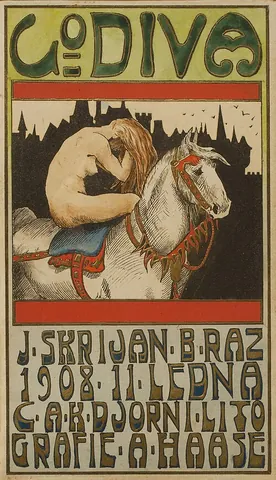
Godiva proper noun: an 11th-century Anglo-Saxon noblewoman who, according to legend, rode unclothed through the streets of Coventry to gain a remission of the oppressive taxation that her husband had imposed on his tenants.

Proper noun
Godiva
- An 11th-century Anglo-Saxon noblewoman who, according to legend, rode unclothed through the streets of Coventry to gain a remission of the oppressive taxation that her husband had imposed on his tenants.
Forms of Godiva
| alternative form | Goodeve |
|---|
Origin of Godiva
From Middle English Godiva, a Latinised form of Old English Godġifu (literally “God gift”), from god (“god”) + ġifu (“gift”). Doublet of Goody, Goodey.
Words that rhyme with Godiva
Questions about Godiva
- What does Godiva mean?
- Godiva means an 11th-century Anglo-Saxon noblewoman who, according to legend, rode unclothed through the streets of Coventry to gain a remission of the oppressive taxation that her husband had imposed on his tenants.
- What part of speech is Godiva?
- Godiva is a proper noun.
- How do you pronounce Godiva?
- Godiva is pronounced /ɡəˈdaɪ.və/.
Words near Godiva in the dictionary
Source and license
Adapted from Wiktionary: Godiva (page history and authors). Text available under the Creative Commons Attribution-ShareAlike 4.0 license. Word.ws reformatted the entry and added links. Wiktionary data of 2026-09-02.
Last updated:
Cite this entry: “Godiva.” Word.ws, https://word.ws/godiva. Based on Wiktionary, CC BY-SA 4.0.