
guanine
/ˈɡwɑː.niːn/
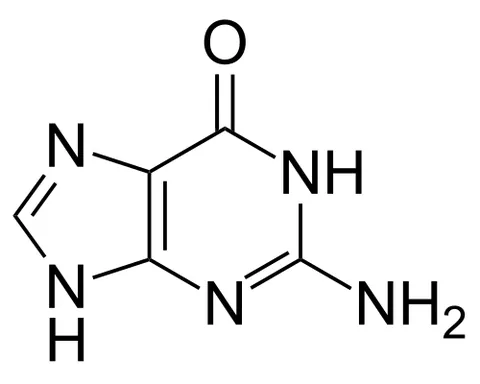
guanine noun: a substance first obtained from guano; it is a nucleic base and pairs with cytosine in DNA and RNA (by means of three hydrogen bonds).

Noun
guanine (plural guanines)
- A substance first obtained from guano; it is a nucleic base and pairs with cytosine in DNA and RNA (by means of three hydrogen bonds).
- Then he found them, the substances that made up the four-letter alphabet in whose language all life is written — adenine and cytosine, guanine and thymine.1997, Ian McEwan, Enduring Love, Vintage (1998), page 164
Forms of guanine
| plural | guanines |
|---|---|
| alternative form (obsolete) | guanin |
Origin of guanine
From guano + -ine. Guanine was named by the German chemist Julius Bodo Unger in 1846 who isolated it from guano.
Words formed from guanine
Questions about guanine
- What does guanine mean?
- Guanine means a substance first obtained from guano; it is a nucleic base and pairs with cytosine in DNA and RNA (by means of three hydrogen bonds).
- What part of speech is guanine?
- Guanine is a noun.
- How do you pronounce guanine?
- Guanine is pronounced /ˈɡwɑː.niːn/.
- What is the plural of guanine?
- The plural of guanine is guanines.
Words near guanine in the dictionary
Source and license
Adapted from Wiktionary: guanine (page history and authors). Text available under the Creative Commons Attribution-ShareAlike 4.0 license. Word.ws reformatted the entry and added links. Wiktionary data of 2026-09-02.
Last updated:
Pronunciation audio from Wikimedia Commons, each file under its own free license: en-us-guanine.ogg, LL-Q1860 (eng)-Tesco250-guanine.wav.
Cite this entry: “guanine.” Word.ws, https://word.ws/guanine. Based on Wiktionary, CC BY-SA 4.0.