
haboku
US/hɑˈboʊ.ku/
haboku noun: a technique of using splashed ink in brushwork painting, especially for painting a landscape.
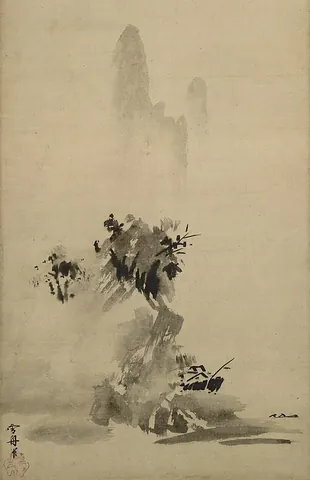

Noun
haboku (uncountable)
- A technique of using splashed ink in brushwork painting, especially for painting a landscape.
- The haboku idiom had appeared in South China in the thirteenth century, and appealed greatly to visiting Japanese Zen Buddhists, who took examples back with them.1979, John M. Rosenfield & William Jay Rathbun, Song of the Brush: Japanese paintings from the Sansō Collection, Seattle Art Museum
- In the very year that the Void began in Kyoto, a Zen monk named Sesshu (1420-1506) left for Ming China and brought back to Japan haboku, or splash ink style and a love of wide open spaces in his paintings. […] Haboku reached its zenith during the Muromachi Period (1470–1550) and then declined.2004, Benjamin Lee Wren, Teaching World Civilization With Joy and Enthusiasm, page 163
Origin of haboku
From Japanese 破墨 (haboku はぼく), from Middle Chinese 破 (pʰà "broken up") + 墨 (mok "ink") (compare Mandarin pòmò 破墨, Cantonese po³-mak⁶ 破墨).
Questions about haboku
- What does haboku mean?
- Haboku means a technique of using splashed ink in brushwork painting, especially for painting a landscape.
- What part of speech is haboku?
- Haboku is a noun.
- How do you pronounce haboku?
- Haboku is pronounced /hɑˈboʊ.ku/ (US).
Words near haboku in the dictionary
Source and license
Adapted from Wiktionary: haboku (page history and authors). Text available under the Creative Commons Attribution-ShareAlike 4.0 license. Word.ws reformatted the entry and added links. Wiktionary data of 2026-09-02.
Last updated:
Cite this entry: “haboku.” Word.ws, https://word.ws/haboku. Based on Wiktionary, CC BY-SA 4.0.