
hare
UK/hɛə/
More pronunciations (1)Fewer pronunciations
British/hɛː/
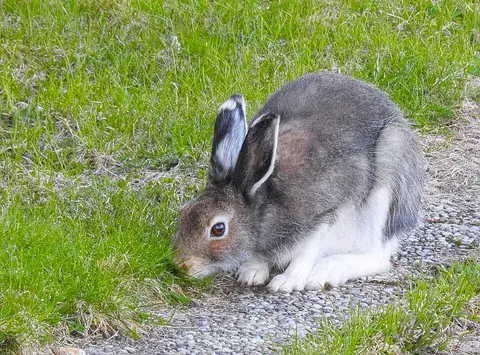
hare noun: any of several plant-eating mammals of the genus Lepus, similar to a rabbit, but larger and with longer ears.

Noun
hare (countable and uncountable, plural hare or hares)
- Any of several plant-eating mammals of the genus Lepus, similar to a rabbit, but larger and with longer ears.
- The hare has a reputation for exciting desire. Hare soup is credited with a particular aphrodisiac value.1961, Harry E. Wedeck, Dictionary of Aphrodisiacs, New York: The Citadel Press, page 111
- The meat from this animal.
- Ashe bit absent-mindedly into a piece of hare and swore mildly when he burned his tongue.1958, Andre Norton, The Time Traders, Cleveland, Oh.; New York, N.Y.: The World Publishing Company, →LCCN, page 79
- Hare is another delicious meat – it’s more ‘steaky’, darker and richer than rabbit.2007, Jamie Oliver, Jamie at Home: Cook Your Way to the Good Life, London: Michael Joseph, Penguin Books, →ISBN, page 273
- The player in a paperchase, or hare and hounds game, who leaves a trail of paper to be followed.
Verb (1)
hare (third-person singular simple present hares, present participle haring, simple past and past participle hared)
- To move swiftly.
- But Wales somehow snaffled possession for fly-half Jones to send half-back partner Mike Phillips haring away with Stoddart in support.2011 February 4, Gareth Roberts, “Wales 19-26 England”, in BBC
- Desperate, Kim hurls his phone overarm at the creature's forehead. It's a solid chunk of metal and it's a dead hit. Grey reels backwards and cracks his skull against the wall. By the time he recovers, Kim is out of sight, haring away down the left corridor, just echoing, fading footsteps on...2015–2021, qntm, “Introductory Antimemetics”, in There Is No Antimemetics Division, →ISBN, page 21
Verb (2)
hare (third-person singular simple present hares, present participle haring, simple past and past participle hared)
- To excite; to tease, or worry; to harry.
- To hare and rate them thus at every turn, is not to teach them, but to vex, and torment them to no purpoſe.1693, John Locke, Some Thoughts Concerning Education
Adjective
hare
Proper noun capitalized: Hare
Hare
- A surname transferred from the nickname.
- Synonym of Sahtú.
- Synonyms:
- Sahtú
- A hamlet in Broadway parish, Somerset, England, previously in South Somerset district (OS grid ref ST2915).
- An unincorporated community in Williamson County, Texas, United States.
- A dialect of Slavey, an Athabaskan language.
- Synonyms:
- Kawchottine
hare meaning in Hindi, Tamil, Marathi and Urdu
hare in Hindi
- animal
- शशक śaśak, शश śaś, ख़रगोश xargoś, खरगोश khargoś, खरहा kharhā
hare in Tamil
- animal
- முயல் muyal
hare in Marathi
- animal
- ससा sasā
hare in Urdu
- animal
- خَرْگوش xargoś, خَرْہا xarhā
More languagesFewer languages
- hare in Bengali
- খরগোশ khorgōś
- hare in Telugu
- కుందేలు kundēlu, శశము śaśamu, చెవులపోతు cevulapōtu
- hare in Malayalam
- ശശം śaśaṁ, മുയൽ muyal
- hare in Kannada
- ಮೊಲ, ಶಶ, ಸಣ್ಣಬಾಲದ ಉದ್ದ ಕಿವಿಗಳ ಸಾಕುಪ್ರಾಣಿ, ರ್ಯಾಬಿಟ್ಟು
- hare in Punjabi
- ਸਹਿਆ sahiā
- hare in Sanskrit
- शश śaśá, शशक śaśaka
- hare in Sinhala
- හාවෝ hāwō
- hare in Assamese
- শহা xoha, শহাপহু xohapohu
- hare in Pashto
- سوی soai
- hare in Tagalog
- liyebre
- hare in Arabic
- قُوَاع quwāʕ, أَرْنَب بَرِّيَّة ʔarnab barriyya, أَرْنَب ʔarnab, ارنب arnab
- hare in Malay
- kelinci, terwelu
- hare in Indonesian
- terwelu, tegalan
- hare in Persian
- خَرْگوش xargōš
- hare in Thai
- กระต่าย grà-dtàai, กระต่ายป่า grà-dtàai-bpàa
- hare in Vietnamese
- thỏ rừng
- hare in Myanmar
- ယုန် yun
Examples of hare in a sentence
- The hunter unslung his rifle and took a bead on the hare.
- The attack on a sea hare by a spiny lobster causes release of the whitish opaline, followed the co-release of both opaline and ink.
- The hispid hare inhabits forested areas.
Synonyms of hare
Forms of hare
| Noun | |
|---|---|
| plural | hare |
| plural | hares |
| Verb | |
| third-person singular present | hares |
| present participle | haring |
| past participle | hared |
| past | hared |
| alternative form | harr |
| Adjective | |
| alternative form | hoar |
Origin of hare
From Middle English hare, from Old English hara (“hare”), from Proto-West Germanic *hasō ~ *haʀ-, from Proto-Germanic *hesô, from Proto-Indo-European *ḱh₂s-én-; possibly related to or influenced by Proto-Germanic *haswaz (“grey”). Cognates See also West Frisian hazze, Dutch haas, German Hase, Norwegian and Swedish hare, Icelandic heri), Old English hasu, Middle High German heswe (“pale, dull”); also Welsh cannu (“to whiten”), ceinach (“hare”), Latin cānus (“white”), cascus (“old”), Old Prussian sasnis (“hare”), Pashto سوی (soe, “hare”) and Sanskrit शश (śaśa, “hare”).
From Middle English harren, harien (“to drag by force, ill-treat”), of uncertain origin. Compare harry, harass.
From Middle English hore, from Old English hār (“hoar, hoary, grey, old”), from Proto-Germanic *hairaz (“grey”). Cognate with German hehr (“noble, sublime”).
Words formed from hare
- Allen's hare
- arctic hare
- Belgian hare
- blue hare
- brown hare
- chief hare
- desert hare
- European hare
- first catch your hare
- forhare
- hare and hounds
- harebell
- harebrain
- hare-brained
- harebrained
- harefoot
- hare-hearted
- harehound
- hare kangaroo
- harekind
- harelike
- hareling
- harelip
- hare lip
- hare-lipped monkey
- hare moon
- hare net
- hare scramble
- hare's ear
- hare-skin
- hare-wallaby
- harish
- hold with the hare and run with the hounds
- jack-hare
- mad as a March hare
- Manchurian hare
- March hare
- mountain hare
- Patagonian hare
- red rock hare
- run with the hare and hunt with the hounds
- scrub hare
- sea hare
- snowshoe hare
- springhare
- start a fresh hare
- start a hare
- start a hare running
- varying hare
- whistling hare
- you can't run with the hare and hunt with the hounds
Phrases with hare
- Hare Bay
- hare lips
- hare moons
- Hare Krishna
- Hare Krishnas
- starts a hare
- hare kangaroos
- hare scrambles
- started a hare
- Hare Indian Dog
- starting a hare
- Hare Indian Dogs
14 more phrasesFewer phrases
- starts a fresh hare
- started a fresh hare
- starting a fresh hare
- starts a hare running
- started a hare running
- starting a hare running
- held with the hare and ran with the hounds
- held with the hare and run with the hounds
- holds with the hare and runs with the hounds
- ran with the hare and hunted with the hounds
- run with the hare and hunted with the hounds
- runs with the hare and hunts with the hounds
- holding with the hare and running with the hounds
- running with the hare and hunting with the hounds
Questions about hare
- What does hare mean?
- Hare means any of several plant-eating mammals of the genus Lepus, similar to a rabbit, but larger and with longer ears.
- What is hare in Hindi?
- Hare in Hindi is शशक (śaśak), शश (śaś), ख़रगोश (xargoś). See Hare meaning in Hindi.
- What part of speech is hare?
- Hare can be a noun, a verb, an adjective or a proper noun.
- How do you pronounce hare?
- Hare is pronounced /hɛə/ (UK).
- What is the plural of hare?
- The plural of hare is hare.
Words near hare in the dictionary
Source and license
Adapted from Wiktionary: hare (page history and authors); Hare (page history and authors); కుందేలు (Telugu) (page history and authors); മുയൽ (Malayalam) (page history and authors); hare (Kannada Wiktionary) (page history and authors); शश (Sanskrit) (page history and authors). Text available under the Creative Commons Attribution-ShareAlike 4.0 license. Word.ws reformatted the entry and added links. Wiktionary data of 2026-09-02.
Last updated:
Pronunciation audio from Wikimedia Commons, each file under its own free license: en-us-hare.ogg.
Cite this entry: “hare.” Word.ws, https://word.ws/hare. Based on Wiktionary, CC BY-SA 4.0.