
hepatoportoenterostomy
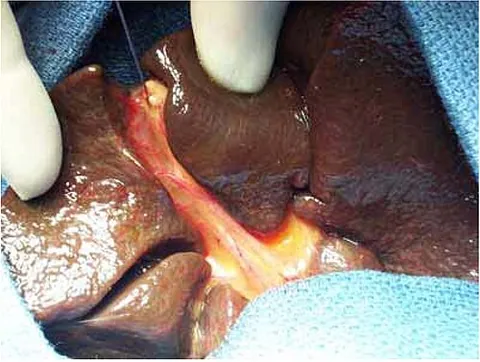
hepatoportoenterostomy noun: a portoenteric reconstruction in which the obliterated extrahepatic biliary tree is excised and a Roux-en-Y limb of jejunum is anastomosed to the porta hepatis, enabling drainage of bile from residual intrahepatic ductules in patients with Biliary atresia.

Noun
hepatoportoenterostomy (plural hepatoportoenterostomies)
- A portoenteric reconstruction in which the obliterated extrahepatic biliary tree is excised and a Roux-en-Y limb of jejunum is anastomosed to the porta hepatis, enabling drainage of bile from residual intrahepatic ductules in patients with Biliary atresia.
Forms of hepatoportoenterostomy
| plural | hepatoportoenterostomies |
|---|
Origin of hepatoportoenterostomy
From hepato- (“of the liver”) + porto- (“of the portal system”) + entero- (“of the small intestine”) + -stomy (“surgery creating a communication”).
Questions about hepatoportoenterostomy
- What does hepatoportoenterostomy mean?
- Hepatoportoenterostomy means a portoenteric reconstruction in which the obliterated extrahepatic biliary tree is excised and a Roux-en-Y limb of jejunum is anastomosed to the porta hepatis, enabling drainage of bile from residual intrahepatic ductules in patients with Biliary atresia.
- What part of speech is hepatoportoenterostomy?
- Hepatoportoenterostomy is a noun.
- What is the plural of hepatoportoenterostomy?
- The plural of hepatoportoenterostomy is hepatoportoenterostomies.
Words near hepatoportoenterostomy in the dictionary
Source and license
Adapted from Wiktionary: hepatoportoenterostomy (page history and authors). Text available under the Creative Commons Attribution-ShareAlike 4.0 license. Word.ws reformatted the entry and added links. Wiktionary data of 2026-09-02.
Last updated:
Cite this entry: “hepatoportoenterostomy.” Word.ws, https://word.ws/hepatoportoenterostomy. Based on Wiktionary, CC BY-SA 4.0.