
heterodont
Syllables: he·te·ro·dont/ˈhɛtəɹəʊdɒnt/US/ˈhɛtəɹəˌdɑnt/
heterodont adjective: having teeth of different types (like most mammals).
.jpg)
Adjective
heterodont (not comparable)
- Having teeth of different types (like most mammals).
- "On the Homologies and Notation of the Teeth of Mammalia," by W[illiam] H[enry] Flower, F.R.S. […] The classification and special homologies of the teeth of the heterodont mammals was next discussed.1868, “Quarterly Chronicle of Microscopical Science”, in Edwin Lankester, George Busk, editors, Quarterly Journal of Microscopical Science, volume VIII (New Series; volume XVI overall), London: John...
- The adaptation of the form of the teeth on both sides to this position, and the accurate adjustment of their contiguous surfaces, shows that it is a natural conformation. They are, moreover, of very nearly even height throughout the series, and in their configuration present a remarkable and...1873 June 19, William Henry Flower, “VI. On a Newly Discovered Extinct Ungulate Mammal from Patagonia, Homalodontotherium Cunninghami.”, in Philosophical Transactions of the Royal Society of London...
- Antonyms:
- homodont
- Of bivalves or their hinge teeth: having two to three wedge-shaped cardinal teeth set in the centre near the umbones, generally also with elongated lateral teeth on the anterior and posterior margins.
- The heterodont arrangement is characteristic of the Venus clams and cockles.
- In this sense all hinges are Heterodont, and the distinction drawn by [Melchior] Neumayr between Heterodont and Desmodont teeth, so far as their situation is concerned, resolves itself into a comparison between teeth originally laterals and both in one valve, with paired laminæ in the opposite...1895 March, William Healey Dall, “The Hinge Teeth”, in Contributions to the Tertiary Fauna of Florida, with Especial Reference to the Miocene Silex-beds of Tampa and the Pliocene Beds of the...
Noun
heterodont (plural heterodonts)
- A heterodont animal.
- [A]mongst heterodonts there are several Rodents which have no deciduous teeth, e.g., the rat; […] Among Marsupials, which are true heterodonts, there is only one milk molar on each side in each jaw; […]1876, Charles S[issmore] Tomes, “The Teeth of Mammals”, in A Manual of Dental Anatomy, Human and Comparative, London: J[ohn] & A[ugustus] Churchill, […], pages 276–277
- On the other hand, in the Mammalian orders with two sets of teeth, these organs are said to acquire fixed individual characters, to receive special denominations, and can be determined from species to species, being equivalent to the Heterodonts. The author [William Henry Flower] then showed that...1868, “Quarterly Chronicle of Microscopical Science”, in Edwin Lankester, George Busk, editors, Quarterly Journal of Microscopical Science, volume VIII (New Series; volume XVI overall), London: John...
- A heterodont bivalve.
- Ordovician actinodontoids are probably ancestral to the heterodonts, unionaceans, and trigoniaceans.1971, Robert A[llen] Cadigan, “Moenkopi Formation and Related Strata”, in Robert A. Cadigan, J. H. Stewart, Petrology of the Triassic Moenkopi Formation and Related Strata in the Colorado Plateau...
- Finally, Carditoidea is basal not only to all other sampled heterodonts but also to Anomalodesmata. This is unexpected; although they appear to be relatively primitive heterodonts, they are mophologically similar to other heterodonts exclusive of anomalodesmatans. More molecular data for other...2000, D. C. Campbell, “Molecular Evidence on the Evolution of the Bivalvia”, in E[lizabeth] M. Harper, J[ohn] D[avid] Taylor, J. A. Crame, editors, The Evolutionary Biology of the Bivalvia...
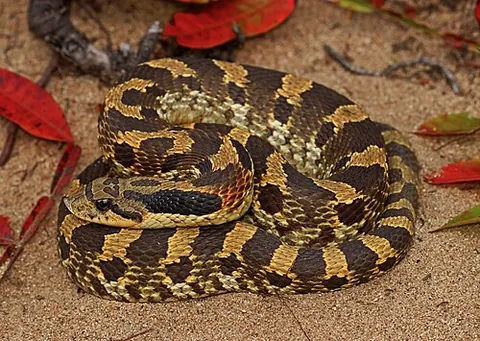
- A snake of the genus Heterodon which is native to North America.
- The second suborder (Macrosformes) corresponds with the Heteroderms of M. André Marie Constant Duméril. These are divided into seven families: […] 4. the Heterodonts, (Dendrophis, Coronella, &c.); […]1841, “REPTILES”, in [George Long], editor, The Penny Cyclopædia of the Society for the Diffusion of Useful Knowledge, volumes XIX (Primaticcio–Richardson), London: Charles Knight and Co., […]...
heterodont meaning in Tamil and Malayalam
heterodont in Tamil
- பலவினப்பல்லுள்ள
heterodont in Malayalam
- വിഷമദന്തി
Examples of heterodont in a sentence
- The principal one is the abseance of any trace of the typical heterodont and diphyodont dentition, found in a more or less modified form in all other placental mammals.1882 April 18, William Henry Flower, “On the Mutual Affinities of the Animals Composing the Order Edentata”, in Proceedings of the...
- Mammalian teeth are characteristically heterodont, i.e. teeth are dissimilar in shape and size.2007 March, “Dentition in Mammals”, in Mahendra Jain, editor, Competition Science Vision: A Specialized Magazine for Medical Entrance &...
- I wish, however, at once to say, that a satisfactory solution will only be arrived at by actual observation of the development of the hinge of heterodont bivalves.1899, Palaeontologica Indica: Memoirs of the Geological Survey of India, volume I, Calcutta, West Bengal: Geological Survey of India...
- The palaeoheterodonts are an extant, Ordovician–Recent, group characterised by heterodont to schizodont dentition.2006, Robert Wynn Jones, “Principal Fossil Groups”, in Applied Palaeontology, Cambridge, Cambridgeshire: Cambridge University Press, →ISBN...
Antonyms of heterodont
Forms of heterodont
| plural | heterodonts |
|---|
Origin of heterodont
From hetero- (prefix meaning ‘different’) + -odont (suffix meaning ‘tooth; toothed’). Hetero- is derived from Ancient Greek ἕτερος (héteros, “one or the other of two; different”), ultimately from Proto-Indo-European *sem- (“together; one”); while -odont is from Ancient Greek ὀδούς (odoús, “tooth; tusk”), ultimately from Proto-Indo-European *h₃ed- (“to bite”) + *-ónts (suffix forming nouns denoting body parts). By surface analysis, hetero- + -odont.
Words formed from heterodont
Questions about heterodont
- What does heterodont mean?
- Heterodont means having teeth of different types (like most mammals).
- What is heterodont in Tamil?
- Heterodont in Tamil is பலவினப்பல்லுள்ள. See Heterodont meaning in Tamil.
- How do you use heterodont in a sentence?
- The principal one is the abseance of any trace of the typical heterodont and diphyodont dentition, found in a more or less modified form in all other placental mammals.
- What part of speech is heterodont?
- Heterodont can be an adjective or a noun.
- How do you pronounce heterodont?
- Heterodont is pronounced /ˈhɛtəɹəʊdɒnt/ (UK).
Words near heterodont in the dictionary
Source and license
Adapted from Wiktionary: heterodont (page history and authors); heterodont (Tamil Wiktionary) (page history and authors); heterodont (Malayalam Wiktionary) (page history and authors). Text available under the Creative Commons Attribution-ShareAlike 4.0 license. Word.ws reformatted the entry and added links. Wiktionary data of 2026-09-02.
Last updated:
Pronunciation audio from Wikimedia Commons, each file under its own free license: LL-Q1860 (eng)-Vealhurl-heterodont.wav.
Cite this entry: “heterodont.” Word.ws, https://word.ws/heterodont. Based on Wiktionary, CC BY-SA 4.0.