
Himeros
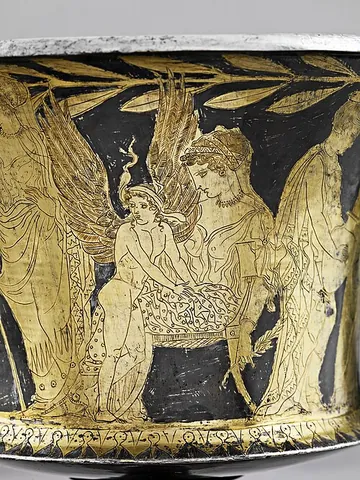
Himeros proper noun: the Greek god of uncontrollable desire, often depicted as a winged child attendant to Aphrodite.

Proper noun
Himeros
- The Greek god of uncontrollable desire, often depicted as a winged child attendant to Aphrodite.
- A late-fifth-century hydria represents Himeros as a young boy who is present at the judgment of Paris: while Eros concentrates on winning over the young shepherd, Himeros and Pothos flank Aphrodite, indicating that this is the goddess upon whom his choice will fall. And a famous black-figure plaque...1999, Janet Lloyd (translator), Claude Calame, Taylor & Francis (Routledge), The Poetics of Eros in Ancient Greece, [1992, I Greci e l'eros], Princeton University Press, pages 31-32
- While both love gods Eros and Himeros are regularly associated with Aphrodite, and they often appear together or separately in overtly erotic contexts, it is a bit tricky to differentiate between these two figures with precision.2010, Monica S. Cyrino, Aphrodite, page 45
Origin of Himeros
Borrowed from Ancient Greek Ἵμερος (Hímeros), ἵμερος (hímeros, “yearning, desire”).
Questions about Himeros
- What does Himeros mean?
- Himeros means the Greek god of uncontrollable desire, often depicted as a winged child attendant to Aphrodite.
- What part of speech is Himeros?
- Himeros is a proper noun.
Words near Himeros in the dictionary
Source and license
Adapted from Wiktionary: Himeros (page history and authors). Text available under the Creative Commons Attribution-ShareAlike 4.0 license. Word.ws reformatted the entry and added links. Wiktionary data of 2026-09-02.
Last updated:
Cite this entry: “Himeros.” Word.ws, https://word.ws/himeros. Based on Wiktionary, CC BY-SA 4.0.