
homo Aristophaneus
Syllables: ho·mo Aris·to·pha·ne·us/ˈhɒməʊ æɹɪsˌtɒfəˈniːəs/US/ˈhɑmoʊ æɹɪsˌtɑfəˈniəs/
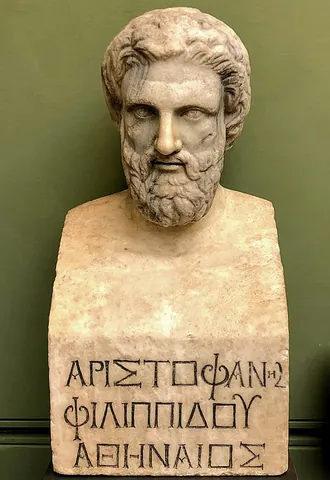
homo Aristophaneus noun: a person with the characteristics and nature depicted in the comedies of the ancient Athenian playwright Aristophanes (c. 446 – c. 386 B.C.E.) as a literary figure, rather than a historically accurate Athenian person; an Aristophanic man.

Noun
homo Aristophaneus
- A person with the characteristics and nature depicted in the comedies of the ancient Athenian playwright Aristophanes (c. 446 – c. 386 B.C.E.) as a literary figure, rather than a historically accurate Athenian person; an Aristophanic man.
- Lest we exaggerate the difference between classes in real life, let us remember that our problem is essentially literary, not sociological: to explain the difference not between real peasants and real aristocrats, but between homo Aristophaneus and homo Platonicus.1964 December, K[enneth] J[ames] Dover, “Eros and Nomos (Plato, Symposium 182a–185c)”, in Bulletin of the Institute of Classical Studies of the University of London, volume XI, number 1, London...
- Despite insistence that he was dealing with the literary man (‘homo Platonicus’ and ‘homo Aristophaneus’), and not the real Athenian aristocrat or farmer, [Kenneth] Dover tended to overlook the literary conventions: Pausanias in the ‘Symposium’ is not ‘homo Platonicus’ but simply one of the...1982, Nancy [H.] Demand, “Notes [endnotes to Chapter 6 (The Muses)]”, in Thebes in the Fifth Century: Heracles Resurgent (Routledge Revivals), Abingdon, Oxfordshire: Routledge, published 2014, →ISBN...
Origin of homo Aristophaneus
PIE word *dʰéǵʰōm Learned borrowing from Latin homō Aristophanēus (literally “Aristophanean man”), not attested in Latin works: homō (“human being, person”) + Aristophanēus (“of, pertaining to, or characteristic of Aristophanes or his works”), possibly influenced by French homo aristophaneus (1951) and German homo aristophaneus (1959) which are attested earlier than the English term. Homō is ultimately derived from Proto-Indo-European *dʰéǵʰōm (“earth; human”); Aristophanēus is borrowed from Ancient Greek Ἀρῐστοφᾰ́νειος (Arĭstophắneios, “of Aristophanes”), from Ᾰ̓ρῐστοφᾰ́νης (Ărĭstophắnēs) (from ᾰ̓́ρῐστος (ắrĭstos, “best”) (ultimately from Proto-Indo-European *h₂er- (“to be suitable, fit; to fix, put together”)) + -φανής (-phanḗs, suffix forming adjectives with the sense ‘appearing, seeming’) (ultimately from Proto-Indo-European *bʰeh₂- (“to shine”))) + -ῐος (-ĭos, suffix forming adjectives with the sense ‘belonging or pertaining to’).
Questions about homo Aristophaneus
- What does homo Aristophaneus mean?
- Homo Aristophaneus means a person with the characteristics and nature depicted in the comedies of the ancient Athenian playwright Aristophanes (c. 446 – c. 386 B.C.E.) as a literary figure, rather than a historically accurate Athenian person; an Aristophanic man.
- What part of speech is homo Aristophaneus?
- Homo Aristophaneus is a noun.
- How do you pronounce homo Aristophaneus?
- Homo Aristophaneus is pronounced /ˈhɒməʊ æɹɪsˌtɒfəˈniːəs/ (UK).
Words near homo Aristophaneus in the dictionary
Source and license
Adapted from Wiktionary: homo Aristophaneus (page history and authors). Text available under the Creative Commons Attribution-ShareAlike 4.0 license. Word.ws reformatted the entry and added links. Wiktionary data of 2026-09-02.
Last updated:
Pronunciation audio from Wikimedia Commons, each file under its own free license: LL-Q1860 (eng)-Vealhurl-homo Aristophaneus.wav.
Cite this entry: “homo Aristophaneus.” Word.ws, https://word.ws/homo_aristophaneus. Based on Wiktionary, CC BY-SA 4.0.