
Iphigenia
/ˌɪfɪd͡ʒɪˈnaɪə/
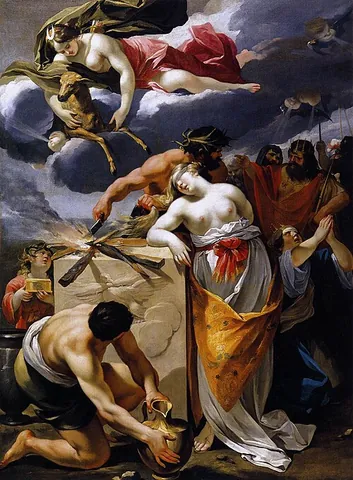
Iphigenia proper noun: the daughter of Agamemnon and Clytaemnestra, who is sacrificed by her father to ensure the safe journey of the Greeks to Troy.

Proper noun
Iphigenia
- The daughter of Agamemnon and Clytaemnestra, who is sacrificed by her father to ensure the safe journey of the Greeks to Troy.
- If we are convinced by the way the Iphigenia myth reworks and distorts the structure of the Metis myth, then we gain a new understanding of the logic underlying Athena's refusal to acknowledge the crime against Iphigenia.2007, Amber Jacobs, On Matricide: Myth, Psychoanalysis, and the Law of the Mother, page 161
- The founding of the sanctuary at Braurona is related to the myths of Iphigenia and her brother, Orestes.2008, Allan Brooks, Myths, Games and Conflict, page 8
Forms of Iphigenia
| alternative form | Ephigenia |
|---|---|
| alternative form | Iphigeneia |
Origin of Iphigenia
From Ancient Greek Ῑ̓φιγένεια (Īphigéneia).
Words that rhyme with Iphigenia
Questions about Iphigenia
- What does Iphigenia mean?
- Iphigenia means the daughter of Agamemnon and Clytaemnestra, who is sacrificed by her father to ensure the safe journey of the Greeks to Troy.
- What part of speech is Iphigenia?
- Iphigenia is a proper noun.
- How do you pronounce Iphigenia?
- Iphigenia is pronounced /ˌɪfɪd͡ʒɪˈnaɪə/.
Words near Iphigenia in the dictionary
Source and license
Adapted from Wiktionary: Iphigenia (page history and authors). Text available under the Creative Commons Attribution-ShareAlike 4.0 license. Word.ws reformatted the entry and added links. Wiktionary data of 2026-09-02.
Last updated:
Pronunciation audio from Wikimedia Commons, each file under its own free license: LL-Q1860 (eng)-Sumxr-Iphigenia.wav.
Cite this entry: “Iphigenia.” Word.ws, https://word.ws/iphigenia. Based on Wiktionary, CC BY-SA 4.0.