
K-complex
/ˈkeɪˌkɒmplɛks/
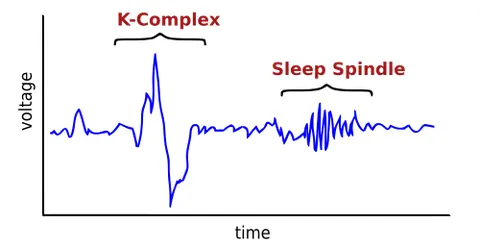
K-complex noun: a waveform that occurs approximately every 60–100 seconds during stage 2 of NREM sleep, and which consists of a brief negative high-voltage peak (usually >100µV), followed by a slower positive complex ~350–550ms, and at 900ms a final negative peak.

Noun
K-complex (plural K-complexes)
Forms of K-complex
| plural | K-complexes |
|---|
Questions about K-complex
- What does K-complex mean?
- K-complex means a waveform that occurs approximately every 60–100 seconds during stage 2 of NREM sleep, and which consists of a brief negative high-voltage peak (usually >100µV), followed by a slower positive complex ~350–550ms, and at 900ms a final negative peak.
- What part of speech is K-complex?
- K-complex is a noun.
- How do you pronounce K-complex?
- K-complex is pronounced /ˈkeɪˌkɒmplɛks/.
- What is the plural of K-complex?
- The plural of K-complex is K-complexes.
Words near K-complex in the dictionary
Source and license
Adapted from Wiktionary: K-complex (page history and authors). Text available under the Creative Commons Attribution-ShareAlike 4.0 license. Word.ws reformatted the entry and added links. Wiktionary data of 2026-09-02.
Last updated:
Cite this entry: “K-complex.” Word.ws, https://word.ws/k-complex. Based on Wiktionary, CC BY-SA 4.0.