
kabuki
Syllables: ka·bu·kiUK/kəˈbuːkiː//kəˈbuːki/
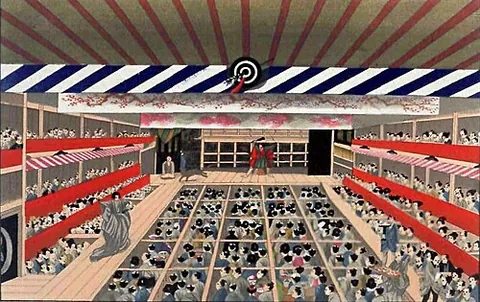
kabuki noun: a form of Japanese theatre in which elaborately costumed male performers use stylized movements, dances, and songs in order to enact tragedies and comedies.

Noun (1)
kabuki (uncountable)
- A form of Japanese theatre in which elaborately costumed male performers use stylized movements, dances, and songs in order to enact tragedies and comedies.
- Despite its self-consciously assumed irreverence toward traditional practices, “Hokaibo” incorporates all the essential elements of classic Kabuki: the all-male company of actors, exaggerated makeup, the stomping dances, the arresting, cross-eyed poses at moments of high drama that are recognized...2007 July 19, Charles Isherwood, “Guilty Pleasures of Comic Kabuki”, in The New York Times, →ISSN, archived from the original on 09 Mar 2021
- Ichikawa, whose real name is Takahiko Kinoshi, made his kabuki debut in 1980 and went on to become one of the country’s most renowned performers.2023 June 27, AFP, “Japanese kabuki actor arrested for allegedly assisting in his mother’s suicide”, in The Guardian, →ISSN, archived from the original on 15 Jul 2023
- A stylized, pretentious, and often hollow performance; (especially) political posturing.
- The whole "weapons of mass destruction" concern was phony from the start, and the drama about inspections was just kabuki: going through the motions.2005 June 12, Michael Kinsley, “No Smoking Gun”, in The Washington Post, archived from the original on 12 Dec 2024
- Health care reform recently brought Kabuki to mind for both Rush Limbaugh—“what you have here is ‘Kabuki theater’”—and New York Times columnist Frank Rich: “[I]f I were to place an incautious bet on which political event will prove the most significant of February 2010, I wouldn’t choose the kabuki...2010 March 14, Jon Lackman, “It’s Time To Retire Kabuki: The word doesn’t mean what pundits think it does”, in Slate, archived from the original on 16 Feb 2020
Noun (2) capitalized: Kabuki
Kabuki (uncountable)
- Alternative letter-case form of kabuki.
kabuki meaning in Marathi, Arabic, Malay and Vietnamese
kabuki in Marathi
- form of Japanese theatre
- काबुकी kābukī
kabuki in Arabic
- form of Japanese theatre
- كَابُوكِي kābūkī
kabuki in Malay
- form of Japanese theatre
- kabuki
kabuki in Vietnamese
- form of Japanese theatre
- kịch kabuki
Forms of kabuki
| alternative form | Kabuki |
|---|
Origin of kabuki
Borrowed from Japanese 歌舞伎 (kabuki).
Words formed from kabuki
Phrases with kabuki
Words that rhyme with kabuki
Questions about kabuki
- What does kabuki mean?
- Kabuki means a form of Japanese theatre in which elaborately costumed male performers use stylized movements, dances, and songs in order to enact tragedies and comedies.
- What is kabuki in Marathi?
- Kabuki in Marathi is काबुकी (kābukī). See Kabuki meaning in Marathi.
- What part of speech is kabuki?
- Kabuki is a noun.
- How do you pronounce kabuki?
- Kabuki is pronounced /kəˈbuːki/ (US).
Words near kabuki in the dictionary
Source and license
Adapted from Wiktionary: kabuki (page history and authors); Kabuki (page history and authors). Text available under the Creative Commons Attribution-ShareAlike 4.0 license. Word.ws reformatted the entry and added links. Wiktionary data of 2026-09-02.
Last updated:
Pronunciation audio from Wikimedia Commons, each file under its own free license: en-us-kabuki.ogg, en-au-kabuki.ogg.
Cite this entry: “kabuki.” Word.ws, https://word.ws/kabuki. Based on Wiktionary, CC BY-SA 4.0.