
Kannon
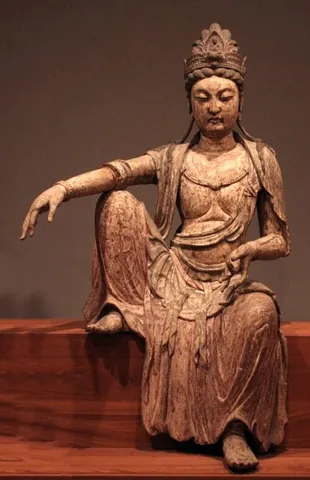
Kannon proper noun: kannon, the Japanese version of Guanyin, the Chinese translation of Avalokiteśvara, the bodhisattva of mercy and compassion.

Proper noun
Kannon
- Kannon, the Japanese version of Guanyin, the Chinese translation of Avalokiteśvara, the bodhisattva of mercy and compassion.
- “A long time ago, Kannon, the Bodhisattva of Compassion, made a deep vow to free all beings and help us wake up to our true and luminous nature.”2021, Ruth Ozeki, The Book of Form and Emptiness, Canongate Books (2022), page 413
Forms of Kannon
| alternative form (dated) | Kwannon |
|---|
Origin of Kannon
From Japanese 観音 (Kannon), from Middle Chinese 觀音 (MC kwan 'im), a translation of Sanskrit अवलोकितेश्वर (avalokiteśvara).
Questions about Kannon
- What does Kannon mean?
- Kannon means kannon, the Japanese version of Guanyin, the Chinese translation of Avalokiteśvara, the bodhisattva of mercy and compassion.
- What part of speech is Kannon?
- Kannon is a proper noun.
Words near Kannon in the dictionary
Source and license
Adapted from Wiktionary: Kannon (page history and authors). Text available under the Creative Commons Attribution-ShareAlike 4.0 license. Word.ws reformatted the entry and added links. Wiktionary data of 2026-09-02.
Last updated:
Cite this entry: “Kannon.” Word.ws, https://word.ws/kannon. Based on Wiktionary, CC BY-SA 4.0.