
leucophanite
/l(j)uːˈkɒfənaɪt/
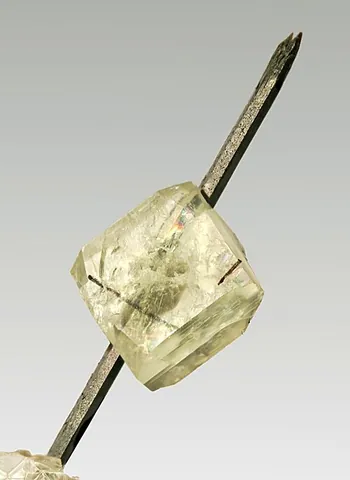
leucophanite noun: a sorosilicate mineral that occurs in pegmatites and alkali igneous complexes as yellow, greenish or white triclinic crystals.

Noun
leucophanite (countable and uncountable, plural leucophanites)
- A sorosilicate mineral that occurs in pegmatites and alkali igneous complexes as yellow, greenish or white triclinic crystals.
Forms of leucophanite
| plural | leucophanites |
|---|
Origin of leucophanite
Originally named Leukophan (1840) by the Norwegian mineralogist Jens Esmark, in allusion to its whitish color, from leuco- (white) + -phane (“appearing”). The suffix -ite, added later, is used to form nouns denoting minerals.
Questions about leucophanite
- What does leucophanite mean?
- Leucophanite means a sorosilicate mineral that occurs in pegmatites and alkali igneous complexes as yellow, greenish or white triclinic crystals.
- What part of speech is leucophanite?
- Leucophanite is a noun.
- How do you pronounce leucophanite?
- Leucophanite is pronounced /l(j)uːˈkɒfənaɪt/.
- What is the plural of leucophanite?
- The plural of leucophanite is leucophanites.
Words near leucophanite in the dictionary
Source and license
Adapted from Wiktionary: leucophanite (page history and authors). Text available under the Creative Commons Attribution-ShareAlike 4.0 license. Word.ws reformatted the entry and added links. Wiktionary data of 2026-09-02.
Last updated:
Pronunciation audio from Wikimedia Commons, each file under its own free license: LL-Q1860 (eng)-Vealhurl-leucophanite.wav.
Cite this entry: “leucophanite.” Word.ws, https://word.ws/leucophanite. Based on Wiktionary, CC BY-SA 4.0.