
mace
/meɪs/
mace noun: a heavy fighting club.

Noun (1)
mace (plural maces)
- A heavy fighting club.
- The Mace is an ancient weapon, formerly much used by cavalry of all nations, and likewise by ecclesiastics, who in consequence of their tenures, frequently took the field, but were by a canon of the church forbidden to wield the sword.1786, Francis Grose, A Treatise on Ancient Armour and Weapons, page 51
- A ceremonial form of this weapon.
- I am a king that find thee; and I know 'Tis not the balm, the sceptre, and the ball, The sword, the mace, the crown imperial, The intertissued robe of gold and pearl1599 (date written), William Shakespeare, “The Life of Henry the Fift”, in Mr. William Shakespeares Comedies, Histories, & Tragedies […] (First Folio), London: […] Isaac Iaggard, and Ed[ward] Blount...
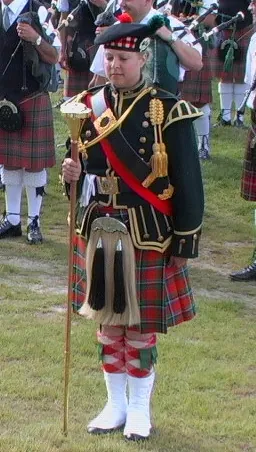
- A long baton used by some drum majors to keep time and lead a marching band. If this baton is referred to as a mace, by convention it has a ceremonial often decorative head, which, if of metal, usually is hollow and sometimes intricately worked.
- An officer who carries a mace as a token of authority.
- On the left were the Commons with their Speaker, attended by the mace. The southern door opened: and the Prince and Princess of Orange, side by side, entered, and took their place under the canopy of state.1849–1861, Thomas Babington Macaulay, The History of England from the Accession of James the Second, volume (please specify |volume=I to V), London: Longman, Brown, Green, and Longmans, →OCLC
- A knobbed mallet used by curriers to make leather supple when dressing it.
- In the foreground one man uses the "head knife” to work over the skin on the beam, while another softens a skin with the currier's mace.1967, Harold B. Gill, Raymond R. Townsend, Thomas K. Ford, The Leatherworker in Eighteenth-Century Williamsburg
- A flail.
- A billiard cue.
Verb (1)
mace (third-person singular simple present maces, present participle macing, simple past and past participle maced)
- To hit someone or something with a mace.
Noun (2)
mace (uncountable)
- A spice obtained from the outer layer of the kernel of the fruit of the nutmeg.
- I must have saffron to color the warden pies; mace; dates, none -- that's out of my note; nutmegs, seven; a race or two of ginger, but that I may beg; four pounds of prunes, and as many of raisins o' th' sun.c. 1610–1611 (date written), William Shakespeare, “The Winters Tale”, in Mr. William Shakespeares Comedies, Histories, & Tragedies […] (First Folio), London: […] Isaac Iaggard, and Ed[ward] Blount...
Noun (3)
mace (countable and uncountable, plural maces)
- Tear gas or pepper spray, especially for personal use.
- […] was sentenced on Friday to 10 years in prison for shooting a man in the eye with a paintball gun, spraying people in the face with bear mace and aiming a loaded handgun at a crowd, prosecutors said.2021 December 10, Michael Levenson, “Self-Proclaimed Proud Boys Member Gets 10 Years for Violence at Portland Protests”, in The New York Times, →ISSN, archived from the original on 18 Feb 2022
Verb (2)
mace (third-person singular simple present maces, present participle macing, simple past and past participle maced)
- To spray in defense or attack with mace (pepper spray or tear gas) using a hand-held device.
- To spray a similar noxious chemical in defense or attack using an available hand-held device such as an aerosol spray can.
- When Reynaldo and Willie had burst into Larkey's drug store to confront him, the old man had maced Willie square in the eyes with an aerosol can of spermicidal birth-control foam.1989, Carl Hiaasen, chapter 22, in Skin Tight, New York: Ballantine Books
Noun (4)
mace (plural maces)
- An old money of account in China equal to one tenth of a tael.
- An old weight of 57.98 grains, approximately 3.8 grams.
- The decimals of the tael, called mace, candareen, and cash (tsien, fǎn, and li) , are employed in reckoning bullion.1883, Samuel Wells Williams, The Middle Kingdom: A Survey of the Geography, Government, Education, Social Life, Arts, Religion, &c., of the Chinese Empire and Its Inhabitants
Proper noun capitalized: Mace
Mace (countable and uncountable, plural Maces)
- Alternative letter-case form of mace (tear gas or pepper spray)
- A male given name, a name derived from the war instrument, a mace
- A surname.
- Prior to the House passing the legislation, only four Republicans had joined all Democrats in signing a petition to force a vote - Thomas Massie, Lauren Boebert, Nancy Mace and Marjorie Taylor Greene.2025 November 18, Brandon Drenon, “The only 'no' vote on releasing Epstein files”, in BBC
- An unincorporated community in Walnut Township, Montgomery County, Indiana, United States.
Noun (5) capitalized: MACE
MACE (plural MACEs)
- Initialism of major adverse cardiovascular event.
mace meaning in Hindi, Tamil, Marathi and Urdu
mace in Hindi
- a spice
- जावित्री jāvitrī, जावत्री jāvatrī
mace in Tamil
- a spice
- சாதிக்காய் cātikkāy, ஜாதிக்காய் jātikkāy
mace in Marathi
- गदा
mace in Urdu
- a spice
- جاوتری jāvitrī, jāvatrī
More languagesFewer languages
- mace in Bengali
- গদা
- mace in Malayalam
- ഗദ gada
- mace in Kannada
- ಜಾಪತ್ರೆ jāpatre
- mace in Punjabi
- ਮੇਸ mes
- mace in Gujarati
- મેસ mes
- mace in Sanskrit
- गदा gadā
- mace in Nepali
- गढ gaḍh
- mace in Arabic
- دَبُّوس dabbūs, قِشْرَةُ جَوْزِ الطِيبِ qišratu jawzi ṭ-ṭībi, بَسْبَاس basbās
- mace in Malay
- cokmar, bunga pala, kembang pala
- mace in Indonesian
- gada, bunga pala
- mace in Persian
- گرز gorz, پوست جوز هندی pust-e jowz-e hendi
Synonyms of mace
Forms of mace
| Noun | |
|---|---|
| plural | maces |
| plural | MACEs |
| Verb | |
| third-person singular present | maces |
| present participle | macing |
| past participle | maced |
| past | maced |
| Proper noun | |
| plural | Maces |
Origin of mace
From Middle English mace, borrowed from Old French mace, mache, from Vulgar Latin *mattia, *mattea, matia, (compare Italian mazza, Spanish maza), probably from Proto-West Germanic *mattjō (“cutting tool, hoe”).
From Middle English, from re-interpretation of macys as a plural (as with pea); from Latin macir. Doublet of macir.
From the name of one brand of the spray, Mace. Pepper spray may be derived from cayenne pepper, but not from mace (etymology 2 above), which is a different spice; rather, it was named after the weapon (etymology 1).
Words formed from mace
Phrases with mace
Words that rhyme with mace
45 more rhymesFewer rhymes
- embrace
- lace
- replace
- displace
- bass
- efface
- plaice
- disgrace
- pes
- abase
- debase
- deface
- interlace
- misplace
- retrace
- white space
- bouillabaisse
- dace
- enlace
- grimace
- nominative case
- red in the face
- -ase
- abaisse
- acoustic bass
- aggrace
- Alsace
- apace
- artspace
- encase
- gather pace
- Harbour Grace
- Havre de Grace
- heart of grace
- into space
- Jace
- Jase
- laisse
- misgrace
- Naas
- outpace
- reys
- supplace
- Thrace
- torace
Questions about mace
- What does mace mean?
- Mace means a heavy fighting club.
- What is mace in Hindi?
- Mace in Hindi is जावित्री (jāvitrī), जावत्री (jāvatrī). See Mace meaning in Hindi.
- What part of speech is mace?
- Mace can be a noun, a verb or a proper noun.
- How do you pronounce mace?
- Mace is pronounced /meɪs/.
- What is the plural of mace?
- The plural of mace is maces.
Words near mace in the dictionary
Source and license
Adapted from Wiktionary: mace (page history and authors); Mace (page history and authors); MACE (page history and authors); mace (Marathi, IndicTrans2 machine translation) (model and license); mace (Bengali, IndicTrans2 machine translation) (model and license). Text available under the Creative Commons Attribution-ShareAlike 4.0 license. Word.ws reformatted the entry and added links. Wiktionary data of 2026-09-02.
Last updated:
Pronunciation audio from Wikimedia Commons, each file under its own free license: en-us-mace.ogg.
Cite this entry: “mace.” Word.ws, https://word.ws/mace. Based on Wiktionary, CC BY-SA 4.0.