
maki-e
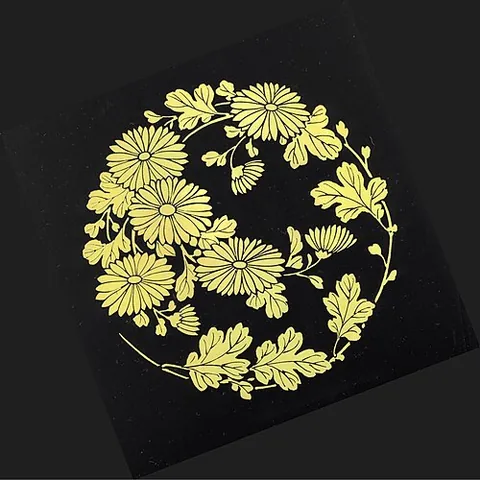
maki-e noun: a style of Japanese lacquerware made with gold or silver sprinkled on wet lacquer.

Noun
maki-e (plural maki-e)
- A style of Japanese lacquerware made with gold or silver sprinkled on wet lacquer.
- Although indigenous to Japan as a technique, early maki-e retained a T'ang Chinese influence in design. Maki-e is achieved by spreading and scattering gold or silver dust, flakes, nuggets, and leaf on a drawing done in sticky lacquer, which is applied over the hardened lacquer foundation.1975, Patricia Salmon, A Guide to Japanese Antiques, page 22
- […] and that was a puzzle until Orson remembered that he’d recounted without seeming upset (this disputed by Greg) that the boy he’d recently gotten rid of had stolen it, along with four of the maki-e lacquer boxes, as if these were objects as easy to sell on the street as a TV or a stereo.1986 November 24, Susan Sontag, “The Way We Live Now”, in The New Yorker
- An object decorated with this style of lacquer.
Forms of maki-e
| plural | maki-e |
|---|
Origin of maki-e
Borrowed from Japanese 蒔絵 (maki e, literally “sown picture; scatter picture”).
Questions about maki-e
- What does maki-e mean?
- Maki-e means a style of Japanese lacquerware made with gold or silver sprinkled on wet lacquer.
- What part of speech is maki-e?
- Maki-e is a noun.
- What is the plural of maki-e?
- The plural of maki-e is maki-e.
Words near maki-e in the dictionary
Source and license
Adapted from Wiktionary: maki-e (page history and authors). Text available under the Creative Commons Attribution-ShareAlike 4.0 license. Word.ws reformatted the entry and added links. Wiktionary data of 2026-09-02.
Last updated:
Cite this entry: “maki-e.” Word.ws, https://word.ws/maki-e. Based on Wiktionary, CC BY-SA 4.0.