
morné
UK/mɔːneɪ/US/moɹ.neɪ/
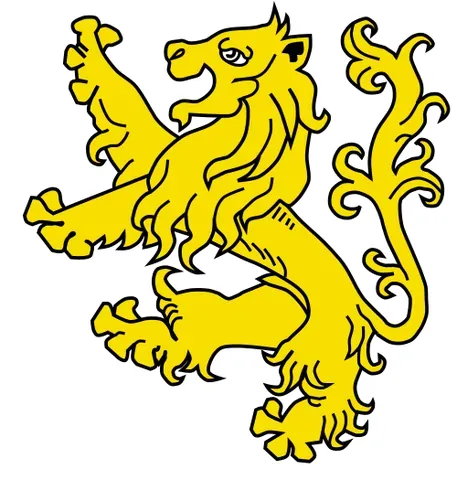
morné adjective: rampant without teeth, beak, tongue, claws, etc.

Adjective
morné (not comparable)
- Rampant without teeth, beak, tongue, claws, etc.
- A lion morné appears as a canting charge in the coat of the old French family of DE MORNAY : - Fascé d'argent, et de gueules, au lion morné de sable couronné d'or brochant sur le tout. I have noticed that the lion morné occurs in the arms of several old Breton families, KERBOURIOU, KERBESCAT...1892, John Woodward, George Burnett, A Treatise on Heraldry, British and Foreign: With English and French Glossaries, page 218
- […] Self-appointed 'reformers' of heraldic terminology will contend that since lions morné and lions eviré have have barely an existence in current armory, the words themselves are mere textbook fill-up […]1963, Julian Franklyn, Shield and Crest: An Account of the Art and Science of Heraldry, page 92
Forms of morné
| alternative form | morne |
|---|---|
| alternative form | mortine |
Origin of morné
From French morné. Possibly doublet of mourn.
Questions about morné
- What does morné mean?
- Morné means rampant without teeth, beak, tongue, claws, etc.
- What part of speech is morné?
- Morné is an adjective.
- How do you pronounce morné?
- Morné is pronounced /mɔːneɪ/ (UK).
Words near morné in the dictionary
Source and license
Adapted from Wiktionary: morné (page history and authors). Text available under the Creative Commons Attribution-ShareAlike 4.0 license. Word.ws reformatted the entry and added links. Wiktionary data of 2026-09-02.
Last updated:
Cite this entry: “morné.” Word.ws, https://word.ws/morn%C3%A9. Based on Wiktionary, CC BY-SA 4.0.