
nalbuphine
/ˈnæl.bjʊ.fiːn/
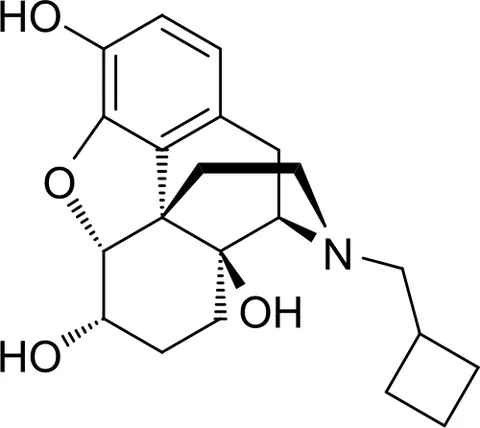
nalbuphine noun: a synthetic opioid antagonist which is very similar to morphine in chemical structure and is given by injection (usually in the form of its hydrochloride) as an analgesic; (−)-(5R,6S,14S)-9a-cyclobutylmethyl-4,5-epoxymorphinan-3,6,14-triol, C₂₁H₂₇NO₄.

Noun
nalbuphine (uncountable)
- A synthetic opioid antagonist which is very similar to morphine in chemical structure and is given by injection (usually in the form of its hydrochloride) as an analgesic; (−)-(5R,6S,14S)-9a-cyclobutylmethyl-4,5-epoxymorphinan-3,6,14-triol, C₂₁H₂₇NO₄.
Origin of nalbuphine
From nal(or)phine + (cyclo)bu(tyl).
Words formed from nalbuphine
- nalbuphine hydrochloride
Questions about nalbuphine
- What does nalbuphine mean?
- Nalbuphine means a synthetic opioid antagonist which is very similar to morphine in chemical structure and is given by injection (usually in the form of its hydrochloride) as an analgesic; (−)-(5R,6S,14S)-9a-cyclobutylmethyl-4,5-epoxymorphinan-3,6,14-triol, C₂₁H₂₇NO₄.
- What part of speech is nalbuphine?
- Nalbuphine is a noun.
- How do you pronounce nalbuphine?
- Nalbuphine is pronounced /ˈnæl.bjʊ.fiːn/.
Words near nalbuphine in the dictionary
Source and license
Adapted from Wiktionary: nalbuphine (page history and authors). Text available under the Creative Commons Attribution-ShareAlike 4.0 license. Word.ws reformatted the entry and added links. Wiktionary data of 2026-09-02.
Last updated:
Cite this entry: “nalbuphine.” Word.ws, https://word.ws/nalbuphine. Based on Wiktionary, CC BY-SA 4.0.