
orangutan
Syllables: rang·u·tan/əˌɹæŋ.uːˈtæn//əˈɹæŋ.əˌtæn/
orangutan noun: an arboreal ape, characterised by its shaggy reddish-brown coat and long arms, of the genus Pongo, native to Borneo and Sumatra.
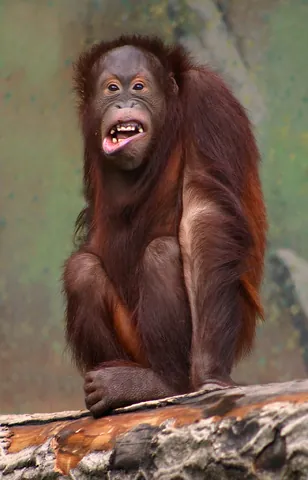

Noun
orangutan (plural orangutans)
orangutan meaning in Hindi, Tamil, Urdu and Assamese
orangutan in Hindi
- arboreal anthropoid ape
- आरंगुटान āraṅguṭān, ओरंगोटंग oraṅgoṭaṅg
orangutan in Tamil
- கானரன், ஓரங்குட்டன்
orangutan in Urdu
- arboreal anthropoid ape
- اورنگوٹان
orangutan in Assamese
- arboreal anthropoid ape
- ওৰাংওটাং üraṅütaṅ
More languagesFewer languages
- orangutan in Tagalog
- urangutang
- orangutan in Arabic
- إِنْسَان اَلْغَاب ʔinsān al-ḡāb, إِنْسَان الْغَابَة ʔinsān al-ḡāba
- orangutan in Malay
- orang utan, mawas
- orangutan in Indonesian
- orang utan, mawas
- orangutan in Thai
- อุรังอุตัง ù-rang-ù-dtang
- orangutan in Vietnamese
- đười ươi
Forms of orangutan
| plural | orangutans |
|---|---|
| alternative form | orang utan |
| alternative form | orang-utan |
| alternative form | orangutang |
| alternative form (archaic) | orang-utang |
| alternative form (archaic) | ourang outang |
| alternative form (archaic) | ourang-outang |
| alternative form (archaic) | ourangoutang |
| alternative form (obsolete) | oran-otan |
| alternative form (obsolete) | oran-outang |
| alternative form (obsolete) | orang-hutan |
| alternative form (obsolete) | orang-otan |
| alternative form (obsolete) | orang-otang |
| alternative form (obsolete) | orang-outan |
| alternative form (obsolete) | orang-outang |
| alternative form (obsolete) | orangotang |
| alternative form (obsolete) | orangoutan |
| alternative form (obsolete) | orangoutang |
| alternative form (obsolete) | ourang-outan |
| alternative form (obsolete) | uran-utan |
Origin of orangutan
Probably via Dutch orang-oetan, orang-oetang, apparently from Malay orang hutan, orang utan (literally “forest man”), from orang (“person, man”) + hutan (“forest”), although as a term for the animal it is attested only recently (earlier and preferred terms being mawas and mayas). As there is originally no evidence for its usage, except occasionally literally, it must be assumed to have been regional, or a descriptive collocation used to explain the animal to early travellers. Forms in -ng are alterations after the first element, orang. The name orangutan has been used in Old Javanese texts, notably in Rāmāyaṇa and Smaradahana, in the form of uraṅutan and wuraṅutan. Its usage to refer to the apes in these texts (from as early as the 9th century CE) has been seen as a refutation of claims that the name orangutan originates from a European source.
Words formed from orangutan
- Bornean orangutan
- orangoid
- Sumatran orangutan
- Tapanuli orangutan
Questions about orangutan
- What does orangutan mean?
- Orangutan means an arboreal ape, characterised by its shaggy reddish-brown coat and long arms, of the genus Pongo, native to Borneo and Sumatra.
- What is orangutan in Hindi?
- Orangutan in Hindi is आरंगुटान (āraṅguṭān), ओरंगोटंग (oraṅgoṭaṅg). See Orangutan meaning in Hindi.
- What part of speech is orangutan?
- Orangutan is a noun.
- How do you pronounce orangutan?
- Orangutan is pronounced /əˌɹæŋ.uːˈtæn/ (UK).
- What is the plural of orangutan?
- The plural of orangutan is orangutans.
Words near orangutan in the dictionary
Source and license
Adapted from Wiktionary: orangutan (page history and authors); orangutan (Tamil Wiktionary) (page history and authors). Text available under the Creative Commons Attribution-ShareAlike 4.0 license. Word.ws reformatted the entry and added links. Wiktionary data of 2026-09-02.
Last updated:
Pronunciation audio from Wikimedia Commons, each file under its own free license: En-us-orangutan.ogg, en-uk-orangutan.ogg.
Cite this entry: “orangutan.” Word.ws, https://word.ws/orangutan. Based on Wiktionary, CC BY-SA 4.0.