
parados
UK/ˈpaɹədɒs/
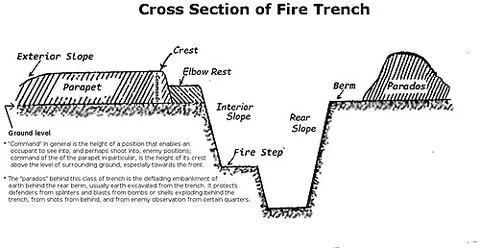
parados noun: generally a screen or embankment to protect the rear of a position from enemy attack, from bomb splinters from behind, from enemy fire from a commanding height, or fire from flanking positions. In common English usage since World War II, the term "parados", particularly in trench warfare, has largely been discarded in favour of "rear parapet", which, etymologically speaking, is a contradiction in terms. In some contexts the term "rear traverse" is preferred, but no usage is exclusive.

Noun
parados (plural parados or paradoses)
- Generally a screen or embankment to protect the rear of a position from enemy attack, from bomb splinters from behind, from enemy fire from a commanding height, or fire from flanking positions. In common English usage since World War II, the term "parados", particularly in trench warfare, has largely been discarded in favour of "rear parapet", which, etymologically speaking, is a contradiction in terms. In some contexts the term "rear traverse" is preferred, but no usage is exclusive.
- ...an elevation of earth which is effected behind fortified places, to secure them from any attack that may be made in reverse. Parapet and parados come from terms signifying in the front or in the rear of anything.1810, Charles James, A New and Enlarged Military Dictionary, T. Egerton, pages 87–
- Although a parados takes up so much room, yet it may be turned to good account in the formation of blindages.1853, anonymous author, Aide-mémoire to the Military Sciences: Framed from Contributions of Officers of the Different Services
- In fortifications that were enfiladed by enemy in positions commanding the fort, an internal parados could defilade the enemy, serving as physical protection and blindage. Usages of the term have varied inconsistently according to times and sources. Some sources use parados as a synonym for a traverse; some other sources represent parados as a special class of traverse and not necessarily at the back of any particular position.
- In trench warfare parados referred to a bank of earth or similar material behind the rear of the trench, opposite the parapet, affording protection from explosions and fragments when shells or bombs overshot the trench.
Examples of parados in a sentence
- In an enclosed work the interior can seldom be sufficiently covered from the enemy’s fire by the parapet, and it becomes necessary to build traverses or parados or both.1888, Charles Booth Brackenbury, Field Works: Their Technical Construction and Tactical Application:
- Earth was thrown to the front (parapet) and rear (parados) in crescents. (The term "parados" fell from use in World War II being replaced by "rear parapet".)2005, Gordon L. Rottman, US World War II and Korean War Field Fortifications 1941–53, →ISBN:
Forms of parados
| plural | parados |
|---|---|
| plural | paradoses |
Origin of parados
Borrowed from French parados; in turn the French derived from Italian para, defence, cognate with English parry, plus French dos cognate with Latin dorsum: the back, i.e. the dorsal aspect. Parados is unrelated to parodos either in etymology or in meaning.
Questions about parados
- What does parados mean?
- Parados means generally a screen or embankment to protect the rear of a position from enemy attack, from bomb splinters from behind, from enemy fire from a commanding height, or fire from flanking positions. In common English usage since World War II, the term "parados", particularly in trench warfare, has largely been discarded in favour of "rear parapet", which, etymologically speaking, is a contradiction in terms. In some contexts the term "rear traverse" is preferred, but no usage is exclusive.
- How do you use parados in a sentence?
- In an enclosed work the interior can seldom be sufficiently covered from the enemy’s fire by the parapet, and it becomes necessary to build traverses or parados or both.
- What part of speech is parados?
- Parados is a noun.
- How do you pronounce parados?
- Parados is pronounced /ˈpaɹədɒs/ (UK).
- What is the plural of parados?
- The plural of parados is parados.
Words near parados in the dictionary
Source and license
Adapted from Wiktionary: parados (page history and authors). Text available under the Creative Commons Attribution-ShareAlike 4.0 license. Word.ws reformatted the entry and added links. Wiktionary data of 2026-09-02.
Last updated:
Cite this entry: “parados.” Word.ws, https://word.ws/parados. Based on Wiktionary, CC BY-SA 4.0.