
piroplasma
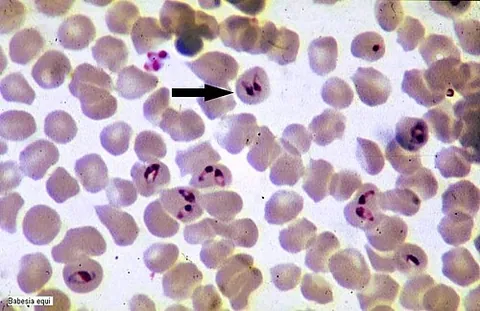
piroplasma noun: babesia, a genus of hematozoa that invades the red blood cells of humans and domesticated animals such as dogs and sheep.

Noun
piroplasma (plural piroplasmas or piroplasmata)
- Babesia, a genus of hematozoa that invades the red blood cells of humans and domesticated animals such as dogs and sheep
- It has been known for some years past that Piroplasma in the digestive tube of an adult female tick can give rise to infection in the offspring of that female, so that one generation of ticks can acquire the parasites from cattle, and the next generation can transmit the disease to other cattle1895, Entomological Pamphlets: Slingerland Collection.
- Any of many other parasitic protozoa related to Babesia in order Piroplasmida
- Present systematics of piroplasms is based almost entirely upon criteria derived from taxonomic interpretation of a combination of morphology of the intraerythrocytic stages, host specificity, vector, mode of pathogenesis and pathogenicity, cross-immunity, frequency of schizonts and piroplasms, and...2011, Jan Votýpka, Piroplasmorida, Tree of Life Web Project
Forms of piroplasma
| plural | piroplasmas |
|---|---|
| plural | piroplasmata |
| alternative form | piroplasm |
Origin of piroplasma
From Latin pirum (“pear”) + Ancient Greek πλάσμα (plásma, “image, formation”).
Questions about piroplasma
- What does piroplasma mean?
- Piroplasma means babesia, a genus of hematozoa that invades the red blood cells of humans and domesticated animals such as dogs and sheep.
- What part of speech is piroplasma?
- Piroplasma is a noun.
- What is the plural of piroplasma?
- The plural of piroplasma is piroplasmas.
Words near piroplasma in the dictionary
Source and license
Adapted from Wiktionary: piroplasma (page history and authors). Text available under the Creative Commons Attribution-ShareAlike 4.0 license. Word.ws reformatted the entry and added links. Wiktionary data of 2026-09-02.
Last updated:
Cite this entry: “piroplasma.” Word.ws, https://word.ws/piroplasma. Based on Wiktionary, CC BY-SA 4.0.