
plasmid
/ˈplæzmɪd/
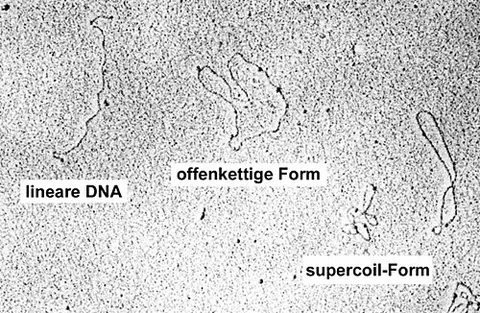
plasmid noun: a loop of double-stranded DNA that is separate from — and replicates independently of — the chromosomes; such loops are most commonly found in bacteria, but they are also sometimes found in archaeans and eukaryotic cells, and they are used in genetic engineering as a vector for gene transfer.

Noun
plasmid (plural plasmids)
- A loop of double-stranded DNA that is separate from — and replicates independently of — the chromosomes; such loops are most commonly found in bacteria, but they are also sometimes found in archaeans and eukaryotic cells, and they are used in genetic engineering as a vector for gene transfer.
- These discussions have left a plethora of terms adrift: pangenes, bioblasts, plasmagenes, plastogenes, chondriogenes, cytogenes and proviruses, which have lost their original utility owing to the accretion of vague or contradictory connotations. At the risk of adding to this list, I propose plasmid...1952 October, J. Lederberg, “Cell genetics and hereditary symbiosis”, in Physiological Reviews, volume 32, number 4, page 403
- This is how the F (for "fertility") plasmid, which forms the basis of a lot of classical E. coli genetics, is transferred from one cell to another.1995, Christopher Howe, Gene Cloning and Manipulation, page 144
Examples of plasmid in a sentence
- At the risk of adding to this list, I propose plasmid as a generic term for any extrachromosomal hereditary determinant.1952 October, J. Lederberg, “Cell genetics and hereditary symbiosis”, in Physiological Reviews, volume 32, number 4, page 403:
- Bacteria are happy to absorb little rings of DNA called plasmids and adopt them as their own.1999, Matt Ridley, Genome, Harper Perennial, published 2004, page 247:
- Plasmids have an essential impact on productivity.2004, Karl Friehs, “Plasmid Copy Number and Plasmid Stability”, in M. Beyer, T. Scheper, editors, New Trends and Developments in...
Forms of plasmid
| plural | plasmids |
|---|
Origin of plasmid
From plasma + -id, coined by American molecular biologist Joshua Lederberg in 1952.
Words formed from plasmid
Words that rhyme with plasmid
Questions about plasmid
- What does plasmid mean?
- Plasmid means a loop of double-stranded DNA that is separate from — and replicates independently of — the chromosomes; such loops are most commonly found in bacteria, but they are also sometimes found in archaeans and eukaryotic cells, and they are used in genetic engineering as a vector for gene transfer.
- How do you use plasmid in a sentence?
- At the risk of adding to this list, I propose plasmid as a generic term for any extrachromosomal hereditary determinant.
- What part of speech is plasmid?
- Plasmid is a noun.
- How do you pronounce plasmid?
- Plasmid is pronounced /ˈplæzmɪd/.
- What is the plural of plasmid?
- The plural of plasmid is plasmids.
Words near plasmid in the dictionary
Source and license
Adapted from Wiktionary: plasmid (page history and authors). Text available under the Creative Commons Attribution-ShareAlike 4.0 license. Word.ws reformatted the entry and added links. Wiktionary data of 2026-09-02.
Last updated:
Pronunciation audio from Wikimedia Commons, each file under its own free license: LL-Q1860 (eng)-Vealhurl-plasmid.wav.
Cite this entry: “plasmid.” Word.ws, https://word.ws/plasmid. Based on Wiktionary, CC BY-SA 4.0.