
rime
UK/ɹaɪm/
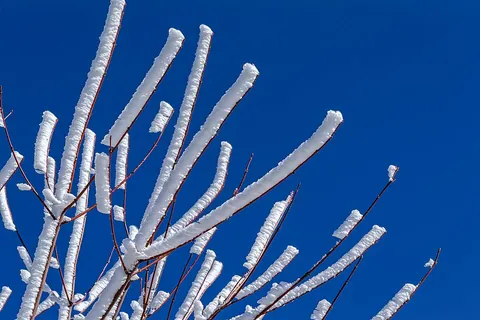
rime noun: archaic in the form rimes: originally, any frozen dew forming a white deposit on exposed surfaces; hoar frost (sense 1). Also the archaic spelling of rhyme.

Noun (1)
rime (countable and uncountable, plural rimes)
- Archaic in the form rimes: originally, any frozen dew forming a white deposit on exposed surfaces; hoar frost (sense 1).
- In a Hoar-Froſt, that vvhich vve call a Rime, is a Multitude of Quadrangular Priſmes, exactly figured, but piled vvithout any Order, one over another.1701, Nehemiah Grew, “Of the Principles of Bodies”, in Cosmologia Sacra: Or A Discourse of the Universe as It is the Creature and Kingdom of God. […], London: […] W[illiam] Rogers, S[amuel] Smith...
- Sylphs! if vvith morn deſtructive Eurus ſprings, / O, claſp the Harebel vvith your velvet vvings; / Screen vvith thick leaves the Jaſmine as it blovvs, / And ſhake the vvhite rime from the ſhuddering Roſe; […]1791, [Erasmus Darwin], “Canto IV”, in The Botanic Garden; a Poem, in Two Parts. […], London: J[oseph] Johnson, […], →OCLC, part I (The Economy of Vegetation), page 204, lines 523–526
- A film or slimy coating.
- White hair as an indication of old age.
- Tales that have the rime of age, / And chronicles of Eld.1839, Henry Wadsworth Longfellow, “Prelude”, in Voices of the Night, Cambridge, Mass.: […] John Owen, →OCLC, page xi
- The cold within him [Ebenezer Scrooge] froze his old features, nipped his pointed nose, shrivelled his cheek, stiffened his gait; made his eyes red, his thin lips blue; and spoke out shrewdly in his grating voice. A frosty rime was on his head, and on his eyebrows, and his wiry chin.1843 December 19, Charles Dickens, “Stave I. Marley’s Ghost.”, in A Christmas Carol. […], London: Chapman & Hall, […], →OCLC, page 3
- Ice formed by the rapid freezing of cold water droplets of fog on to a cold surface.
- Synonyms:
- frost, hoar frost
- A coating or sheet of ice so formed.
- A cold fog or mist.
- When Tommy and Elspeth reached the Den the mist lay so thick that they had to feel their way though it to the Ailie, where they found Gavinia alone and scared. […] "As sure as death," she said, "there was some living thing standing there; I couldna see it for the rime, but I heard it breathing...1896, J[ames] M[atthew] Barrie, “End of the Jacobite Rising”, in Sentimental Tommy: The Story of His Boyhood, London; Paris: Cassell and Company […], →OCLC, page 341
Verb (1)
rime (third-person singular simple present rimes, present participle riming, simple past and past participle rimed)
- To cover (something) with rime (noun etymology 1, noun sense 1 or etymology 1, noun sense 3.1) or (loosely) hoar frost.
- ―No more ſhall hoary Boreas, iſſuing forth / VVith Eurus, lead the tempeſts of the North; / Rime the pale Davvn, or veil'd in flaky ſhovvers / Chill the ſvveet boſoms of the ſmiling Hours.1791, [Erasmus Darwin], “Canto IV”, in The Botanic Garden; a Poem, in Two Parts. […], London: J[oseph] Johnson, […], →OCLC, part I (The Economy of Vegetation), page 186, lines 311–314
- [T]he hoar was a blanching on post and hedge, riming the dykes, […]1933 July, Lewis Grassic Gibbon [pseudonym; James Leslie Mitchell], “Stratus”, in Cloud Howe, London: Jarrolds Publishers […], →OCLC, page 193
- To cover (something) with a thin coating or film; to coat.
- Oh, London, London! […] the mornings silvery gray, and the multitudinous monuments rimed by years, thunder of hoofs in ways without end, and the silence of mighty parks—Bud lay awake in the nights to think of them.1907, Neil Munro, chapter XXXII, in Bud […], New York, N.Y.; London: Harper & Brothers, →OCLC, page 300
- Sometimes followed by up: of a thing: to become covered with rime or (loosely) hoar frost.
Noun (2)
rime (countable and uncountable, plural rimes)
Verb (2)
rime (third-person singular simple present rimes, present participle riming, simple past and past participle rimed)
Verb (3)
rime (third-person singular simple present rimes, present participle riming, simple past and past participle rimed)
Verb (4)
rime (third-person singular simple present rimes, present participle riming, simple past and past participle rimed)
Noun (3)
rime (plural rimes)
- A narrow aperture or opening; a chink, a crack, a fissure; a rent, a rip.
- [T]he ſevvet of oxen […] is alſo good againſt the inflammation of the eares, the ſtupidity and dulneſſe of the teeth, the running of the eyes, the vlcers and rimes of the mouth, and ſtiffneſſe of the neck.1607, Conradus Gesnerus [i.e., Conrad Gessner]; Edward Topsell, “Of Cowes”, in The Historie of Foure-footed Beastes. […], London: […] William Iaggard, →OCLC, page 83
- [T]hough birds have no Epiglottis, yet can they ſo contract the rime or chinck of their Larinx, as to prevent the admiſſion of vvet or dry ingeſted, […]1646, Thomas Browne, “Of the Passage of Meate and Drinke”, in Pseudodoxia Epidemica: […], London: […] T[homas] H[arper] for Edward Dod, […], →OCLC, 4th book, paragraph 10, page 198
Verb (5)
rime (third-person singular simple present rimes, present participle riming, simple past and past participle rimed)
- Followed by into: to probe, to pry.
- Our act was, with finger, and nail, and eye, to rime into every jot of it [a case]; and our words were—'I am sure there is something inside. If not, it would open sensibly.'1877, R[ichard] D[oddridge] Blackmore, “Hermetically Sealed”, in Erema: Or My Father’s Sin […], volume III, London: Smith, Elder, & Co., […], →OCLC, page 55
Also used as
rime is also the archaic spelling of rhyme.
rime meaning in Hindi, Arabic and Indonesian
rime in Hindi
- any frozen dew forming a white deposit on exposed surfaces — see also hoar frost
- तुषार tuṣār
rime in Arabic
- any frozen dew forming a white deposit on exposed surfaces — see also hoar frost
- بَرَد barad
rime in Indonesian
- any frozen dew forming a white deposit on exposed surfaces — see also hoar frost
- rime
Examples of rime in a sentence
- And moonlight splendour of intensest rime, / With which frost paints the pines in winter time.1820 (date written), Percy Bysshe Shelley, “The Witch of Atlas”, in Mary W[ollstonecraft] Shelley, editor, Posthumous Poems of Percy Bysshe...
- The night had been heavy and lowering: but towards the morning it had changed to a slight frost: and the ground and the trees were now covered with rime.1821 September–October, [Thomas De Quincey], “[Part I.] Preliminary Confessions.”, in Confessions of an English Opium-Eater, 2nd edition...
- But there are accents sweeter far / When Love leaps down our evening star, / Holds back the blighting wings of Time, / Melts with his breath the crusty rime, […]1846, Walter Savage Landor, “[Miscellaneous.] [Poem] CCXX.”, in The Works of Walter Savage Landor. […], volume II, London: Edward Moxon...
- The raw rimes were not so pernicious as in the hollows, and the frosts were scarcely so severe.1883 March, Thomas Hardy, “The Three Strangers”, in Wessex Tales: Strange, Lively, and Commonplace […], volume I, London; New York, N.Y....
Synonyms of rime
Forms of rime
| Noun | |
|---|---|
| plural | rimes |
| Verb | |
| third-person singular present | rimes |
| present participle | riming |
| past participle | rimed |
| past | rimed |
Origin of rime
The noun is derived from Middle English rim, rime, rym, ryme (“hoar frost; rime”), from Old English hrīm (“frost”), from Proto-West Germanic *hrīm (“rime; hoar frost”), from Proto-Germanic *hrīmą (North Germanic), *hrīmaz, *hrīmô (“rime; hoar frost”), probably from Proto-Indo-European *krey- (“to graze, touch; to streak”). The verb is derived from the noun. (The Old English equivalent, which did not survive into modern English, was behrīman.) Cognates * Middle Dutch riim, rijm, rīm (modern Dutch rijm (“hoar frost”)) * Old Danish *rim (only in rimfrost (“rime frost”); modern Danish rim (“hoar frost”)) * Old French rime, rimee (Middle French rime, rimee (“hoar frost”), Anglo-Norman rime, rimee (“hoar frost”)) * Old High German rīm (Middle High German rīm, Bavarian Reim (“dew; fog; light frost”) (dialectal)) * Old Norse hrím (Icelandic hrím, Norwegian rim (“hoar frost”)) * Old Saxon hrīm * Old Swedish *riim, *rim (only in rimfrost (“rime frost”); modern Swedish rim) * West Frisian rime, rym
A variant of rhyme (noun and verb), from Middle English rim, rime, ryme (“identical sound in words from the vowel in their stressed syllables to their ends; measure, meter, rhythm; song, verse, etc., with rhyming lines”, noun), and Middle English rimen, rymen, rim, rime (“to recite or write verse; to sing songs; to tell a story in verse; to fit into verse; (figurative) to agree, make sense”, verb): see further at rhyme.
From Middle English rimen, rime (“to count, enumerate”) [and other forms], from Old English rīman, rȳman (“to count, number, reckon; to calculate, compute, count up; to enumerate, recount; to account, esteem as”) (rare), from Proto-Germanic *rīmijaną, *rīmaną (“to count, enumerate”), from Proto-Indo-European *(a)rēy- (“to add; to count; to customize; to order, regulate”), possibly from Proto-Indo-European *h₂rey- (“to arrange; to count”), ultimately from *h₂er- (“to fit, put together; to fix; to slot”), and thus a doublet of rhyme.
Words formed from rime
Phrases with rime
Words that rhyme with rime
31 more rhymesFewer rhymes
Questions about rime
- What does rime mean?
- Rime means archaic in the form rimes: originally, any frozen dew forming a white deposit on exposed surfaces; hoar frost (sense 1).
- What is rime in Hindi?
- Rime in Hindi is तुषार (tuṣār). See Rime meaning in Hindi.
- How do you use rime in a sentence?
- And moonlight splendour of intensest rime, / With which frost paints the pines in winter time.
- What part of speech is rime?
- Rime can be a noun or a verb.
- How do you pronounce rime?
- Rime is pronounced /ɹaɪm/ (UK).
- What is the plural of rime?
- The plural of rime is rimes.
Words near rime in the dictionary
Source and license
Adapted from Wiktionary: rime (page history and authors). Text available under the Creative Commons Attribution-ShareAlike 4.0 license. Word.ws reformatted the entry and added links. Wiktionary data of 2026-09-02.
Last updated:
Pronunciation audio from Wikimedia Commons, each file under its own free license: En-us-rhyme.ogg.
Cite this entry: “rime.” Word.ws, https://word.ws/rime. Based on Wiktionary, CC BY-SA 4.0.