
salt
/sɔlt//sɒlt/
salt noun: a common substance, chemically consisting mainly of sodium chloride (NaCl), used extensively as a food ingredient, seasoning, condiment, and preservative.
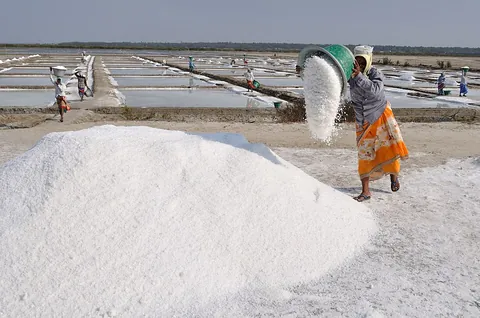

Noun (1)
salt (countable and uncountable, plural salts)
- A common substance, chemically consisting mainly of sodium chloride (NaCl), used extensively as a food ingredient, seasoning, condiment, and preservative.
- Near-synonyms: table salt, rock salt, road salt
- Take gode almaunde mylke y-draw wyth wyn, an let hem boyle to-gederys, an caste þer-to Safroun an Salt; […]1430, Thomas Austin, editor, Two Fifteenth-century Cookery-books. Harleian ms. 279 (ab. 1430), & Harl. ms. 4016 (ab. 1450), with Extracts from Ashmole ms. 1429, Laud ms. 553, & Douce ms. 55 (Early...
- Synonyms:
- common salt, table salt, rock salt, road salt
- One of the compounds formed from the reaction of an acid with a base, where a positive ion replaces a hydrogen of the acid.
- A salt marsh, a saline marsh at the shore of a sea.
- A sailor (also old salt).
- Around the door are generally to be seen, laughing and gossiping, clusters of old salts.1850, Nathaniel Hawthorne, The Scarlet Letter
- I never go as a passenger; nor, though I am something of a salt, do I ever go to sea as a Commodore, or a Captain, or a Cook.1851 November 14, Herman Melville, “chapter 1”, in Moby-Dick; or, The Whale, 1st American edition, New York, N.Y.: Harper & Brothers; London: Richard Bentley, →OCLC
- A sequence of random data added to plain text data (such as passwords or messages) prior to encryption or hashing, in order to make brute force decryption more difficult.
- A person who seeks employment at a company in order to (once employed by it) help unionize it.
- Flavour; taste; seasoning.
- Though we are justices and doctors and churchmen […] we have some salt of our youth in us.c. 1597 (date written), William Shakespeare, “The Merry Wiues of Windsor”, in Mr. William Shakespeares Comedies, Histories, & Tragedies […] (First Folio), London: […] Isaac Iaggard, and Ed[ward]...
- Piquancy; wit; sense.
- Attic salt
- A dish for salt at table; a salt cellar.
- I out and bought some things; among others, a dozen of silver salts.1664 September 18 (date written; Gregorian calendar), Samuel Pepys, Mynors Bright, transcriber, “September 9th, 1664”, in Henry B[enjamin] Wheatley, editor, The Diary of Samuel Pepys […], volume IV...
- Epsom salts or other salt used as a medicine.
- Skepticism and common sense.
- Any politician's statements must be taken with a grain of salt, but his need to be taken with a whole shaker of salt.
- Tears; indignation; outrage; arguing.
- There was so much salt in that thread about the poor casting decision.
- The money demanded by Eton schoolboys during the montem.
Adjective
salt (comparative more salt, superlative most salt)
- Of water: containing salt, saline.
- Why the Sea is Salt
- After a few days of north-west wind, the waters of the Gordon will be found salt for twelve miles up from the bar.1874, Marcus Clarke, For the Term of His Natural Life, Penguin, published 2009, page 97
- Treated with salt as a preservative; cured with salt, salted.
- salt beef
- Philander went into the next room[…]and came back with a salt mackerel that dripped brine like a rainstorm.1913, Joseph C[rosby] Lincoln, chapter VIII, in Mr. Pratt’s Patients, New York, N.Y.; London: D[aniel] Appleton and Company, →OCLC
- Of land, fields etc.: flooded by the sea.
- a salt marsh
- Of plants: growing in the sea or on land flooded by the sea.
- salt grass
- Related to salt deposits, excavation, processing or use.
- a salt mine
- The salt factory is a key connecting element in the seawater infrastructure.
- Bitter; sharp; pungent.
- I have a salt and sorry rheum offends me […].c. 1603–1604 (date written), William Shakespeare, “The Tragedie of Othello, the Moore of Venice”, in Mr. William Shakespeares Comedies, Histories, & Tragedies […] (First Folio), London: […] Isaac...
- Salacious; lecherous; lustful; (of animals) in heat.
- It is impossible you should see this, / Were they as prime as goats, as hot as monkeys, / As salt as wolves in pride, and fools as gross / As ignorance made drunk.c. 1603–1604 (date written), William Shakespeare, “The Tragedie of Othello, the Moore of Venice”, in Mr. William Shakespeares Comedies, Histories, & Tragedies […] (First Folio), London: […] Isaac...
- And when he saw that all the dogs were flocking about her, yarring at the retardment of their accesse to her, and every way keeping such a coyle with her, as they are wont to do about a proud or salt bitch, he forthwith departed […]1653, Thomas Urquhart, transl., The First Book of the works of Mr. Francis Rabelais, Book 2, Chapter 22, p. 153
- Costly; expensive.
Verb
salt (third-person singular simple present salts, present participle salting, simple past and past participle salted)
- To add salt to.
- to salt fish, beef, or pork; to salt the city streets in the winter
- Synonyms:
- salt down
- To deposit salt as a saline solution.
- The brine begins to salt.
- To fill with salt between the timbers and planks for the preservation of the timber.
- To blast metal into (as a portion of a mine) in order to cause to appear to be a productive seam.
- To add bogus evidence to an archaeological site.
- To add certain chemical elements to (a nuclear or conventional weapon) so that it generates more radiation.
- The composition of the fallout can also be changed by "salting" the weapon to be detonated. This consists in the inclusion of significant quantities of certain elements, possibly enriched in specific isotopes, for the purpose of producing induced radioactivity. There are several reasons why a...1964, U.S. Atomic Energy Commission, The Effects of Nuclear Weapons, page 417
- To sprinkle throughout.
- They salted the document with arcane language.
- The Libertarians wish we had won the Vietnamese War, they would like to revoke civil rights legislation, they believe (even though they are supposedly anti-state) in a stronger Pentagon. They are salted with Nixonites, Young Americans for Freedom, John Birchers, Reaganites — in other words the old...1976 December 11, Ronnie Allen, “No Political Eunuch”, in Gay Community News, volume 4, number 24, page 4
- To add filler bytes before encrypting, in order to make brute-force decryption more resource-intensive.
- To sow with salt (of land), symbolizing a curse on its re-inhabitation.
- In this place were put to the ground and salted the houses of José Mascarenhas.
- To lock a page title so it cannot be created.
- To seek employment at a company in order to help unionize it.
- And then there was a different faction of organizers who you call more like “professional activists” or “white leftists,” and they were maybe more privileged, maybe just joined the job to salt for the union.2026 June 2, Alex Skopic, Chris Smalls, “Chris Smalls Is Still Fighting the Bosses”, in Current Affairs
Noun (2)
salt (plural salts)
- A bounding; a leaping; a prance.
- […] he hath the skill to draw
Their nectar forth, with kissing; and could make
More wanton salts from this brave promontory,
Down to this valley, than the nimble roe;1616, Ben Jonson, The Devil Is an Ass, in Gifford’s 1816 edition volume V page 67
- […] he hath the skill to draw
Proper noun (1) capitalized: SALT
SALT
- Acronym of Strategic Arms Limitation Talks.
Noun (3) capitalized: SALT
SALT (plural SALTs)
- Acronym of state and local tax(es) [deduction], a tax deduction whereby some portion of the money paid as taxes to state and local governments is not taxed at the federal level; the tax-deductible portion is nominally capped, but the cap is circumventable via special-interest loopholes.
- Both the SALT limitations and the doubled standard deduction expire after 2025, putting SALT on the 2025 menu for lawmakers.2024 August 9, Andrew Lautz, “How SALT May Shake Up the 2025 Tax Debate”, in Bipartisan Policy Center
- In general, income taxes paid or accrued in carrying on a trade or business or an income-producing activity are subject to the SALT cap. The SALT cap is set to expire for taxable years beginning after December 31, 2025.2025 May, “The One, Big, Beautiful Bill”, in United States House Committee on Ways & Means, page 37
- Acronym of speech and language therapist.
- Acronym of speech and language therapy.
Proper noun (2) capitalized: Salt
Salt (countable and uncountable, plural Salts)
- A village in Salt and Enson parish, Stafford borough, Staffordshire, England (OS grid ref SJ9527).
- A surname.
salt meaning in Hindi, Tamil, Marathi and Urdu
salt in Hindi
- sodium chloride
- नमक namak, लोन lon, लवण lavaṇ, मिल्ह milha
- compound of an acid and a base
- लवण lavaṇ
salt in Tamil
- sodium chloride
- உப்பு uppu, லவண lavaṇa
- salty
- உப்பாக uppāka, உவர்ப்பு uvarppu, உப்பு கரிக்க uppu karikka
- saline
- உப்பாக uppāka, உவர்ப்பு uvarppu
- to add salt to
- உப்பு சேர் uppu cēr, உப்பிடு uppiṭu
salt in Marathi
- sodium chloride
- मीठ mīṭh, लवण lavaṇ, लोण loṇ
- compound of an acid and a base
- क्षार kṣār
salt in Urdu
- sodium chloride
- نَمَک namak
More languagesFewer languages
- salt in Bengali
- নুন nun, লবণ lobon
- salt in Telugu
- ఉప్పు uppu, లవణం lavaṇaṁ
- salt in Malayalam
- ഉപ്പ് uppŭ, ലവണം lavaṇaṁ
- salt in Kannada
- ಉಪ್ಪು uppu, ಲವಣ lavaṇa
- salt in Punjabi
- ਨਮਕ namak, ਲੂਣ lūṇ, ਲਵਣ lavaṇ, ਨਮਕੀਨ namkīn
- salt in Gujarati
- મીઠું mīṭhũ, લૂણ lūṇ, લવણ lavaṇ
- salt in Odia
- ଲୁଣ luṇa
- salt in Sanskrit
- लवण lavaṇa
- salt in Sinhala
- ලුණු luṇu, ලවණ lawaṇa
- salt in Assamese
- লোণ lün, নিমখ nimokh
- salt in Nepali
- नून nūna, लवण lawaṇ
- salt in Pashto
- مالګه mālga
- salt in Tagalog
- asin
- salt in Arabic
- مِلْح milḥ, ملح malḥ, مَلَّحَ mallaḥa
- salt in Malay
- garam
- salt in Indonesian
- garam
- salt in Persian
- نَمَک namak
- salt in Thai
- เกลือ glʉʉa
- salt in Vietnamese
- muối
- salt in Myanmar
- ဆား hca:
- Sindhi
- لوُڻُ luurnu
- Dhivehi
- ލޮނު lonu
- Dzongkha
- ཚྭ tshwa
Examples of salt in a sentence
- Common salt, chloride of sodium, appears to be essential to the life of the higher animals.1880, Arthur Herbert Church, Food: Some Account of Its Sources, Constituents and Uses, London: Chapman and Hall, page 24:
- Tears, he knew, would cost his body salt.2013, Bear Grylls, True Grit: the Epic True Stories of Heroism and Survival That Have Shaped My Life, →ISBN, page 9:
- The composition of the fallout can also be changed by "salting" the weapon to be detonated.1964, U.S. Atomic Energy Commission, The Effects of Nuclear Weapons, page 417:
- They are salted with Nixonites, Young Americans for Freedom, John Birchers, Reaganites — in other words the old Joe McCarthy gang again.1976 December 11, Ronnie Allen, “No Political Eunuch”, in Gay Community News, volume 4, number 24, page 4:
Synonyms of salt
Antonyms
Forms of salt
| Noun | |
|---|---|
| plural | salts |
| plural | SALTs |
| Adjective | |
| comparative | more salt |
| superlative | most salt |
| Verb | |
| third-person singular present | salts |
| present participle | salting |
| past participle | salted |
| past | salted |
| Proper noun | |
| plural | Salts |
Origin of salt
PIE word *sḗh₂l From Middle English salt, from Old English sealt, from Proto-West Germanic *salt, from Proto-Germanic *saltą, from Proto-Indo-European *sḗh₂l (“salt”). Doublet of sal, salary, and salsa, all ultimately from Latin sāl (“salt”), which it superseded as the general term for "salt". Cognate with Dutch zout, German Salz, Danish, Faroese, Icelandic, Norwegian Bokmål, Norwegian Nynorsk, and Swedish salt.
Borrowed from Latin saltus.
From Middle English [Term?], from Old English Selte. Compare Salter. The Staffordshire village was recorded as Selte in 1086 (DB), for a salt pit or saltworks.
Words formed from salt
- Saltaire
- Salt and Enson
- add salt to injury
- antisalt
- besalted
- bisalt
- black salt
- blacksalter
- bread and salt
- cerebral salt-wasting syndrome
- hydrosalt
- kitchen salt
- lay salt on someone's tail
- nonsalt
- old salt
- oversalt
- oxysalt
- pepper and salt
- persalt
- polysalt
- protosalt
- resalt
- salt and chilli chips
- salt and pepper chips
- salt-and-pepper noise
- saltbox
- saltbush
- saltcat
- salt cave
- Salt Coates
- salt coffee
- salt daddy
- salt eel
- saltery
- saltfish
- saltfoot
- Saltford
- saltfree
- salt-free
- saltgrass
- salthouse
- saltie
- saltine
- saltish
- salt lamp
- saltland
- saltless
- saltlike
- saltly
- saltmaker
- saltmaking
- salt marsh elder
- saltmonger
- saltmouth
- salt myrtle
- salt-myrtle
- salt of wisdom
- saltometer
- saltproof
- salt stick
Phrases with salt
- salt up
- bay salt
- Salt Ash
- salt box
- salt cat
- Salt Cay
- salt cod
- salt hay
- salt out
- salt pan
- salt pig
- Salt Sea
173 more phrasesFewer phrases
- sea salt
- bath salt
- bile salt
- gold salt
- hair salt
- pink salt
- road salt
- rock salt
- salt acid
- salt away
- salt beef
- salt cake
- salt clay
- salt cods
- salt dome
- salt down
- salt flat
- salt hays
- Salt Hill
- salt junk
- salt lake
- salt lick
- salt line
- salt meat
- salt mine
- salt pans
- salt pigs
- salt pork
- salt tree
- Attic salt
- Epsom salt
- flake salt
- fruit salt
- green salt
- horse salt
- inner salt
- mixed salt
- pound salt
- salt beefs
- salt boxes
- salt cakes
- salt caves
- salt cedar
- salt chuck
- Salt Creek
- salt domes
- salt dough
- salt flats
- salt gland
- salt glaze
- salt grass
- salt horse
- Salt Laker
- salt lakes
- salt lamps
- salt licks
- salt lines
- Salt March
- salt marsh
- salt meats
- salt mines
- salt porks
- salt rheum
- Salt River
- salt spoon
- salt spray
- salt trees
- salt truck
- salt water
- salt wedge
- salt works
- table salt
- throw salt
- white salt
- amphid salt
- butter salt
- celery salt
- common salt
- double salt
- garlic salt
- kosher salt
- pounds salt
- salt bottom
- salt bridge
- salt cedars
- salt cellar
- salt chucks
- salt doughs
- salt garden
- salt glands
- salt glazes
- salt horses
- Salt Island
- Salt Lakers
- salt of tin
- salt rheums
- salt shaker
- salt spoons
- salt sprays
- salt sticks
- salt trucks
- salt waters
- salt wedges
- sulfur salt
- acid of salt
- baker's salt
- chicken salt
- Frémy's salt
- hei hei salt
- mineral salt
- organic salt
- pounded salt
- salt bottoms
- salt bridges
- salt cellars
- salt daddies
- salt gardens
- salt glacier
- salt grasses
- salt marshes
- salt of soda
- salt shakers
- sulphur salt
- bronzing salt
- Glaser's salt
- Monsel's salt
- pinch of salt
- pounding salt
- prunella salt
- Rochelle salt
- salt glaciers
- salt of amber
- salt of lemon
- salt of Venus
- salt sedative
- salt the mine
- sedative salt
- smelling salt
- Tutton's salt
- above the salt
- below the salt
- diazonium salt
- essential salt
- Glauber's salt
- hartshorn salt
- Himalayan salt
- koshering salt
- not worth salt
- Salt Lake City
- salt marsh hay
- salt of Saturn
- salt of sorrel
- salt of tartar
- salt tectonics
- salt the earth
- spirit of salt
- syntactic salt
- dishwasher salt
- Great Salt Lake
- Meerwein's salt
- pinches of salt
- polychrest salt
- salt and pepper
- salt marsh hays
- salt marsh moth
- salt of vitriol
- salt spray test
- salt substitute
- Schlippe's salt
- spirits of salt
- covenant of salt
- microcosmic salt
- Salt Lake County
Words that rhyme with salt
Questions about salt
- What does salt mean?
- Salt means a common substance, chemically consisting mainly of sodium chloride (NaCl), used extensively as a food ingredient, seasoning, condiment, and preservative.
- What is salt in Hindi?
- Salt in Hindi is नमक (namak), लोन (lon), लवण (lavaṇ). See Salt meaning in Hindi.
- How do you use salt in a sentence?
- Common salt, chloride of sodium, appears to be essential to the life of the higher animals.
- What part of speech is salt?
- Salt can be a noun, an adjective, a verb or a proper noun.
- How do you pronounce salt?
- Salt is pronounced /sɒlt/ (UK).
- What is the plural of salt?
- The plural of salt is salts.
Words near salt in the dictionary
Source and license
Adapted from Wiktionary: salt (page history and authors); SALT (page history and authors); Salt (page history and authors). Text available under the Creative Commons Attribution-ShareAlike 4.0 license. Word.ws reformatted the entry and added links. Wiktionary data of 2026-09-02.
Last updated:
Pronunciation audio from Wikimedia Commons, each file under its own free license: En-uk-salt.ogg, en-us-salt.ogg.
Cite this entry: “salt.” Word.ws, https://word.ws/salt. Based on Wiktionary, CC BY-SA 4.0.