
shunga
/ˈʃʊŋə/
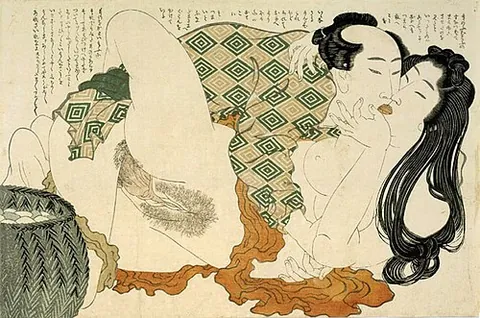
shunga noun: a style of Japanese erotic art.

Noun
shunga (uncountable)
- A style of Japanese erotic art
- The works confound stereotypes of Japanese etiquette, even as they update the tradition of the anatomically explicit shunga print.2007 October 12, Roberta Smith, “Art in Review”, in New York Times
Adjective capitalized: Shunga
Shunga (not comparable)
- Of or relating to the ancient Indian Shunga Empire that flourished between 187 and 78 B.C.E.
- Under Shunga patronage, the core of the Great Stupa, thought to date from the era of the Mauryan emperor Ashoka (r. ca. 273–232 B.C.), was enlarged to its present diameter of 120 feet, covered with a stone casing, topped with a balcony and umbrella, and encircled with a stone railing.2000, “Shunga Dynasty (ca. 2nd–1st century B.C.)”, in The Metropolitan Museum of Art
Origin of shunga
From Japanese 春画, from Middle Chinese 春 (t͡ʃʰwin "spring", by extension "sexual", "erotic") + 畫 (hwɛ̀ "painting").
Possibly from Sanskrit शुङ्ग (śuṅga, “fig tree”).
Questions about shunga
- What does shunga mean?
- Shunga means a style of Japanese erotic art.
- What part of speech is shunga?
- Shunga can be a noun or an adjective.
- How do you pronounce shunga?
- Shunga is pronounced /ˈʃʊŋə/.
Words near shunga in the dictionary
Source and license
Adapted from Wiktionary: shunga (page history and authors); Shunga (page history and authors). Text available under the Creative Commons Attribution-ShareAlike 4.0 license. Word.ws reformatted the entry and added links. Wiktionary data of 2026-09-02.
Last updated:
Cite this entry: “shunga.” Word.ws, https://word.ws/shunga. Based on Wiktionary, CC BY-SA 4.0.