
sinew
Syllables: sin·ewUK/ˈsɪnjuː/
More pronunciations (1)Fewer pronunciations
Multicultural London English/ˈsɪny/
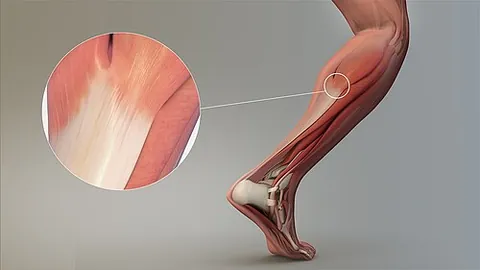
sinew noun: a cord or tendon of the body.

Noun
sinew (plural sinews)
- A cord or tendon of the body.
- A cord or string, particularly (music) as of a musical instrument.
- Muscular power, muscle; nerve, nervous energy; vigor, vigorous strength.
- That which gives strength or in which strength consists; a supporting factor or member; mainstay.
- [S]he loſt a noble and renowned brother, in his loue toward her, euer moſt kinde and naturall: with him the portion and ſinew of her fortune, her marriage dowry: with both, her combynate-husband, this well-ſeeming Angelo.c. 1603–1604 (date written), William Shakespeare, “Measure for Measure”, in Mr. William Shakespeares Comedies, Histories, & Tragedies […] (First Folio), London: […] Isaac Iaggard, and Ed[ward]...
- The Bodies of Men, Munition, and Mony may justly be called the ſinews of War, yet of them the two firſt are more neceſſary, for Men and Arms have means to find Mony and Meate: but Mony and Meate cannot ſo eaſily find Soldiers and ſwords.1658, Walter Raleigh, “A Collection of Political Observations (Confirmed by Reason and Experience) Advertising Princes, Statesmen, and Private Persons how to Demean Themselves in All Fortunes and...
- A nerve.
Verb
sinew (third-person singular simple present sinews, present participle sinewing, simple past and past participle sinewed)
- To knit together or make strong with, or as if with, sinews.
- And now to London with Triumphant march, / There to be crowned Englands Royall King: / From whence, ſhall Warwicke cut the Sea to France, / And aske the Ladie Bona for thy Queene: / So ſhalt thou ſinow both theſe Lands together, / And hauing France thy Friend, thou ſhalt not dread / The ſcattred...c. 1591–1592 (date written), William Shakespeare, “The Third Part of Henry the Sixt, […]”, in Mr. William Shakespeares Comedies, Histories, & Tragedies […] (First Folio), London: […] Isaac Iaggard...
- [I]t were to be wiſhed that we tried the restrictive arts of government, and made law the protector, but not the tyrant of the people. […] [W]e ſhould then find that wretches, now ſtuck up for long tortures, left luxury ſhould feel a momentary pang, might, if properly treated, ſerve to ſinew the...1766, [Oliver Goldsmith], “The Same Subject Continued”, in The Vicar of Wakefield: […], volume II, Salisbury, Wiltshire: […] B. Collins, for F[rancis] Newbery, […], →OCLC, page 123
sinew meaning in Hindi, Tamil, Urdu and Bengali
sinew in Hindi
- sinew
- ताँत tā̃t, पेशी peśī
sinew in Tamil
- குடைவு, குழிப்பை, குழிவு, தசைக்கட்டு, பொறை
sinew in Urdu
- sinew, tendon, ligament
- نس nas
sinew in Bengali
- পেশীবন্ধনী, টেন্ডন, শক্তির উৎস
More languagesFewer languages
- sinew in Telugu
- నరము naramu, నాడి nāḍi
- sinew in Malayalam
- തന്തു, നാഡി, ബലം, സ്നായു
- sinew in Kannada
- ನರಕಟ್ಟು, ಕಸುವು
- sinew in Sanskrit
- स्नावन् snā́van, स्नायु snā́yu, स्नसा snasā, गुण guṇá
Forms of sinew
| Noun | |
|---|---|
| plural | sinews |
| alternative form | sinnew |
| Verb | |
| third-person singular present | sinews |
| present participle | sinewing |
| past participle | sinewed |
| past | sinewed |
Origin of sinew
From Middle English synwe, synewe (“tendon; ligament or other connective tissue; muscle; nerve; leaf vein”), from Old English sinu (“tendon, sinew; nerve”), from Proto-West Germanic *sinu, from Proto-Germanic *sinwō, from Proto-Indo-European *snéh₁wr̥ (“sinew, tendon”), from *(s)neh₁- (“to twist (threads), spin, weave”). The word is cognate with sinnow (“sinew”), Scots senon, sinnon, Saterland Frisian Siene (“sinew”), West Frisian senuw, sine (“sinew; nerve”), Dutch zeen (“sinew”), Dutch zenuw (“nerve”), German Sehne (“tendon, sinew; cord”), Icelandic sin (“tendon”), Danish sene (“tendon, sinew”), Swedish sena (“sinew”), Avestan 𐬯𐬥𐬁𐬎𐬎𐬀𐬭 (snāuuar, “tendon, sinew”), Ancient Greek νεῦρον (neûron, “tendon; nerve; cord”), Latin nervus (“tendon, sinew; nerve”), Sanskrit स्नावन् (snāván, “sinew, tendon; muscle”), Tocharian B ṣñor (“sinew”). Doublet of nerve and neuron.
Words formed from sinew
Questions about sinew
- What does sinew mean?
- Sinew means a cord or tendon of the body.
- What is sinew in Hindi?
- Sinew in Hindi is ताँत (tā̃t), पेशी (peśī). See Sinew meaning in Hindi.
- What part of speech is sinew?
- Sinew can be a noun or a verb.
- How do you pronounce sinew?
- Sinew is pronounced /ˈsɪnjuː/ (UK).
- What is the plural of sinew?
- The plural of sinew is sinews.
Words near sinew in the dictionary
Source and license
Adapted from Wiktionary: sinew (page history and authors); ताँत (Hindi) (page history and authors); sinew (Tamil Wiktionary) (page history and authors); نس (Urdu) (page history and authors); sinew (Bengali Wiktionary) (page history and authors); నరము (Telugu) (page history and authors); sinew (Malayalam Wiktionary) (page history and authors); sinew (Kannada Wiktionary) (page history and authors); गुण (Sanskrit) (page history and authors). Text available under the Creative Commons Attribution-ShareAlike 4.0 license. Word.ws reformatted the entry and added links. Wiktionary data of 2026-09-02.
Last updated:
Pronunciation audio from Wikimedia Commons, each file under its own free license: en-au-sinew.ogg.
Cite this entry: “sinew.” Word.ws, https://word.ws/sinew. Based on Wiktionary, CC BY-SA 4.0.