
thiamazole
UK/θʌɪˈam.ə.zəʊl/US/θaɪˈæm.əˌzoʊl/
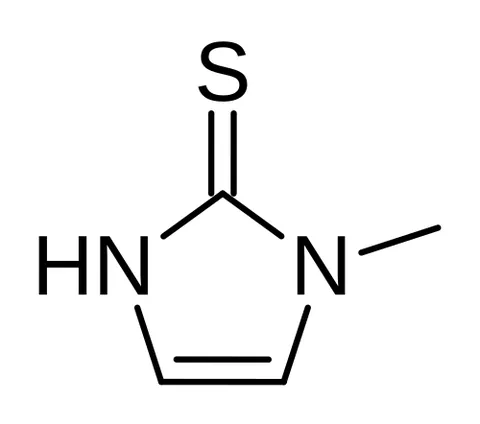
thiamazole noun: an imidazole derivative that interferes with the synthesis of thyroid hormone and is given orally in the treatment of hyperthyroidism; 1-methylimidazole-2-thiol, C₃H₂N₂(CH₃)(SH).

Noun
thiamazole (uncountable)
- An imidazole derivative that interferes with the synthesis of thyroid hormone and is given orally in the treatment of hyperthyroidism; 1-methylimidazole-2-thiol, C₃H₂N₂(CH₃)(SH).
Forms of thiamazole
| alternative form | methimazole |
|---|
Origin of thiamazole
From thia- + (i)m(id)azole.
Questions about thiamazole
- What does thiamazole mean?
- Thiamazole means an imidazole derivative that interferes with the synthesis of thyroid hormone and is given orally in the treatment of hyperthyroidism; 1-methylimidazole-2-thiol, C₃H₂N₂(CH₃)(SH).
- What part of speech is thiamazole?
- Thiamazole is a noun.
- How do you pronounce thiamazole?
- Thiamazole is pronounced /θʌɪˈam.ə.zəʊl/ (UK).
Words near thiamazole in the dictionary
Source and license
Adapted from Wiktionary: thiamazole (page history and authors). Text available under the Creative Commons Attribution-ShareAlike 4.0 license. Word.ws reformatted the entry and added links. Wiktionary data of 2026-09-02.
Last updated:
Cite this entry: “thiamazole.” Word.ws, https://word.ws/thiamazole. Based on Wiktionary, CC BY-SA 4.0.