
Trianon
/ˈtɹiːəˌnɒn/
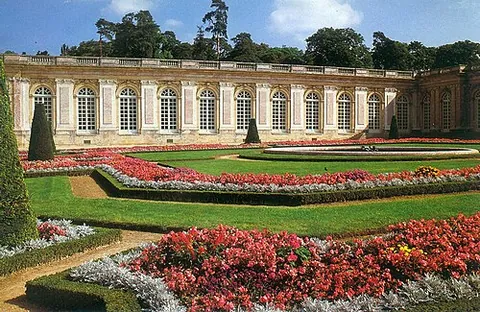
Trianon noun: either of the Grand Trianon and Petit Trianon, two royal palaces constructed in Versailles, France, in the 17th and 18th centuries.

Noun
Trianon (plural Trianons)
- Either of the Grand Trianon and Petit Trianon, two royal palaces constructed in Versailles, France, in the 17th and 18th centuries.
- The Treaty of Trianon, a peace treaty signed in the Grand Trianon on 4 June 1920, which formally ended World War I between most of the Allies and the Kingdom of Hungary, leaving Hungary as a landlocked state with less than one-third of its prewar area.
Forms of Trianon
| plural | Trianons |
|---|
Origin of Trianon
From French Trianon, the name of a hamlet that formerly occupied the site on which the Grand Trianon would be built.
Questions about Trianon
- What does Trianon mean?
- Trianon means either of the Grand Trianon and Petit Trianon, two royal palaces constructed in Versailles, France, in the 17th and 18th centuries.
- What part of speech is Trianon?
- Trianon is a noun.
- How do you pronounce Trianon?
- Trianon is pronounced /ˈtɹiːəˌnɒn/.
- What is the plural of Trianon?
- The plural of Trianon is Trianons.
Words near Trianon in the dictionary
Source and license
Adapted from Wiktionary: Trianon (page history and authors). Text available under the Creative Commons Attribution-ShareAlike 4.0 license. Word.ws reformatted the entry and added links. Wiktionary data of 2026-09-02.
Last updated:
Pronunciation audio from Wikimedia Commons, each file under its own free license: LL-Q1860 (eng)-Flame, not lame-Trianon.wav.
Cite this entry: “Trianon.” Word.ws, https://word.ws/trianon. Based on Wiktionary, CC BY-SA 4.0.