
wolf
/wʊlf//wʊlf/
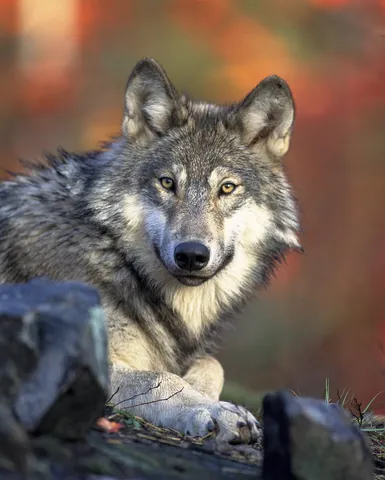
wolf noun: canis lupus; the largest wild member of the canine subfamily.

Noun
wolf (plural wolves)
- Canis lupus; the largest wild member of the canine subfamily.
- He would listen quietly at meetings of the Politburo, or to distinguished visitors, puffing at his Dunhill pipe, doodling aimlessly - his secretaries Poskrebyshev and Dvinsky write that his pads were sometimes covered with the phrase ‘Lenin-teacher-friend’, but the last foreigner to visit him, in...1968, Robert Conquest, “The Purge Begins”, in The Great Terror: Stalin's Purge of the Thirties, Macmillan Company, →LCCN, →OCLC, →OL, page 74
- Synonyms:
- grey wolf
- Any of several related canines that resemble Canis lupus in appearance, especially those of the genus Canis.
- A man who makes amorous advances to many women.
- A wolf tone or wolf note.
- The soft violin solo was marred by persistent wolves.
- Any very ravenous, rapacious, or destructive person or thing; especially, want; starvation.
- They toiled hard to keep the wolf from the door.
- the bee wolf
- One of the destructive, and usually hairy, larvae of several species of beetles and grain moths.
- A white worm which infests granaries, the larva of Nemapogon granella, a tineid moth.
- A wolf spider (Lycosidae spp.).
- An eating ulcer or sore. See lupus.
- If God should send a cancer upon thy face, or a wolf into thy side1651, Jer[emy] Taylor, The Rule and Exercises of Holy Living. […], 2nd edition, London: […] Francis Ashe […], →OCLC
- A willying machine, that uses willow twigs to cleanse wool.
- The loosening and purifying of the raw cotton from the various impurities , such as sand, grit, &c., is accomplished by beating with the hand, or by the Wolf machine, by means of a cylinder, the surface of which is covered with sharp iron teeth1872, Johann Rudolph von Wagner, A handbook of Chemical Technology
Verb
wolf (third-person singular simple present wolfs, present participle wolfing, simple past and past participle wolfed)
- To devour; to gobble; to eat (something) voraciously.
- "Here's these legal ferrets has got our Puddin' in their clutches, and here's us, spellbound with anguish, watchin' them wolfin' it."1918, Norman Lindsay, The Magic Pudding, Sydney: Angus and Robertson, page 150
- After a wolfed burger dinner, I called the night number at Administrative Vice and inquired about known lesbian gathering places.1987, James Ellroy, The Black Dahlia
- To make amorous advances to many women; to hit on women; to cruise for sex.
- [1940s Chicago punk:] ‘I’ve seen a thing or two in my time,’ he still liked to boast, ‘that was how I found out the best place for wolfin’ ain’t the taverns. It ain’t in dance halls ’r on North Clark on Saturday night. It’s in the front row in Sunday school on Sunday mornin’. Oh yeh, I know a thing...1949, Nelson Algren, The Man with the Golden Arm
- To hunt for wolves.
Proper noun (1) capitalized: Wolf
Wolf
- The constellation Lupus.
Proper noun (2) capitalized: Wolf
Wolf (plural Wolfs)
- A surname transferred from the given name.
- A male given name.
wolf meaning in Hindi, Tamil, Marathi and Urdu
wolf in Hindi
- animal
- भेड़िया bheṛiyā, वृक vŕk
wolf in Tamil
- animal
- ஓநாய் ōnāy
wolf in Marathi
- animal
- लांडगा lāṇḍgā, वृक vŕk
wolf in Urdu
- animal
- بھیڑِیا bheṛiyā, گُرْگ gurg
More languagesFewer languages
- wolf in Bengali
- নেকড়ে nekoṛe
- wolf in Telugu
- తోడేలు tōḍēlu
- wolf in Malayalam
- ചെന്നായ് cennāyŭ
- wolf in Kannada
- ತೋಳ tōḷa
- wolf in Punjabi
- ਬਘਿਆੜ baghiāṛa, بَگِھیاڑ baghieyāṛ
- wolf in Gujarati
- ભેડીયો bheḍīyo
- wolf in Odia
- ଗଧିଆ gadhiā
- wolf in Sanskrit
- वृक vṛka, श्वक śvaka
- wolf in Sinhala
- වෘකයා wr̥kayā
- wolf in Assamese
- কুকুৰনেচীয়া বাঘ kukurnesia bagh
- wolf in Nepali
- ब्वाँसो bwā̃so
- wolf in Pashto
- لېوه lewë, شرمښ šërmëẍ
- wolf in Tagalog
- lobo
- wolf in Arabic
- ذِئْب ḏiʔb, ديب dīb, ذيب ḏīb, اِلْتَهَمَ بِشَرَاهَة iltahama bi-šarāha
- wolf in Malay
- serigala, zib
- wolf in Indonesian
- serigala
- wolf in Persian
- گُرْگ gurg
- wolf in Thai
- หมาป่า mǎa-bpàa, สุนัขป่า sù-nák-bpàa, ขม้ำ khà màhm, สวาปาม swáá bpaam
- wolf in Vietnamese
- sói, chó sói
- wolf in Myanmar
- ဝံပုလွေ wampu.lwe
- Kashmiri
- رامہٕ ہوٗن rāmhụ hūn
Examples of wolf in a sentence
- Vicars seated himself and began wolfing a sandwich.2013, Neil Martin, Collected Stories of the Sea:
- [1940s Chicago punk:] ‘I’ve seen a thing or two in my time,’ he still liked to boast, ‘that was how I found out the best place for wolfin’ ain’t the taverns.1949, Nelson Algren, The Man with the Golden Arm:
Synonyms of wolf
Forms of wolf
| Noun | |
|---|---|
| plural | wolves |
| Verb | |
| third-person singular present | wolfs |
| present participle | wolfing |
| past participle | wolfed |
| past | wolfed |
| alternative form (rare) | wolve |
| Proper noun | |
| plural | Wolfs |
Origin of wolf
Inherited from Middle English wolf, from Old English wulf, ƿulf, from Proto-West Germanic *wulf, from Proto-Germanic *wulfaz, from Proto-Indo-European *wĺ̥kʷos. Doublet of lobo and lupus. Cognates Cognate with Scots wouf, North Frisian wulew, Saterland Frisian and German Low German Wulf, West Frisian, Alemannic German, and Dutch wolf, Bavarian bolf, bölf, Woif, Cimbrian and Mòcheno bolf, German Wolf, Luxembourgish Wollef, Vilamovian wuf, Yiddish וואָלף (volf), Danish, Norwegian Bokmål, and Norwegian Nynorsk ulv, Faroese úlvur, Icelandic úlfur, Swedish ulf, ulv, Gothic 𐍅𐌿𐌻𐍆𐍃 (wulfs); also Irish and Scottish Gaelic olc (“bad, evil”), Lepontic 𐌖𐌋𐌊𐌏𐌔 (ulkos), Manx olk (“bad”), Sanskrit वृक (vṛ́ka), Persian گرگ (gorg), Latgalian vylks, Latvian vìlks, Lithuanian vilkas, Belarusian воўк (vowk), Bulgarian вълк (vălk), Czech and Slovak vlk, Macedonian and Russian волк (volk), Polish wilk, Serbo-Croatian вук, vuk, Slovene volk, Ukrainian вовк (vovk), Albanian ujk, ulk, Latin lupus, Greek λύκος (lýkos), Hittite 𒉿𒀠𒆪𒉿𒀸, Lydian 𐤥𐤠𐤩𐤥𐤤 (walwe, “lion”), Tocharian B walkwe.
From wolf.
From Middle English and German short forms of given names containing the Germanic element "wolf".
Words formed from wolf
- aard-wolf
- aardwolf
- antiwolf
- aphid wolves
- Arctic wolf spider
- Armbruster's wolf
- Beowulf
- Big Bad Wolf
- brush wolf
- buy wolf tickets
- coywolf
- cry wolf
- demiwolf
- Desertas wolf spider
- dire wolf
- earthwolf
- eastern wolf
- Ethelwolf
- folf
- folfsky
- Futsing wolf snake
- ghost wolf
- have the wolf by the ear
- he-wolf
- hungry like the wolf
- keep the wolf from the door
- like a wolf on the fold
- Lone Wolf
- maned wolf
- man is a wolf to man
- man-wolf
- merwolf
- mer-wolf
- rabid wolf spider
- raised by wolves
- red wolf
- rye wolf
- seawolf
- sea wolf
- a wolf
- sell wolf tickets
- she-wolf
- the wolf is at the door
- the wolf may lose his teeth but never his nature
- tiger wolf
- werewolf
- were wolf
- were-wolf
- wher-wolf
- white wolf
- who keeps company with the wolf will learn to howl
- wolfaboo
- wolf at the door
- wolf back
- wolf bean
- wolfberry
- wolf call
- wolf-cat
- wolf child
- wolf-child
Phrases with wolf
- wolf up
- bee wolf
- Ezo wolf
- wolf cub
- wolf cut
- wolf dog
- wolf eel
- wolf net
- wolf pup
- gray wolf
- grey wolf
- wolf cubs
133 more phrasesFewer phrases
- wolf cuts
- wolf dogs
- wolf down
- wolf eels
- wolf fish
- wolf hook
- wolf jump
- wolf moon
- wolf nets
- wolf note
- wolf pack
- wolf pups
- wolf tone
- wolf tree
- wolf worm
- aphid wolf
- cried wolf
- cries wolf
- polar wolf
- saw a wolf
- see a wolf
- wolf beans
- wolf calls
- wolf hooks
- wolf jumps
- wolf moons
- wolf notes
- wolf packs
- Wolf Point
- wolf snake
- wolf teeth
- wolf tones
- wolf tooth
- wolf trees
- wolf whelp
- wolf worms
- zebra wolf
- arctic wolf
- crying wolf
- Honshu wolf
- Indian wolf
- seen a wolf
- sees a wolf
- Taimyr wolf
- timber wolf
- tundra wolf
- wolf father
- wolf fishes
- wolf lichen
- Wolf number
- wolf snakes
- wolf spider
- wolf ticket
- wolf whelps
- wolf willow
- African wolf
- Chinese wolf
- Iberian wolf
- Iranian wolf
- Italian wolf
- Mexican wolf
- painted wolf
- prairie wolf
- Tibetan wolf
- wolf fathers
- wolf herring
- wolf in wool
- wolf lichens
- Wolf numbers
- wolf packing
- wolf spiders
- wolf tickets
- wolf warrior
- wolf whistle
- Apennine wolf
- Egyptian wolf
- Hokkaido wolf
- Japanese wolf
- Manitoba wolf
- mountain wolf
- Sakhalin wolf
- seeing a wolf
- wolf children
- wolf herrings
- wolf interval
- wolf warriors
- wolf whistled
- wolf whistles
- Antarctic wolf
- Bernard's wolf
- Ethiopian wolf
- Greenland wolf
- Gregory's wolf
- Himalayan wolf
- Tasmanian wolf
- wolf intervals
- wolf whistling
- Abyssinian wolf
- wolf eliminator
- wolf eliminators
- Alsatian wolf dog
- buys wolf tickets
- Great Plains wolf
- sold wolf tickets
- Alsatian wolf dogs
- Florida black wolf
- rabid wolf spiders
- sells wolf tickets
- African golden wolf
- Alaskan tundra wolf
- Arctic wolf spiders
- bought wolf tickets
- buying wolf tickets
- Futsing wolf snakes
- wolf in one's belly
- wolf of Wall Street
- Falkland Island wolf
- selling wolf tickets
- Desertas wolf spiders
- Falkland Islands wolf
- Interior Alaskan wolf
- wolf in a lamb's skin
- wolf in one's stomach
- had the wolf by the ear
- has the wolf by the ear
- wolf guarding the sheep
- what's the time, Mr Wolf
- wolf in sheep's clothing
- Alexander Archipelago wolf
- having the wolf by the ear
- kept the wolf from the door
- keeps the wolf from the door
- keeping the wolf from the door
Words that rhyme with wolf
Questions about wolf
- What does wolf mean?
- Wolf means canis lupus; the largest wild member of the canine subfamily.
- What is wolf in Hindi?
- Wolf in Hindi is भेड़िया (bheṛiyā), वृक (vŕk). See Wolf meaning in Hindi.
- How do you use wolf in a sentence?
- Vicars seated himself and began wolfing a sandwich.
- What part of speech is wolf?
- Wolf can be a noun, a verb or a proper noun.
- How do you pronounce wolf?
- Wolf is pronounced /wʊlf/ (UK).
- What is the plural of wolf?
- The plural of wolf is wolves.
Words near wolf in the dictionary
Source and license
Adapted from Wiktionary: wolf (page history and authors); Wolf (page history and authors). Text available under the Creative Commons Attribution-ShareAlike 4.0 license. Word.ws reformatted the entry and added links. Wiktionary data of 2026-09-02.
Last updated:
Pronunciation audio from Wikimedia Commons, each file under its own free license: En-uk-a wolf.ogg, En-us-wolf.ogg.
Cite this entry: “wolf.” Word.ws, https://word.ws/wolf. Based on Wiktionary, CC BY-SA 4.0.