Word of the Day:
glaive
What It Means
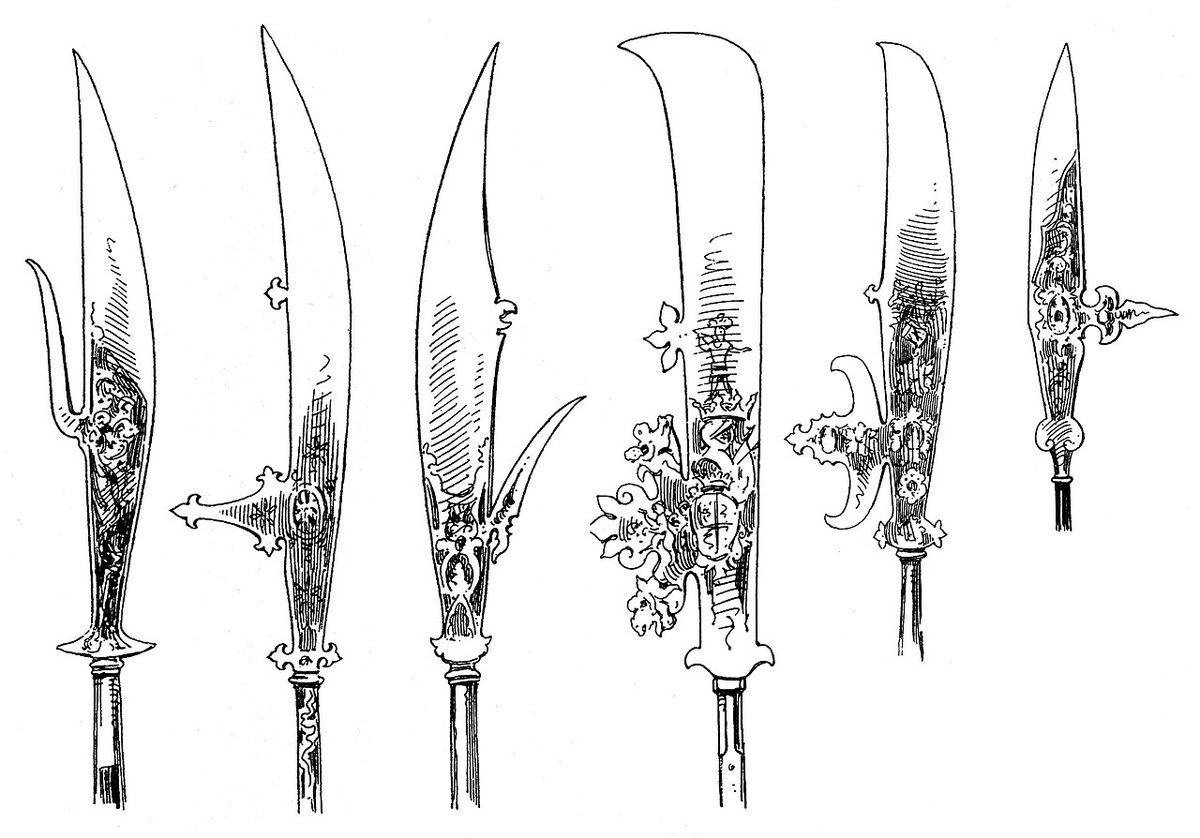
A light lance with a long, sharp-pointed head.
A weapon consisting of a pole with a large blade fixed on the end, the edge of which is on the outside curve.
A sword, particularly a broadsword.
Glaive in Context
“The lance, or glaive as it is often called, of the eleventh and twelfth centuries was quite straight and smooth; a vamplate was added in the fourteenth, small at first but larger later, for the protection of the right arm.”
Did You Know?
From Middle English gleyve (“lance, glaive”), from Old French glaive (“lance; sword”), from Late Latin glavus. The further etymology is uncertain; one possibility is that glavus reflects Latin gladius (“sword”) crossed with clāva (“club”); another is that it derives from a re-crossing of gladius with Proto-Celtic *kladiwos (“sword”); yet another is that it is a borrowing into Late Latin from Old Irish claideb. All of the aforementioned words derive ultimately from Proto-Indo-European *kelh₂- (“to beat; to break”). The Oxford English Dictionary notes that none of these words had the oldest meaning of Old French glaive (“lance”). The English word is cognate with Middle Dutch glavie, glaye (“lance”); Middle High German glavîe, glævîn (“lance”), Swedish glaven (“lance”).
Source and license
Adapted from Wiktionary: glaive (page history and authors). Text available under the Creative Commons Attribution-ShareAlike 4.0 license. Word.ws chose the word and reformatted its meaning, examples and origin.
Cite this entry: “glaive.” Word.ws, https://word.ws/glaive. Based on Wiktionary, CC BY-SA 4.0.