
glaive
/ɡleɪv/
glaive noun: a light lance with a long, sharp-pointed head.

Noun
glaive (plural glaives)
- A light lance with a long, sharp-pointed head.
- The lance, or glaive as it is often called, of the eleventh and twelfth centuries was quite straight and smooth; a vamplate was added in the fourteenth, small at first but larger later, for the protection of the right arm.1919, R[obert] Coltman Clephan, chapter II, in The Tournament: Its Periods and Phases, London: Methuen & Co., […], →OCLC, page 18
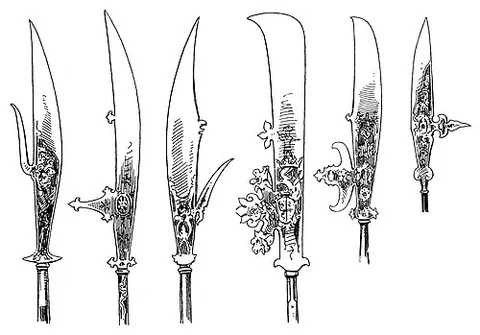
- A weapon consisting of a pole with a large blade fixed on the end, the edge of which is on the outside curve.
- The Welch Glaive is a kind of bill, ſometimes reckoned among the pole axes. They were formerly much in uſe. [...] In the Britiſh Muſeum there is an entry of a warrant, granted to Nicholas Spicer, authoriſing him to impreſs ſmiths for making two thouſand Welch bills or glaives.1786, Francis Grose, A Treatise on Ancient Armour and Weapons, […], London: […] S. Hooper […], →OCLC, page 52
- With the spear comes the use of the shield; yet the San Cristoval spearmen use no such defence, but turn off spears thrown at them with long curved glaives, and the shields in use in Florida are not made in that island.1891, R[obert] H[enry] Codrington, “Arts of Life”, in The Melanesians: Studies in their Anthropology and Folk-lore, Oxford, Oxfordshire: Clarendon Press, →OCLC, page 305
- A sword, particularly a broadsword.
- [T]he glaiue which he did wield / He gan forthwith t'auale, and way vnto me yield.1596, Edmund Spenser, “Book IV, Canto X”, in The Faerie Queene. […], part II (books IV–VI), London: […] [Richard Field] for William Ponsonby, →OCLC, stanza 19, page 144
- Wherefore do you ſo ill tranſlate yourſelf, / Out of the ſpeech of peace, that bears ſuch grace, / Into the harſh and boiſt'rous tongue of war? / Turning your books to glaives, your ink to blood, / Your pens to lances, and your tongue divine / To a loud trumpet, and a point of war?c. 1596–1599, William Shakespear[e], “The Second Part of Henry IV. […]”, in The Works of Mr. William Shakespear, volume III (Consisting of Historical Plays), Oxford, Oxfordshire: […] Clarendon-Press...
glaive meaning in Persian
glaive in Persian
- weapon consisting of a pole with a large blade
- کتاره kattâre, بلارک balârak
Examples of glaive in a sentence
- At that moment Ilane swung the bladed staff—glaive, Kel remembered as it swung, they called it a glaive—in a wide side cut, slicing one pirate across the chest.1999, Tamora Pierce, First Test: A Tortall Legend (Protector of the Small; 1), New York, N.Y.: Ember, Random House Children’s Books...
- Thus furth he drew his truſty glaive, / While thouſands all arround, / Drawn frae their ſheaths glanſt in the ſun, / And loud the bougills ſound.1750, Allan Ramsay, “Hardyknute. A Fragment of an Old Heroic Ballad.”, in The Tea-table Miscellany: Or, A Collection of Choice Songs, Scots...
- Yea, that same awful angel with the glaive / Which in disparadising orbit swept / Lintel and pilaster and architravea. 1908 (date written), Francis Thompson, “[Miscellaneous Odes.] Laus Amara Doloris”, in The Works of Francis Thompson, volume II (Poems)...
Forms of glaive
| plural | glaives |
|---|---|
| alternative form | glave |
| alternative form | gleave |
Origin of glaive
From Middle English gleyve (“lance, glaive”), from Old French glaive (“lance; sword”), from Late Latin glavus. The further etymology is uncertain; one possibility is that glavus reflects Latin gladius (“sword”) crossed with clāva (“club”); another is that it derives from a re-crossing of gladius with Proto-Celtic *kladiwos (“sword”); yet another is that it is a borrowing into Late Latin from Old Irish claideb. All of the aforementioned words derive ultimately from Proto-Indo-European *kelh₂- (“to beat; to break”). The Oxford English Dictionary notes that none of these words had the oldest meaning of Old French glaive (“lance”). The English word is cognate with Middle Dutch glavie, glaye (“lance”); Middle High German glavîe, glævîn (“lance”), Swedish glaven (“lance”).
Words formed from glaive
Words that rhyme with glaive
Questions about glaive
- What does glaive mean?
- Glaive means a light lance with a long, sharp-pointed head.
- What is glaive in Persian?
- Glaive in Persian is کتاره (kattâre), بلارک (balârak). See Glaive meaning in Persian.
- How do you use glaive in a sentence?
- At that moment Ilane swung the bladed staff—glaive, Kel remembered as it swung, they called it a glaive—in a wide side cut, slicing one pirate across the chest.
- What part of speech is glaive?
- Glaive is a noun.
- How do you pronounce glaive?
- Glaive is pronounced /ɡleɪv/ (UK).
- What is the plural of glaive?
- The plural of glaive is glaives.
Words near glaive in the dictionary
Source and license
Adapted from Wiktionary: glaive (page history and authors). Text available under the Creative Commons Attribution-ShareAlike 4.0 license. Word.ws reformatted the entry and added links. Wiktionary data of 2026-09-02.
Last updated:
Pronunciation audio from Wikimedia Commons, each file under its own free license: LL-Q1860 (eng)-I learned some phrases-glaive.wav, En-us-glaive.mp3.
Cite this entry: “glaive.” Word.ws, https://word.ws/glaive. Based on Wiktionary, CC BY-SA 4.0.