
grave
/ɡɹeɪv/
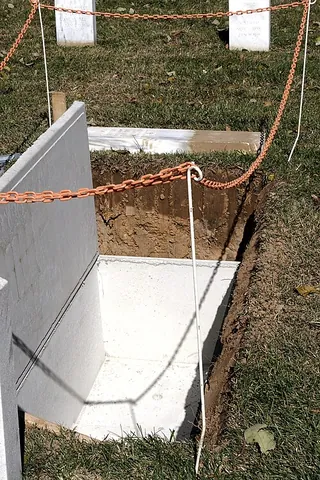
grave noun: an excavation in the earth as a place of burial.

Noun (1)
grave (countable and uncountable, plural graves)
- An excavation in the earth as a place of burial.
- He had lain in the grave four days.1611, The Holy Bible, […] (King James Version), London: […] Robert Barker, […], →OCLC, John 11:17
- Let mee not be ashamed, O Lord, for I haue called vpon thee: let the wicked be ashamed, and let them be silent in the graue.1611, The Holy Bible, […] (King James Version), London: […] Robert Barker, […], →OCLC, Psalms 31:17
- Any place of interment.
- Any place containing one or more corpses.
- Death, destruction.
- […]Meeting is pleasure, parting is a grief; / An inconstant lover is worse than a thief; / A thief can but rob you, and take all you have, / An inconstant lover will bring you to the grave![…]a. 1769, unknown, The Cuckoo, archived from the original on 26 Sep 2019, lines 9–12
- […]balanced on the biggest wave you race towards an early grave.1973, “Breathe”, in Roger Waters (lyrics), David Gilmour and Richard Wright (music), The Dark Side of the Moon, performed by Pink Floyd
- Deceased people; the dead.
- "Hold your jaw, woman! I've had enough to vex me to-day without you startin' your tantrums. You're jealous of the grave. That's wot's the matter with you." "And her brats can insult me as they like - me that 'as cared for you these five years."1925 July – 1926 May, A[rthur] Conan Doyle, “(please specify the chapter number)”, in The Land of Mist (eBook no. 0601351h.html), Australia: Project Gutenberg Australia, published April 2019
Verb (1)
grave (third-person singular simple present graves, present participle graving, simple past graved, past participle graved or graven)
- To dig.
- He hath graven and digged up a pit.1526, [William Tyndale, transl.], The Newe Testamẽt […] (Tyndale Bible), [Worms, Germany: Peter Schöffer], →OCLC, vij:[16]
- To carve or cut, as letters or figures, on some hard substance; to engrave.
- Thou shalt take two onyx stones, and grave on them the names of the children of Israel.1611, The Holy Bible, […] (King James Version), London: […] Robert Barker, […], →OCLC, Exodus 28:9
- Deep lines were graven on her pale forehead, and on her wan, thin cheeks.1872, James De Mille, The Cryptogram, HTML edition, The Gutenberg Project, published 2009
- To carve out or give shape to, by cutting with a chisel; to sculpture.
- to grave an image
- To impress deeply (on the mind); to fix indelibly.
- O! may they graven in thy heart remain.1718, Mat[thew] Prior, “Solomon on the Vanity of the World. A Poem in Three Books.”, in Poems on Several Occasions, London: […] Jacob Tonson […], and John Barber […], →OCLC, (please specify the page)
- To entomb; to bury.
- […]And lie full low, graved in the hollow ground.1595 December 9 (first known performance), William Shakespeare, “The Life and Death of King Richard the Second”, in Mr. William Shakespeares Comedies, Histories, & Tragedies: Published According to...
- To write or delineate on hard substances, by means of incised lines; to practice engraving.
Adjective
grave (comparative graver, superlative gravest)
- Characterised by a dignified sense of seriousness.
- [Mercuti] Ask for me tomorrow, and you shall find me a grave man.c. 1591–1595 (date written), William Shakespeare, “The Tragedie of Romeo and Ivliet”, in Mr. William Shakespeares Comedies, Histories, & Tragedies […] (First Folio), London: […] Isaac Iaggard, and...
- Synonyms:
- austere, solemn, sombre, frightful, demure, serious, earnest, grievous, lack-laughter, thoughtful
- Low in pitch, tone etc.
- The thicker the cord or string, the more grave is the note or tone.1854, John Weeks Moore, Encyclopedia of Music
- Antonyms:
- acute, deep, flat, low-pitched
- Serious, in a negative sense; important, formidable.
- Israel’s behaviour is doing grave damage to the Palestinian people and to any hope for peace.2016 February 6, James Zogby, “Israel’s prickliness blocks the long quest for peace”, in The National
- Khrushchev made a grave miscalculation when he failed to appreciate the growing opposition to his power and overestimated the support of his bureaucracy.2017, Vladimir Shlapentokh, A Normal Totalitarian Society, page 80
- Dull, produced in the middle or back of the mouth. (See Grave and acute on Wikipedia.Wikipedia )
- Influential, important; authoritative.
- An illiterate fool sits in a mans seat; and the common people hold him learned, grave, and wise.1624, Democritus Junior [pseudonym; Robert Burton], The Anatomy of Melancholy: […], 2nd edition, Oxford, Oxfordshire: […] John Lichfield and James Short, for Henry Cripps, →OCLC, partition II...
- Synonyms:
- magisterial, masterful, oracular, sterling
Noun (2)
grave (plural graves)
- A grave accent, the diacritic mark `.
Noun (3)
grave (plural graves)
Verb (2)
grave (third-person singular simple present graves, present participle graving, simple past and past participle graved)
- To clean, as a vessel's bottom, of barnacles, grass, etc., and pay it over with pitch — so called because graves or greaves were formerly used for this purpose.
Noun (4)
grave (plural graves)
- A kilogram.
- At the origin of the metric system the new unit of weight was called the grave, and was equivalent to the kilogram. The denomination grave would in some respects have been preferable to kilogram.1899, John Sturgeon Mackay, Arithmetic Theoretical and Practical, page 117
Proper noun capitalized: Grave
Grave (plural Graves)
- A surname.
grave meaning in Hindi, Tamil, Marathi and Urdu
grave in Hindi
- excavation for burial
- क़ब्र qabra, समाधि samādhi, गोर gor
grave in Tamil
- கல்லறை, சவக்குழி, புதைகுழி, கடுமையான
grave in Marathi
- कबर, कबरी, कबरीला
grave in Urdu
- excavation for burial
- قَبْر qabr, گور gor
More languagesFewer languages
- grave in Bengali
- কবর kobor, সমাধি śomadhi
- grave in Telugu
- సమాధి samādhi
- grave in Malayalam
- കബർ kabaṟ, കബ്ര kabra, പൂത്ത് pūttŭ, കുഴി kuḻi
- grave in Kannada
- ಸಮಾಧಿ, ಗೋರಿ, ಹುದಿಗೆ, ಹೂತೆಡೆ
- grave in Punjabi
- ਕਬਰ kabar, ਗੋਰ gor
- grave in Gujarati
- ગોર gor, કબર kabar
- grave in Odia
- ସମାଧି samādhi
- grave in Sanskrit
- धीर्य dhī́rya
- grave in Assamese
- কবৰ kobor
- grave in Nepali
- चिहान cihān
- grave in Pashto
- قبر qabər
- grave in Tagalog
- malma
- grave in Arabic
- قَبْر qabr, ضَرِيح ḍarīḥ, قبر gabir
- grave in Malay
- pusara, kubur
- grave in Indonesian
- kubur
- grave in Persian
- گور gōr, قَبْر qabr
- grave in Thai
- หลุมฝังศพ lǔm-fǎng-sòp, หลุมศพ lǔm-sòp
- grave in Vietnamese
- mộ, mồ, mả, phần mộ
- grave in Myanmar
- သင်္ချိုင်း sanghkyuing:
Examples of grave in a sentence
- The men went right down to a place in the grass where a grave was dug.1856, Gustave Flaubert, translated by Eleanor Marx-Aveling, Madame Bovary, Part III, Chapter X:
- Shall a man grave his sorrows upon a stone when he hath but need to write them on the water?'1886 October – 1887 January, H[enry] Rider Haggard, She: A History of Adventure, London: Longmans, Green, and Co., published 1887, →OCLC:
Synonyms of grave
30 more synonymsFewer synonyms
Antonyms
Forms of grave
| Noun | |
|---|---|
| plural | graves |
| Verb | |
| third-person singular present | graves |
| present participle | graving |
| past | graved |
| past participle | graved |
| past participle | graven |
| Adjective | |
| comparative | graver |
| superlative | gravest |
| Proper noun | |
| plural | Graves |
Origin of grave
From Middle English grave, grafe, from Old English græf, grafu (“cave, grave, trench”), from Proto-West Germanic *grab, from Proto-Germanic *grabą, *grabō (“grave, trench, ditch”), from Proto-Indo-European *gʰrebʰ- (“to dig, scratch, scrape”). Cognate with West Frisian grêf (“grave”), Dutch graf (“grave”), Low German Graf (“a grave”), Graff, German Grab (“grave”), Danish, Swedish and Norwegian grav (“grave”), Icelandic gröf (“grave”). Related to groove.
From Middle English graven, from Old English grafan (“to dig, dig up, grave, engrave, carve, chisel”), from Proto-Germanic *grabaną (“to dig”), from Proto-Indo-European *gʰrebʰ- (“to dig, scratch, scrape”). Cognate with Dutch graven (“to dig”), German graben (“to dig”), Danish grave (“to dig”), Swedish gräva (“to dig”), Icelandic grafa (“to dig”).
From Middle French grave, a learned borrowing from Latin gravis (“heavy, important”). Compare Old French greve (“terrible, dreadful”). Doublet of grief.
Words formed from grave
- begrave
- beyond the grave
- cold in one's grave
- common grave
- cradle-to-grave
- dance on someone's grave
- dig one's grave with a fork
- dig one's grave with a fork and spoon
- dig one's own grave
- follow to the grave
- cradle to grave
- the cradle to the grave
- gravebound
- grave candle
- graveclothes
- gravedance
- gravedancer
- grave dancer
- grave dancing
- grave-dancy
- gravedigger
- grave digger
- gravedigging
- gravedom
- graveful
- grave good
- grave-good
- grave-goods
- grave goods
- gravekeeper
- grave lantern
- graveless
- gravelike
- grave marker
- gravemound
- grave-rob
- graverobber
- grave robber
- grave-robbing
- graverobbing
- graveside
- gravesite
- gravesome
- gravestead
- gravestone
- graveward
- gravewards
- grave wax
- graveyard
- have one foot in the grave
- ingrave
- mass grave
- one foot in the grave
- on foenem grave
- passage grave
- pauper's grave
- quiet as a grave
- quiet as the grave
- roll in one's grave
- roll over in one's grave
Phrases with grave
- war grave
- accent grave
- grave accent
- watery grave
- grave accents
- grave candles
- grave dancers
- grave diggers
- grave markers
- Grave Mixture
- grave robbers
- grave lanterns
55 more phrasesFewer phrases
- grave as a judge
- silent as a grave
- take to the grave
- took to the grave
- white man's grave
- white men's grave
- taken to the grave
- takes to the grave
- double grave accent
- dug one's own grave
- silent as the grave
- spin in one's grave
- spun in one's grave
- taking to the grave
- turn in one's grave
- digs one's own grave
- double grave accents
- follows to the grave
- from cradle to grave
- rolls in one's grave
- spins in one's grave
- turns in one's grave
- followed to the grave
- rolled in one's grave
- turned in one's grave
- following to the grave
- rolling in one's grave
- some white man's grave
- turning in one's grave
- digging one's own grave
- spinning in one's grave
- turn over in one's grave
- danced on someone's grave
- dances on someone's grave
- rolls over in one's grave
- take someone to the grave
- took someone to the grave
- dancing on someone's grave
- rolled over in one's grave
- taken someone to the grave
- takes someone to the grave
- dug one's grave with a fork
- rolling over in one's grave
- taking someone to the grave
- digs one's grave with a fork
- from the cradle to the grave
- take something to one's grave
- took something to one's grave
- taken something to one's grave
- takes something to one's grave
- digging one's grave with a fork
- taking something to one's grave
- dug one's grave with a fork and spoon
- digs one's grave with a fork and spoon
- digging one's grave with a fork and spoon
Words that rhyme with grave
Questions about grave
- What does grave mean?
- Grave means an excavation in the earth as a place of burial.
- What is grave in Hindi?
- Grave in Hindi is क़ब्र (qabra), समाधि (samādhi), गोर (gor). See Grave meaning in Hindi.
- How do you use grave in a sentence?
- The men went right down to a place in the grass where a grave was dug.
- What part of speech is grave?
- Grave can be a noun, a verb, an adjective or a proper noun.
- How do you pronounce grave?
- Grave is pronounced /ɡɹeɪv/.
- What is the plural of grave?
- The plural of grave is graves.
Words near grave in the dictionary
Source and license
Adapted from Wiktionary: grave (page history and authors); Grave (page history and authors); grave (Tamil Wiktionary) (page history and authors); grave (Marathi, IndicTrans2 machine translation) (model and license); సమాధి (Telugu) (page history and authors); കബ്ര (Malayalam) (page history and authors); grave (Kannada Wiktionary) (page history and authors); ਕਬਰ (Punjabi) (page history and authors); કબર (Gujarati) (page history and authors); ସମାଧି (Odia) (page history and authors); धीर्य (Sanskrit) (page history and authors); चिहान (Nepali) (page history and authors). Text available under the Creative Commons Attribution-ShareAlike 4.0 license. Word.ws reformatted the entry and added links. Wiktionary data of 2026-09-02.
Last updated:
Pronunciation audio from Wikimedia Commons, each file under its own free license: en-us-grave.ogg.
Cite this entry: “grave.” Word.ws, https://word.ws/grave. Based on Wiktionary, CC BY-SA 4.0.