
zero crossing
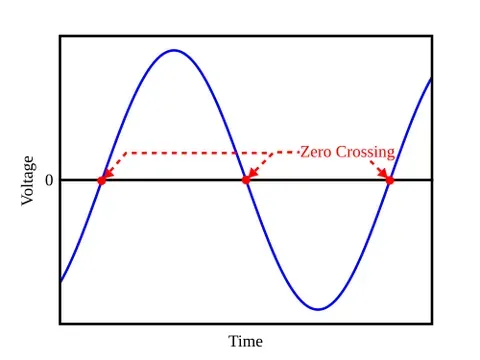
zero crossing noun: a point where a function's graph intersects the x-axis, meaning the function's output (or sign) changes from positive to negative, or vice-versa, passing through zero; used in signal processing, electronics, and audio analysis for tasks like frequency measurement, noise reduction, and differentiating sound types, as it marks significant transitions in waveforms and data.

Noun
zero crossing (plural zero crossings)
- A point where a function's graph intersects the x-axis, meaning the function's output (or sign) changes from positive to negative, or vice-versa, passing through zero; used in signal processing, electronics, and audio analysis for tasks like frequency measurement, noise reduction, and differentiating sound types, as it marks significant transitions in waveforms and data.
Forms of zero crossing
| plural | zero crossings |
|---|
Questions about zero crossing
- What does zero crossing mean?
- Zero crossing means a point where a function's graph intersects the x-axis, meaning the function's output (or sign) changes from positive to negative, or vice-versa, passing through zero; used in signal processing, electronics, and audio analysis for tasks like frequency measurement, noise reduction, and differentiating sound types, as it marks significant transitions in waveforms and data.
- What part of speech is zero crossing?
- Zero crossing is a noun.
- What is the plural of zero crossing?
- The plural of zero crossing is zero crossings.
Words near zero crossing in the dictionary
Source and license
Adapted from Wiktionary: zero crossing (page history and authors). Text available under the Creative Commons Attribution-ShareAlike 4.0 license. Word.ws reformatted the entry and added links. Wiktionary data of 2026-09-02.
Last updated:
Cite this entry: “zero crossing.” Word.ws, https://word.ws/zero_crossing. Based on Wiktionary, CC BY-SA 4.0.