
baste
/beɪst/
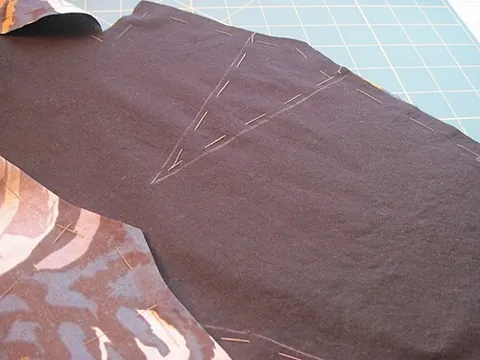
baste verb: to sew with long or loose stitches, as for temporary use, or in preparation for gathering the fabric.

Verb (1)
baste (third-person singular simple present bastes, present participle basting, simple past and past participle basted)
- To sew with long or loose stitches, as for temporary use, or in preparation for gathering the fabric.
- He bastes the coat together with thick white thread almost like string, using stitches big enough to be ripped out easily later.1991 June 14, J.F. Pirro, “Custom Work”, in Chicago Reader
Verb (2)
baste (third-person singular simple present bastes, present participle basting, simple past and past participle basted)
- To sprinkle flour and salt and drip butter or fat on, as on meat in roasting.
- To coat over something.
- Ice Cold Daydream" bastes the bayou funk of the Meters in swirling psychedelia, while "Sweet Thang," a swampy blues cowritten with his dad, sounds like something from Dr. John's "Night Tripper" phase.2001 April 20, Peter Margasak, “Almost Famous”, in Chicago Reader
- To mark (sheep, etc.) with tar.
Noun
baste (plural bastes)
- A basting; a sprinkling of drippings etc. in cooking.
- "Just like a leg of mutton being roasted before a slow fire without any one to give it a baste," groaned the old man.1876, The Odd Fellow's Companion
Verb (3)
baste (third-person singular simple present bastes, present participle basting, simple past and past participle basted)
baste meaning in Tamil, Urdu, Bengali and Tagalog
baste in Tamil
- சீனப் பட்டு, தைப்பதற்கு முன்னீடாகப் பெருந்தையல் போடு, தளர்த்தியாய் இழைபோட்டு, தடியாலடி, புடை, சிதை
baste in Urdu
- چھڑی سے پٹائی کرنا, گھی پھیرنا
baste in Bengali
- সেলাই করা
baste in Tagalog
- sew with long or loose stitches
- lagwatan, lagwatin
Forms of baste
| Verb | |
|---|---|
| third-person singular present | bastes |
| present participle | basting |
| past participle | basted |
| past | basted |
| Noun | |
| plural | bastes |
Origin of baste
Late Middle English, from Old French bastir (“build, construct, sew up (a garment)”).
From Middle English basten, of uncertain etymon, possibly from Old French basser (“moisten, soak”), from bacin (“basin”).
From the surface, either an indigenous cognate or borrowed from North Germanic; compare: Old Norse bausta, Icelandic beysta, Norwegian Nynorsk bøysta, Swedish bösta, bysta, Danish bøste (“to smack, thresh”), to a Proto-Germanic *baustjaną. Compare derivatives Old Norse bǫstl (“arrow”), Swedish böstel (“racket, pestle”), böste (“crowbar”). Further compare fist, German Faust (“fist”), etc, and Latin fustis (“cudgel”). Might be related to French bâton (“stick”) (formerly baston); English baton comes from bâton; see also French bastonnade (“the act of beating with a stick”).
Words formed from baste
Words that rhyme with baste
Questions about baste
- What does baste mean?
- Baste means to sew with long or loose stitches, as for temporary use, or in preparation for gathering the fabric.
- What is baste in Tamil?
- Baste in Tamil is சீனப் பட்டு, தைப்பதற்கு முன்னீடாகப் பெருந்தையல் போடு, தளர்த்தியாய் இழைபோட்டு. See Baste meaning in Tamil.
- What part of speech is baste?
- Baste can be a verb or a noun.
- How do you pronounce baste?
- Baste is pronounced /beɪst/.
- What is the past tense of baste?
- The past tense of baste is basted.
Words near baste in the dictionary
Source and license
Adapted from Wiktionary: baste (page history and authors); baste (Tamil Wiktionary) (page history and authors); baste (Urdu Wiktionary) (page history and authors); baste (Bengali Wiktionary) (page history and authors). Text available under the Creative Commons Attribution-ShareAlike 4.0 license. Word.ws reformatted the entry and added links. Wiktionary data of 2026-09-02.
Last updated:
Pronunciation audio from Wikimedia Commons, each file under its own free license: en-us-baste.ogg.
Cite this entry: “baste.” Word.ws, https://word.ws/baste. Based on Wiktionary, CC BY-SA 4.0.