
combe
/kuːm/
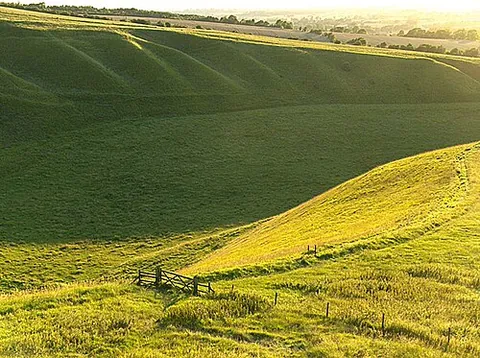
combe noun: a valley, often wooded and often with no river.

Noun
combe (plural combes)
- A valley, often wooded and often with no river
- its long, latticed window [...] looked out on a wild spreading view of hill and heather and wooded combe.1914, Saki, ‘The Cobweb’, Beasts and Superbeasts
- gradual rise the shelving combe displayed.1805, Robert Southey, “(please specify the page)”, in Madoc, London: […] [F]or Longman, Hurst, Rees, and Orme, and A[rchibald] Constable and Co, […], by James Ballantyne, […], →OCLC
- A cirque.
Proper noun capitalized: Combe
Combe (countable and uncountable, plural Combes)
- A surname.
- A hamlet and civil parish (without a council) in West Berkshire district, Berkshire (OS grid ref SU3760).
- A small village in Brixton parish, South Hams district, Devon (OS grid ref SX5452).
- A hamlet near Scorriton, West Buckfastleigh parish, South Hams district, Devon (OS grid ref SX7068).
- A hamlet in Malborough parish, South Hams district, Devon (OS grid ref SX7138).
- A hamlet in Wadhurst parish, Wealden district, East Sussex (OS grid ref TQ6228).
- A hamlet and civil parish in west Herefordshire, on the border with Wales (OS grid ref SO3463).
- A village and civil parish in West Oxfordshire district, Oxfordshire (OS grid ref SP4116).
- A hamlet in Huish Episcopi parish, Somerset, previously in South Somerset district (OS grid ref ST4128).
Forms of combe
| Noun | |
|---|---|
| plural | combes |
| alternative form | comb |
| alternative form | coomb |
| alternative form | coombe |
| alternative form | coom |
| alternative form | coome |
| Proper noun | |
| plural | Combes |
Origin of combe
From earlier coom(e), coomb(e), from Middle English *coumbe, *cumbe, *combe, from Old English cumb, comb (“a low place enclosed with hills, dale, valley”), of obscure origin. Likely an adaptation of Old English cumb (“cup, basin; a liquid measure”) compare Dutch kom (“bowl, basin”), German Kumpf (“vessel, container”), but could also possibly be from, or influenced by, Celtic or Anglo-Norman/French; it is currently unclear, and may additionally be an example of a Wanderwort. Compare Welsh cwm (“a hollow valley”), Anglo-Norman cumbe (“a valley, a hollow”), Ancient Greek κύμβη (kúmbē, “hollow”), Sanskrit कुम्भ (kumbha, “a pot, jug”), etc. through Proto-Indo-European *ḱumbʰ-.
From Old English cumb.
Words formed from combe
Words that rhyme with combe
48 more rhymesFewer rhymes
- gloom
- home
- presume
- whom
- womb
- resume
- tomb
- abloom
- legume
- loom
- rheum
- backroom
- boardroom
- coomb
- entomb
- enwomb
- exhume
- flume
- grume
- kaboom
- Khartoum
- neume
- packing room
- shroom
- sloom
- subsume
- absume
- addoom
- anteroom
- barroom
- bitume
- brume
- chum
- cloom
- cwm
- desume
- fixing room
- foredoom
- fwoom
- glume
- illume
- khoum
- locker room
- raying room
- simoom
- spume
- thoom
- toom
Questions about combe
- What does combe mean?
- Combe means a valley, often wooded and often with no river.
- What part of speech is combe?
- Combe can be a noun or a proper noun.
- How do you pronounce combe?
- Combe is pronounced /kuːm/ (UK).
- What is the plural of combe?
- The plural of combe is combes.
Words near combe in the dictionary
Source and license
Adapted from Wiktionary: combe (page history and authors); Combe (page history and authors). Text available under the Creative Commons Attribution-ShareAlike 4.0 license. Word.ws reformatted the entry and added links. Wiktionary data of 2026-09-02.
Last updated:
Pronunciation audio from Wikimedia Commons, each file under its own free license: LL-Q1860 (eng)-Vealhurl-combe.wav.
Cite this entry: “combe.” Word.ws, https://word.ws/combe. Based on Wiktionary, CC BY-SA 4.0.