
ecumenopolis
UK/ˌɛkjuːmɛˈnɒpəlɪs/
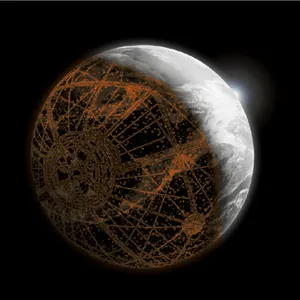
ecumenopolis noun: the largest theoretical human settlement, a planetwide conurbation.

Noun
ecumenopolis (plural ecumenopolises or ecumenopoleis or ecumenopoli)
- The largest theoretical human settlement, a planetwide conurbation.
- A city spanning an entire planet or large moon.
Proper noun capitalized: Ecumenopolis
Ecumenopolis
- The global conurbation predicted and advocated by Constantinos Doxiadis.
Forms of ecumenopolis
| plural | ecumenopolises |
|---|---|
| plural | ecumenopoleis |
| plural | ecumenopoli |
Origin of ecumenopolis
From ecumene (“inhabited world”) + -polis (“city”). From use as a common noun of Ecumenopolis, applying the concept to diverse scenarios. Ultimately from Ancient Greek.
Coined by Constantinos Apostolou Doxiadis in 1967 from the Ancient Greek words οἰκουμένη (oikouménē, “the world”) + πόλις (pólis, “city”), “a city spanning the whole world”.
Words formed from ecumenopolis
Questions about ecumenopolis
- What does ecumenopolis mean?
- Ecumenopolis means the largest theoretical human settlement, a planetwide conurbation.
- What part of speech is ecumenopolis?
- Ecumenopolis can be a noun or a proper noun.
- How do you pronounce ecumenopolis?
- Ecumenopolis is pronounced /ˌɛkjuːmɛˈnɒpəlɪs/ (UK).
- What is the plural of ecumenopolis?
- The plural of ecumenopolis is ecumenopolises.
Words near ecumenopolis in the dictionary
Source and license
Adapted from Wiktionary: ecumenopolis (page history and authors); Ecumenopolis (page history and authors). Text available under the Creative Commons Attribution-ShareAlike 4.0 license. Word.ws reformatted the entry and added links. Wiktionary data of 2026-09-02.
Last updated:
Cite this entry: “ecumenopolis.” Word.ws, https://word.ws/ecumenopolis. Based on Wiktionary, CC BY-SA 4.0.