
grass
/ɡɹɑːs/[ɡɹ̠ɑːs]
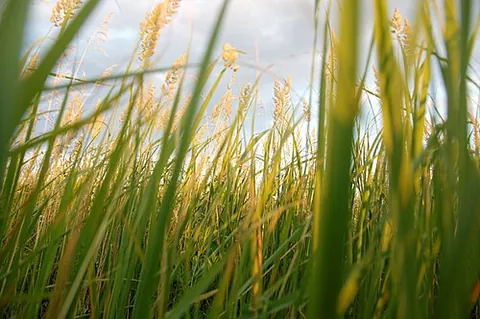
grass noun: any plant of the family Poaceae, characterized by leaves that arise from nodes in the stem and leaf bases that wrap around the stem, especially those grown as ground cover rather than for grain.

Noun
grass (countable and uncountable, plural grasses)
- Any plant of the family Poaceae, characterized by leaves that arise from nodes in the stem and leaf bases that wrap around the stem, especially those grown as ground cover rather than for grain.
- Thou turnest man to destruction: and sayest, Returne yee children of men. / For a thousand yeeres in thy sight are but as yesterday when it is past: and as a watch in the night. / Thou carriest them away as with a flood, they are as a sleepe: in the morning they are like grasse which groweth vp. /...1611, The Holy Bible, […] (King James Version), London: […] Robert Barker, […], →OCLC, Psalms 90:3–6
- The cicale above in the lime, / And the lizards below in the grass, / Were as silent as ever old Tmolus was, / Listening to my sweet pipings.a. 1823 (date written), Percy Bysshe Shelley, “Hymn of Pan”, in Mary W[ollstonecraft] Shelley, editor, Posthumous Poems of Percy Bysshe Shelley, London: […] [C. H. Reynell] for John and Henry L[eigh]...
- Any of the various plants that are not in the family Poaceae that resemble grasses.
- A lawn.
- The outside world, especially in the phrase "touch grass".
- Marijuana.
- Jojo left his home in Tucson, Arizona / For some California grass1970, Paul McCartney, “Get Back”, in Let It Be, performed by The Beatles
- An informer; snitch, police informer; one who betrays a group (of criminals, etc) to the authorities.
- What just happened must remain secret. Don't be a grass.
- He was a grass and an arse lick and he didn't do it for him, he did it for his brother, because if Vaughan had hit him especially with his mallet, Mark was the kind of lowlife that would have pressed charges and then that's a whole different problem.2007, Paul Knight, Coding of a Concrete Animal, page 215
- Sharp, closely spaced discontinuities in the trace of a cathode-ray tube, produced by random interference.
- Noise on an A-scope or similar type of radar display.
- The problem in radar detection is to have a signal to noise ratio that will allow the echo to be seen through the grass on the radar screen. The use of a long pulse allows a greater average signal strength to be returned in the target echoes.1960, Radarman 3 & 2, volume 1, United States. Bureau of Naval Personnel, page 49
- Some of the scattered waves can be picked up by the receiver and may show up as "grass" on the radar presentation. Weather radars make use of this phenomenon to chart the progress of storms.1963, Analysis of Weapons, page 61
- The season of fresh grass; spring or summer.
- Synonyms:
- breakup, spring, springtime
- That which is transitory.
- The grasse withereth, the flowre fadeth; because the spirit of the Lord bloweth vpon it: surely the people is grasse.1611, The Holy Bible, […] (King James Version), London: […] Robert Barker, […], →OCLC, Isaiah 40:7
- Synonyms:
- ephemera
- Asparagus; "sparrowgrass".
- 'Have ready a hundred of ſmall graſs boiled, then ſave tops enough to ſtick the rolls with, the reſt cut ſmall and put into the cream, fill the loaves with them.'1769, Hannah Glasse, The Art of Cookery made Plain and Easy, 9th edition, page 195
- The surface of a mine.
Verb
grass (third-person singular simple present grasses, present participle grassing, simple past and past participle grassed)
- To lay out on the grass; to knock down (an opponent etc.).
- The Chicken himself attributed this punishment to his having had the misfortune to get into Chancery early in the proceedings, when he was severely fibbed by the Larkey one, and heavily grassed.1846 October 1 – 1848 April 1, Charles Dickens, Dombey and Son, London: Bradbury and Evans, […], published 1848, →OCLC
- He flew at me with his knife, and I had to grass him twice, and got a cut over the knuckles, before I had the upper hand of him.1893, Arthur Conan Doyle, The Naval Treaty, Norton, published 2005, page 709
- Synonyms:
- flatten, floor, lay low, lay out, knock down, knock out, knock over, strike down
- To act as a grass or informer, to betray; to report on (criminals etc) to the authorities.
- "Grassed on me he did," I said morosely. (Note: Grass is English thief slang for inform.)^([sic])1962 [1959], William S. Burroughs, Naked Lunch, New York: Grove Press, page 2
- "I'm dressed as a woman, but I am still technically a man. I believe that to comply with the law of the land I ought to continue to use the Gents', but in order not to look out place I intend to use the Ladies' from now on. I trust none of you will grass on me..."2004, David Nobbs, Sex and Other Changes, page 95
- Synonyms:
- bewray, blow the whistle, clepe, denounce, dime, dime out, dob, drop a dime, drop a dime on someone, finger
- To cover with grass or with turf.
- To feed with grass.
- To expose, as flax, on the grass for bleaching, etc.
- To bring to the grass or ground; to land.
- Let him hook and land a tigerfish of 20 lb., at the imminent risk of capsizing and joining the company of the engaging crocodiles, or, when he has grassed the fish, of having a finger bitten off by his iron teeth […]1903, John Buchan, The African Colony
- In typical Necker style, the farmer walked to the line and mounted his gun without any shilly-shally. If he grassed the bird, he and Faurote would go into a shootout. If he missed, Faurote would win.2011, Deeanne Gist, Love on the Line, page 138
Proper noun (1) capitalized: Grass
Grass
- A group of languages spoken in Papua New Guinea.
Proper noun (2) capitalized: Grass
Grass
- A surname.
- A township in Spencer County, Indiana, United States, named after pioneer settler Daniel Grass.
grass meaning in Hindi, Tamil, Marathi and Urdu
grass in Hindi
- ground cover plant
- घास ghās
grass in Tamil
- ground cover plant
- புல் pul
grass in Marathi
- ground cover plant
- गवत gavat
grass in Urdu
- ground cover plant
- گھاس ghās, عَلَف 'alaf, سَبْزَہ sabza
More languagesFewer languages
- grass in Bengali
- ঘাস ghaś, তৃণ trin
- grass in Telugu
- గడ్డి gaḍḍi, తృణము tr̥ṇamu, కసవు kasavu
- grass in Malayalam
- പുല്ല് pullŭ
- grass in Kannada
- ಪುಲ್ pul, ಹುಲ್ಲು hullu
- grass in Punjabi
- ਘਾਹ ghāh, گھاہ ghāh
- grass in Gujarati
- ઘાસ ghās
- grass in Odia
- ଘାସ ghāsa
- grass in Sanskrit
- तृण tṛṇa
- grass in Sinhala
- තණ taṇa, තණකොළ taṇakoḷa
- grass in Assamese
- ঘাঁহ ghãh
- grass in Nepali
- घाँस ghā̃s
- grass in Pashto
- واش wāš, شنه šnə
- grass in Tagalog
- damo, damuhan
- grass in Arabic
- حَشِيش ḥašīš, عُشْب ʕušb, نجيلة negila, حشيش ḥašīš
- grass in Malay
- rumput
- grass in Indonesian
- rumput
- grass in Persian
- سَبْزَه sabza, عَلَف alaf, سَبْزِه sabze, چَمَن čaman
- grass in Thai
- หญ้า yâa
- grass in Vietnamese
- cỏ, bãi cỏ
- grass in Myanmar
- မြက် mrak
Examples of grass in a sentence
- The trees of a forest are thin; the corn or grass is thin.
- An organic mulch is a mulch made of natural substances such as leaves or grass clippings.
- The hunting dog drove the birds out of the tall grass.
Synonyms of grass
30 more synonymsFewer synonyms
Forms of grass
| Noun | |
|---|---|
| plural | grasses |
| Verb | |
| third-person singular present | grasses |
| present participle | grassing |
| past participle | grassed |
| past | grassed |
| Proper noun | |
| alternative form | Grassie |
Origin of grass
Inherited from Middle English gras, from Old English græs, from Proto-West Germanic *gras, from Proto-Germanic *grasą (“grass”), from Proto-Indo-European *gʰreh₁- (“to grow”). Cognates Cognate with Scots gress (“grass”), North Frisian gaars, geers, Gērs, gjars, gjas, gäärs (“grass”), Saterland Frisian Gäärs (“grass”), West Frisian gers (“grass”), Cimbrian gras, grass (“grass”), German and Luxembourgish Gras (“grass, weed”), Dutch gras (“grass, turf, pasture”), Mòcheno and Vilamovian gros (“grass”), West Flemish ges (“grass”), Yiddish גראָז (groz, “grass”), Danish græs (“grass”), Faroese, Icelandic, and Norwegian Nynorsk gras (“grass”), Norwegian Bokmål gras, gress (“grass”), Swedish gräs (“grass”), Gothic 𐌲𐍂𐌰𐍃 (gras, “herb”); also Latin herba (“plant, weed, grass”), Albanian grath (“grass blade, spike”). Related to grow, green. The "informer" sense is probably a shortening of grasshopper (“police officer, informant”), rhyming slang for copper (“police officer”) or shopper (“informant”); the exact sequence of derivation is unclear.
Words formed from grass
- above grass
- adder's grass
- after-grass
- aftergrass
- Aleppo grass
- alfa grass
- alkali grass
- all cows eat grass
- Angleton grass
- Antarctic hair grass
- arrowgrass
- ass in the grass
- at grass
- autograss
- Bahama grass
- bahia grass
- bahiagrass
- bamboo grass
- barnyard grass
- basketgrass
- beachgrass
- beardgrass
- beargrass
- beetle grass
- bentgrass
- bent grass
- Bermuda grass
- billion-dollar grass
- bison grass
- blackgrass
- blade of grass
- blind grass
- blue-eyed grass
- blue grass
- bluegrass
- bluestem grass
- bristlegrass
- broadleaf carpet grass
- bromegrass
- buffalo grass
- bunchgrass
- bunch grass
- bunny grass
- burgrass
- bushman grass
- button grass
- California grass
- canary grass
- canegrass
- carnation-grass
- carpet grass
- cat grass
- centipede grass
- cheatgrass
- cheat grass
- Chilcotts Grass
- China grass
- Christmas grass
- citronella grass
- clover grass
Phrases with grass
- grass on
- grass up
- dog grass
- grass cat
- Grass Cay
- grass oil
- grass pea
- grass rat
- grass top
- hog grass
- oat grass
- pin grass
166 more phrasesFewer phrases
- ray grass
- rye grass
- saw grass
- cane grass
- cord grass
- cusa grass
- daba grass
- doob grass
- doub grass
- dune grass
- fork grass
- gama grass
- grass bass
- grass beef
- grass carp
- grass cats
- grass fire
- Grass Flat
- grass frog
- grass grub
- grass hand
- grass knot
- Grass Lake
- grass moon
- grass moth
- grass oils
- grass peas
- grass pink
- grass plot
- grass rake
- grass rats
- grass seed
- grass time
- grass tops
- grass trap
- grass tree
- hair grass
- holy grass
- kans grass
- love grass
- lyme grass
- moor grass
- much grass
- nipa grass
- palm grass
- para grass
- Pará grass
- reed grass
- rice grass
- rope grass
- salt grass
- snow grass
- sour grass
- star grass
- tape grass
- toad grass
- wire grass
- arrow grass
- beach grass
- beard grass
- cogon grass
- couch grass
- cow's grass
- cutty grass
- devil grass
- fever grass
- go to grass
- goose grass
- grass carps
- grass cloth
- grass court
- grass crown
- grass dance
- grass fires
- grass frogs
- grass grubs
- grass hands
- grass jelly
- grass knots
- grass moons
- grass moths
- grass pinks
- grass plots
- grass rakes
- grass roots
- grass seeds
- grass skirt
- grass snake
- grass times
- grass traps
- grass trees
- grass widow
- halfa grass
- hippo grass
- honey grass
- joint grass
- kauri grass
- Mardi Grass
- marsh grass
- Means grass
- midge grass
- onion grass
- panic grass
- pearl grass
- penny grass
- plume grass
- quack grass
- quake grass
- razor grass
- rosha grass
- sedge grass
- sheda grass
- shoal grass
- spear grass
- steek grass
- Sudan grass
- sugar grass
- sword grass
- tiger grass
- touch grass
- Tunis grass
- Vasey grass
- witch grass
- basket grass
- cotton grass
- deer's grass
- Easter grass
- finger grass
- get to grass
- ginger grass
- grass cloths
- grass courts
- grass crowns
- grass dances
- grass hockey
- grass parrot
- grass plover
- grass rooter
- grass script
- grass shrimp
- grass skirts
- grass snakes
- grass tetany
- Grass Valley
- grass widows
- Guinea grass
- hungry grass
- kikuyu grass
- kuskus grass
- Lagoon Grass
- maiden grass
- Manila grass
- marram grass
- marvel grass
- meadow grass
- monkey grass
- Napier grass
- needle grass
- oyster grass
- paddle grass
- pampas grass
- quitch grass
- redtop grass
- rescue grass
- Rhodes grass
- ribbon grass
Words that rhyme with grass
1 more rhymesFewer rhymes
Questions about grass
- What does grass mean?
- Grass means any plant of the family Poaceae, characterized by leaves that arise from nodes in the stem and leaf bases that wrap around the stem, especially those grown as ground cover rather than for grain.
- What is grass in Hindi?
- Grass in Hindi is घास (ghās). See Grass meaning in Hindi.
- What part of speech is grass?
- Grass can be a noun, a verb or a proper noun.
- How do you pronounce grass?
- Grass is pronounced /ɡɹɑːs/.
- What is the plural of grass?
- The plural of grass is grasses.
Words near grass in the dictionary
Source and license
Adapted from Wiktionary: grass (page history and authors); Grass (page history and authors). Text available under the Creative Commons Attribution-ShareAlike 4.0 license. Word.ws reformatted the entry and added links. Wiktionary data of 2026-09-02.
Last updated:
Pronunciation audio from Wikimedia Commons, each file under its own free license: En-uk-grass.ogg, en-us-grass.ogg.
Cite this entry: “grass.” Word.ws, https://word.ws/grass. Based on Wiktionary, CC BY-SA 4.0.