
greave
/ɡɹiːv/
greave noun: a bush; a tree; a grove.

Noun (1)
greave (plural greaves)
Noun (2)
greave (plural greaves)
Noun (3)
greave (plural greaves)
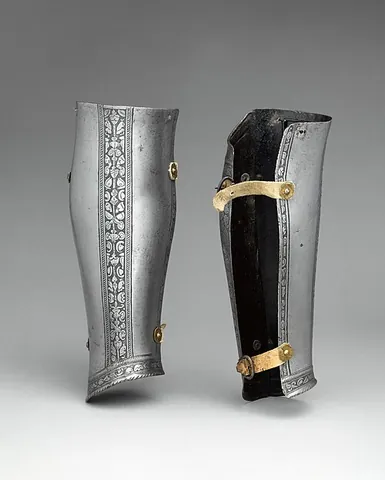
- A piece of armour that protects the leg, especially the shin, and occasionally the tops of the feet.
- And through the stained windows bright, / From o'er the red-tiled eaves, / The sunlight blazed with colored light / On golden helms and greaves.1883, Howard Pyle, The Merry Adventures of Robin Hood […], New York, N.Y.: […] Charles Scribner’s Sons […], →OCLC
- Then he cast off his breast-plate, thigh pieces, and greaves, while Alleyne followed his example.1891, A[rthur] Conan Doyle, The White Company, New York, N.Y.; Boston, Mass.: Thomas Y[oung] Crowell & Company […], →OCLC
- Synonyms:
- cnemid
Verb
greave (third-person singular simple present greaves, present participle greaving, simple past and past participle greaved)
- To clean (a ship's bottom); to grave.
greave meaning in Arabic
greave in Arabic
- piece of armour that protects the leg, especially the shin
- دِرْع لِلسَّاقِ
Synonyms of greave
Forms of greave
| Noun | |
|---|---|
| plural | greaves |
| alternative form | greeve |
| Verb | |
| third-person singular present | greaves |
| present participle | greaving |
| past participle | greaved |
| past | greaved |
Origin of greave
From Middle English greve, from Old English grǣfe, grǣfa (“bush, bramble, grove, thicket, copse, brush-wood (for burning), fuel”). Cognate with Scots greve, greave (“grove”). Compare also Proto-Germanic *grainiz (“twig”), of unknown origin, whence Old Norse grein (“branch, bough”). Closely related to Old English grāf, grāfa (“grove”). See grove.
From Middle English greve, greyve, from Old English grǣfa, grēfa (“pit, cave, hole, grave, trench”), from Proto-Germanic *grēbō, an ablaut variant of to *grōbō (“pit, ditch”) (whence doublet of groove) , from Proto-Indo-European *gʰrebʰ- (“to dig, scratch, scrape”). Cognate with North Frisian groop (“pit, sewer, gutter”), Dutch groef (“pit, hole, gutter”), German Grube (“pit, hole”), Icelandic gröf (“pit, grave”). Also related to grave.
From Middle English greve, grayve, from Old French greve (“shin”), of uncertain origin; possibly from Egyptian Arabic جورب (“stocking, leg cover”). Watkins suggests a connection with greve (“part in the hair”), due to the resemblance of the medial ridge to a part in the hair, from graver (“to part (the hair); engrave”), of Germanic origin, from Frankish *graban (“to engrave”); if so, related to Etymology 2 above.
Words formed from greave
Words that rhyme with greave
45 more rhymesFewer rhymes
- eve
- grieve
- Kharkiv
- breve
- conceive
- naive
- neve
- Pishchiv
- weave
- keeve
- Neave
- Piskiv
- reeve
- screeve
- skeeve
- aggrieve
- beleave
- French leave
- interweave
- perceive
- reave
- seave
- sheave
- shrieve
- sleave
- steeve
- steve
- take French leave
- Abib
- beeve
- deceive
- dreve
- Dutch leave
- eave
- gneeve
- khedive
- nieve
- peeve
- preconceive
- rebelieve
- reperceive
- thieve
- transceive
- we've
- Yves
Questions about greave
- What does greave mean?
- Greave means a bush; a tree; a grove.
- What is greave in Arabic?
- Greave in Arabic is دِرْع لِلسَّاقِ. See Greave meaning in Arabic.
- What part of speech is greave?
- Greave can be a noun or a verb.
- How do you pronounce greave?
- Greave is pronounced /ɡɹiːv/.
- What is the plural of greave?
- The plural of greave is greaves.
Words near greave in the dictionary
Source and license
Adapted from Wiktionary: greave (page history and authors). Text available under the Creative Commons Attribution-ShareAlike 4.0 license. Word.ws reformatted the entry and added links. Wiktionary data of 2026-09-02.
Last updated:
Pronunciation audio from Wikimedia Commons, each file under its own free license: en-us-grieve.ogg.
Cite this entry: “greave.” Word.ws, https://word.ws/greave. Based on Wiktionary, CC BY-SA 4.0.