
mow
UK/ˈməʊ//ˈmoʊ/
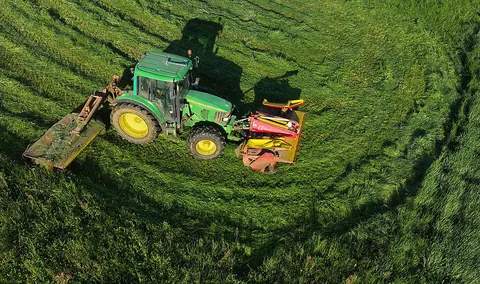
mow verb: to cut down grass or crops. Also the alternative form of mew.

Verb (1)
mow (third-person singular simple present mows, present participle mowing, simple past mowed, past participle mown or mowed)
- To cut down grass or crops.
- He mowed the lawn every few weeks in the summer.
- Just let me wake up in the morning to the smell of new-mown hay.1969, “Skyline Pigeon”, in Bernie Taupin (lyrics), Elton John (music), Empty Sky, performed by Elton John
- To cut down or slaughter in great numbers.
- In the afternoon they attacked again, in close formation: our artillery mowed them, but they came on and on, […]1915, Captain Robert Palmer, Letters from Mesopotamia
- On the one hand, we had a scenario where, effectively, the American admiral just went "You know what, all the destroyers attack", at which point they mowed through the Japanese destroyers like a Grim Reaper through a harvest of very, very dead gorn, especially with the Brooklyns in support.2019 March 6, Drachinifel, 25:58 from the start, in The Battle of Samar (Alternate History) - Bring on the Battleships!, archived from the original on 04 Jul 2022
Noun (1)
mow (plural mows)
- The act of mowing (a garden, grass, etc.).
- The lawn hasn't had a mow for a couple of months, so it's like a jungle out there!
- A shot played with a sweeping or scythe-like motion.
- I consider it would engender a stiff, tame, cautious mode of play, with only now and then a mow, or a chopping hit.1828, Sporting Magazine (volume 21? 71? page 10)
- At times, they seemed to be playing an especially orgiastic version of Stick Cricket, all computerised mows over midwicket and 30 off the over.2015, Lawrence Booth, The Shorter Wisden 2015
Noun (2)
UK/məʊ/US/moʊ/
mow (plural mows)
- A scornful grimace; a wry face.
- Make mows at him.c. 1599–1602 (date written), William Shakespeare, “The Tragedie of Hamlet, Prince of Denmarke”, in Mr. William Shakespeares Comedies, Histories, & Tragedies […] (First Folio), London: […] Isaac...
- Those that paint them dying […] delineate the prisoners spitting in their executioners faces, and making mowes at them., Folio Society, 2006, vol.1, p.212
Verb (2)
UK/məʊ/US/moʊ/
mow (third-person singular simple present mows, present participle mowing, simple past and past participle mowed)
- To make grimaces, mock.
- For every trifle are they set upon me: / Sometime like apes that mow and chatter at me, / And after bite me;1610–1611 (date written), William Shakespeare, “The Tempest”, in Mr. William Shakespeares Comedies, Histories, & Tragedies […] (First Folio), London: […] Isaac Iaggard, and Ed[ward] Blount, published...
- Nodding, becking, and mowing.1848, William Tyndale, edited by Henry Walter, Doctrinal Treatises and Introductions to Different Portions of the Holy Scriptures
Noun (3)
IPA/maʊ̯/
mow (plural mows)
Verb (3)
IPA/maʊ̯/
mow (third-person singular simple present mows, present participle mowing, simple past and past participle mowed)
- To put into mows.
Noun (4) capitalized: MOW
MOW
- Initialism of meals on wheels.
Proper noun capitalized: Mow
Mow (plural Mows)
- A surname.
Also used as
mow is also the alternative form of mew.
mow meaning in Arabic, Indonesian and Vietnamese
mow in Arabic
- to cut down
- جَزَّ jazza
mow in Indonesian
- to cut down
- memotong rumput
mow in Vietnamese
- to cut down
- cắt, cắt cỏ
Examples of mow in a sentence
- Look at the sap mowing our lawn while we pretend our own lawnmower is broken.
- You said you were going to mow the lawn today. – I never!
- If you mow regularly, a mulching mower will be beneficial to your lawn.
Synonyms of mow
Forms of mow
| Verb | |
|---|---|
| third-person singular present | mows |
| present participle | mowing |
| past | mowed |
| past participle | mown |
| past participle | mowed |
| Noun | |
| plural | mows |
| Proper noun | |
| plural | Mows |
Origin of mow
From Middle English mowen (participle mowen), from Old English māwan (past tense mēow, past participle māwen), from Proto-West Germanic *māan, from Proto-Germanic *mēaną, from Proto-Indo-European *h₂meh₁- (“to mow, reap”). Cognate with Saterland Frisian mjo (“to mow”), Dutch maaien (“to mow”), German mähen (“to mow”), Luxembourgish méien (“to mow”), Danish meje (“to mow”), Swedish meja (“to mow”); see also Hittite [script needed] (ḫamešḫa, “spring/early summer”, literally “mowing time”), Latin metō (“to harvest, mow”), Ancient Greek ἀμάω (amáō, “to mow”).
From Middle English mowe, from Old French moe (“grimace”), from Frankish *mauwa (“pout, protruding lip”), from Proto-Germanic *mawwō (“muff, sleeve”). Akin to Middle Dutch mouwe (“protruding lip”). Doublet of moue ("pout").
From Middle English mowe, form Old English mūga, mūha, from Proto-West Germanic *mūgō, *mūhō, from Proto-Germanic *mūgô, *mūhō; perhaps connected to Ancient Greek μύκων (múkōn, “heap”). Cognate with Norwegian muge (“heap, crowd, flock”).
Words formed from mow
Phrases with mow
Words that rhyme with mow
Questions about mow
- What does mow mean?
- Mow means to cut down grass or crops.
- What is mow in Arabic?
- Mow in Arabic is جَزَّ (jazza). See Mow meaning in Arabic.
- What part of speech is mow?
- Mow can be a verb, a noun or a proper noun.
- How do you pronounce mow?
- Mow is pronounced /ˈməʊ/ (UK).
- What is the past tense of mow?
- The past tense of mow is mowed.
Words near mow in the dictionary
Source and license
Adapted from Wiktionary: mow (page history and authors); MOW (page history and authors); Mow (page history and authors). Text available under the Creative Commons Attribution-ShareAlike 4.0 license. Word.ws reformatted the entry and added links. Wiktionary data of 2026-09-02.
Last updated:
Pronunciation audio from Wikimedia Commons, each file under its own free license: en-us-mow.ogg.
Cite this entry: “mow.” Word.ws, https://word.ws/mow. Based on Wiktionary, CC BY-SA 4.0.